
Vehicle Features That Make Daily Texas Driving Easier
Driving in Texas can involve long commutes, busy highways, sudden weather changes, busy urban roads, and plenty of stop-and-go traffic. A vehicle that feels comfortable on a short trip may not always be equally convenient for a longer daily commute.
The right combination of vehicle features can make everyday driving easier by improving visibility, reducing driver workload, making parking simpler, and adding useful convenience. Safety technology is especially important because modern vehicles can provide warnings or assistance in situations where a driver may have limited visibility. The National Highway Traffic Safety Administration explains how features such as forward collision warning, blind spot warning, lane departure warning, and automatic emergency braking can support drivers.
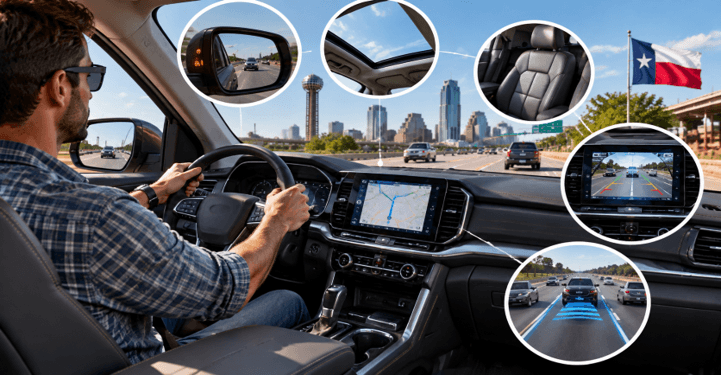
1. Driver Assistance Features for Highway Travel
Texas highways can turn a routine commute into a long drive. Driver assistance features can make these trips more manageable while still requiring the driver to remain attentive.
If someone is comparing vehicles or researching options locally, a Hyundai dealership in Tomball, TX can be one place to review available models and compare which features are included at different equipment levels.
Adaptive Cruise Control
Adaptive cruise control can adjust a vehicle’s speed to maintain a selected following distance from the vehicle ahead. This can be useful on the highway when traffic speeds frequently change.
It does not eliminate the need for driver attention. Instead, it can reduce some of the repeated acceleration and braking involved in steady highway traffic.
Lane Keeping Assistance
Lane keeping assistance can provide steering support when a vehicle begins to drift from its lane. This can be particularly useful during long drives when fatigue or momentary distraction could affect lane position.
Drivers should understand the specific operation and limitations of the system before relying on it.
2. Blind Spot Monitoring for Busy Roads
Changing lanes can become challenging when surrounding traffic is heavy. Large vehicles, vehicles approaching from behind, and areas outside the driver’s direct field of view can create blind spots.
How Blind Spot Warning Helps
Blind spot warning systems monitor areas beside and behind the vehicle and alert the driver when they detect another vehicle in a difficult-to-see area.
This feature can be especially useful on multilane roads where drivers regularly need to merge or change lanes. However, it should complement—not replace—checking mirrors and looking over the shoulder before changing lanes.
Why It Matters in Daily Driving
A driver who spends significant time on highways may perform dozens of lane changes during a typical week. An extra warning can provide useful information when traffic conditions make surrounding vehicles harder to track.
3. Forward Collision Warning and Automatic Emergency Braking
Unexpected traffic changes can happen anywhere, from a busy intersection to a congested highway. Forward collision warning can alert drivers when the system detects a potential collision with a vehicle ahead.
Automatic emergency braking goes a step further by applying the brakes when certain collision conditions are detected.
A Helpful Layer of Protection
These technologies are designed to assist drivers, not replace them. NHTSA identifies forward collision warning and automatic emergency braking among important driver assistance technologies and explains that some systems warn the driver. Others can intervene when a collision is imminent.
When comparing vehicles, drivers should check whether these technologies are standard or optional and understand exactly what each system is designed to do.
4. A Good Backup Camera and Parking Sensors
Daily driving does not happen only on highways. Parking lots, driveways, garages, and crowded shopping areas can present their own challenges.
A backup camera shows the area directly behind the vehicle while reversing. Parking sensors can provide additional alerts when the vehicle approaches an object.
Easier Parking
These features can make it easier to judge available space when backing into a parking spot or maneuvering in a tight area.
A backup camera is particularly useful because it can reveal areas that are difficult to see through the rear window alone. NHTSA notes that rearview video systems are required on new vehicles and are intended to help prevent backover crashes.
Drivers should still check mirrors, look around the vehicle, and remain aware of pedestrians and obstacles.
5. Comfortable Seating and Adjustable Controls
With so much focus on technology, a car’s physical comfort can also make a big difference in everyday driving.
After an hour or so of driving a day, a driver may find it helpful to have proper support in the seat as well as adequate maneuvering.
Look for Useful Adjustability
Features worth considering include:
- Adjustable driver’s seat
- Adjustable steering wheel
- Lumbar support
- Power seat controls
- Heated seats where appropriate
- Easy-to-reach controls
- Clear instrument displays
The idea is not to look for the most adjustments. Rather, drivers should search for a position where they can sit up so that they can see well and reach the pedals and controls with ease.
6. Automatic Climate Control
In Texas, the weather can be a big consideration when driving.
The automatic climate control can be programmed by the driver to a desired temperature and will regulate the fan speed and airflow to achieve this.
Why It Helps
In extremely hot temperatures, an automatic climate control system eliminates the need for repeated manual adjustments while driving.
This can make the cabin more comfortable for commuters without having to turn the dial on the temperature setting frequently.
For families, rear climate controls are also beneficial in case their rear passengers have various comfort preferences.
7. Smartphone Connectivity and Hands-Free Controls
Today’s motorists rely on their cell phones to navigate, communicate, listen to music, and for other daily activities. These functions could be made more accessible through the incorporation of smartphones without the need to repeatedly use a phone.
Navigation and Audio
Common functions can be easily accessed with Apple CarPlay, Android Auto, Bluetooth, voice control, and steering-wheel controls.
The primary advantage is to show key information inside the vehicle, without the driver having to glance at a hand-held device.
Hands-free technology is still to be used responsibly. Convenience technology should minimize distractions, not tempt drivers to use their cell phone while driving.
8. Good Visibility and Automatic Lighting
Visibility is important whether a driver is traveling through a neighborhood, merging onto a highway, or driving at night.
An ergonomic seating position, properly sized side mirrors, strong lights, and unobstructed windshields can help make driving routine safer and easier.
Automatic High Beams
Automatic headlamps can automatically switch between high and low beams based on light and traffic. According to NHTSA, automatic high beams are one of the modern driver assistance technologies.
Drivers should also be aware of situations where it might not function as described and take responsibility for selecting suitable lighting.
Mirror Visibility
Bad mirror positioning is no way to salvage a good technology. Mirrors should be positioned so there are no unnecessary blind spots and they don’t obstruct the view of traffic.
9. Tire Pressure Monitoring and Practical Safety Equipment
Some vehicle features are useful but not necessarily noticeable.
TPMS may warn drivers if the tires are under- or overinflated. Proper tire pressure can aid in handling, tire performance, and everyday on-the-road reliability.
Additional safety features such as airbags, seatbelts, stability control, and adequate lighting are also crucial items of safety equipment to look for.
10. Storage and Interior Flexibility
The daily routine of driving involves more than just transport. Groceries, work equipment, sports equipment, luggage, or other items can be carried by drivers.
It might be convenient to have a vehicle that offers storage that makes regular errands simpler.
Consider Everyday Space
Useful features can include:
- Foldable rear seats
- Multiple cupholders
- Center-console storage
- Door pockets
- A useful cargo area
- Under-floor storage
- Multiple USB charging ports
The correct amount of space will vary based on the driver’s driving habits. A commuter who is commuting mostly alone will value a smaller interior, whereas a family will want the ability to seat and carry more cargo.
Choosing Features Based on Your Driving Routine
It isn’t always the case that the more features a vehicle has, the better it will suit every driver. The best way to think about this is what it will be doing and where it will be doing it.
For highway commuters, adaptive cruise control, lane assist, and blind-spot monitoring might matter more. A person who spends more time in urban areas may place a higher value on parking sensors, a reliable backup camera, visibility, and compactness.
Families can look for features such as flexible cargo space, rear-seat comfort, climate control, and safety technologies. For frequent long-distance drivers, comfort, lights, connectivity, and driver assistance are more likely to be considerations.
Conclusion
The top vehicle features for everyday driving in Texas are the ones that help to address actual issues in the driver’s typical driving routine. Some of this work can be taken off your shoulders when driving long distances; blind spot monitoring can give you an extra warning when changing lanes, and parking technology can make narrow parking more manageable.
Other factors, like comfort, climate control, connectivity, visibility, tire monitoring, and convenient storage, can also make a difference in everyday convenience. Drivers can get more value from their choices by selecting features most relevant to the situations they are most likely to face.
FAQs
1. What vehicle features are most useful for highway driving?
For frequent highway drivers, adaptive cruise control, blind spot monitoring, lane-keeping assistance, and forward collision warning are helpful. These systems can provide information or help when traffic changes, but the driver must stay aware and ready, and he must know what each technology can and cannot do.
2. Are driver assistance features a replacement for attentive driving?
No. Driver assistance systems should give support to the driver and never replace him. Automatic emergency braking, lane assist, adaptive cruise control, and other features have operating requirements and limitations. Drivers still have to observe traffic, control the motor vehicle, and react to traffic.
3. What should I consider besides technology when choosing a vehicle?
Take comfort, visibility, seating position, storage, climate control, fuel or energy efficiency, and convenience in your routine into account. If a vehicle’s size, layout, comfort, and capabilities fit your everyday driving, it may be better, even if it lacks some advanced features.
Popular on OTW Right Now!




About The Author

Gagan Bhangu
Founder of otechworld.com and managing editor. He is a tech geek, web-developer, and blogger. He holds a master's degree in computer applications and making money online since 2015.