
How Does Laser Rust Removal Work? A Guide to Modern Metal Cleaning
Rust is a common problem for metal parts, tools, machinery, vehicles, and industrial equipment. Once oxidation builds up on a metal surface, it can affect appearance, surface quality, and long-term performance. Traditional methods such as sanding, abrasive blasting, and chemical cleaning can remove rust, but they may also create dust, waste, or additional surface treatment work.
Laser rust removal offers another approach. Instead of using abrasives or chemicals, it uses concentrated laser energy to remove unwanted layers from a surface. This makes laser cleaning an increasingly useful option for industrial maintenance, restoration, and metal surface preparation.
What Is Laser Rust Removal?
Laser rust removal is a cleaning process that uses a focused laser beam to remove rust, oxidation, paint, oil, and other contaminants from a material surface.
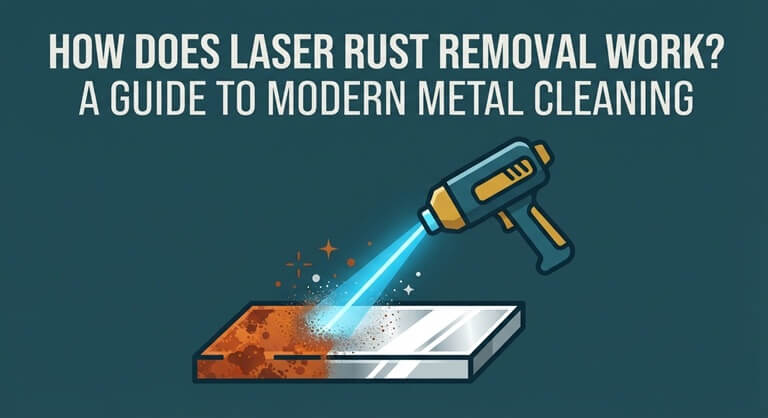
The basic principle is selective removal. Rust and other contaminants absorb laser energy differently from the underlying metal. When the laser parameters are properly adjusted, the unwanted layer absorbs enough energy to break down, vaporize, or detach from the surface, while the base material can remain largely unaffected.
This process is especially useful when surface control is important. Operators can adjust factors such as laser power, scanning pattern, pulse frequency, and cleaning speed according to the material and contamination.
How Does Laser Rust Removal Work?
The process begins when the laser cleaning head directs a focused beam toward the contaminated surface. As the beam moves across the workpiece, the rust absorbs the laser energy.
The rapid energy input causes the rust layer to heat and break away from the metal. Depending on the material and laser settings, the removed contaminants may be vaporized or expelled from the surface.
The operator controls the cleaning process by adjusting the laser parameters and moving the cleaning head across the target area. This makes it possible to clean specific sections without treating the entire component.
Pulse laser systems are particularly useful for applications where precision is important. Short laser pulses can deliver energy to the contaminated layer while limiting heat transfer to the surrounding material.
Why Use Laser Cleaning for Rust?
One of the main advantages of laser rust removal is its level of control. Traditional abrasive methods physically contact the surface, while laser cleaning is a non-contact process.
This can be useful when working with parts that have complex shapes, delicate surfaces, or areas where excessive abrasion should be avoided.
Laser cleaning can also reduce the need for consumables. Sandpaper, blasting media, and chemical cleaning agents must be purchased, stored, and replaced. A laser cleaning system does not require abrasive media during operation, which can simplify the cleaning workflow.
Another benefit is the ability to target specific areas. Operators can direct the laser toward rusted sections rather than removing material from the entire surface.
Where Is Laser Rust Removal Used?
Laser rust removal can be applied across many industries.
In automotive maintenance, it can be used to clean rust from components, remove coatings, and prepare metal surfaces for further work. In manufacturing, laser cleaning can help prepare parts before welding, coating, or other production processes.
It is also useful for machinery maintenance. Rust and oxidation can develop on equipment that is exposed to moisture or harsh working environments. A portable laser cleaning system can make it easier to perform maintenance directly at the worksite.
For companies looking at different laser technologies and industrial applications, HANTENCNC provides laser cleaning, welding, marking, and cutting equipment for a range of manufacturing and maintenance needs.
What Is a Handheld Laser Rust Remover?
A handheld system combines laser cleaning technology with a portable cleaning head. Instead of moving a large workpiece through a fixed cleaning system, an operator can move the laser head over the contaminated area.
This design is useful for large components, machinery, metal structures, automotive parts, and on-site maintenance.
For example, a handheld laser rust remover can use a 300W pulsed laser source to remove rust and oxidation from metal surfaces. The system uses water cooling and offers adjustable laser power and multiple scanning modes, allowing operators to adapt the cleaning process to different tasks.
What Should You Consider When Choosing a Laser Cleaner?
Laser power is one of the first factors to consider. Lower-power systems may be suitable for lighter contamination and precision cleaning, while higher-power systems can provide greater productivity for heavy rust and coating removal.
The laser type also matters. Pulsed lasers are often selected for precision surface cleaning because they can deliver short bursts of energy to the target layer.
Scanning speed, scan width, cooling method, cleaning modes, and operator controls should also be considered. A system with adjustable parameters gives users more flexibility when working with different materials and contamination levels.
Safety is equally important. Laser cleaning equipment should be operated according to the manufacturer’s safety requirements, with appropriate protective equipment and controlled working areas.
Is Laser Rust Removal Better Than Traditional Methods?
There is no single cleaning method that is ideal for every application. Abrasive blasting, mechanical cleaning, and chemical treatment can still be useful for certain jobs.
However, laser cleaning offers several advantages when precision, reduced consumables, and controlled surface treatment are important. It is a non-contact process, can target specific areas, and can be adjusted for different cleaning requirements.
As laser technology continues to develop, laser rust removal is becoming a practical option for manufacturers, maintenance teams, restoration specialists, and other users who need a controlled way to clean metal surfaces.
The key is to match the laser system and operating parameters with the material, rust condition, surface requirements, and production goals. With the right setup, laser cleaning can provide a more controlled approach to modern metal
Popular on OTW Right Now!




About The Author

Gagan Bhangu
Founder of otechworld.com and managing editor. He is a tech geek, web-developer, and blogger. He holds a master's degree in computer applications and making money online since 2015.