
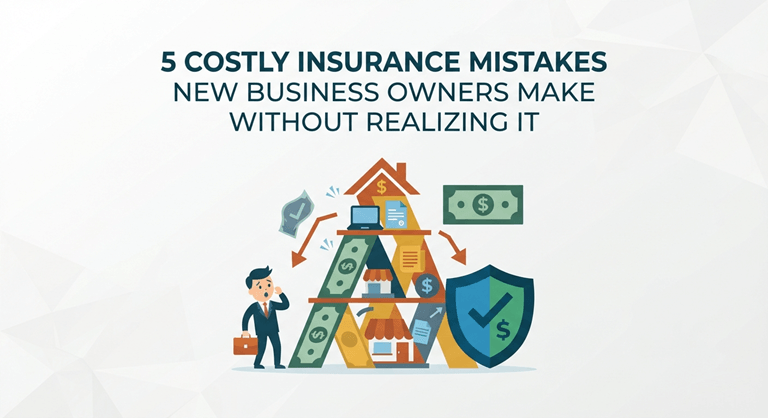
5 Costly Insurance Mistakes New Business Owners Make Without Realizing It
You just signed your first big client, and you’re already thinking about payroll, inventory, and whether your logo looks good on a mug. Insurance is the last thing on your mind. That’s exactly how the expensive mistakes happen. One lawsuit, one broken window, one client data leak, and you’re suddenly writing checks that make your startup funding look like pocket change. Here’s the thing: you can skip most of this pain. You need to know which traps to avoid before you sign on the dotted line.
Why Do New Business Owners Skip Coverage in the First Place?
Rational and plausible reasons are given. I’m working from my kitchen table! My client has signed a contract that they will not sue me. Or, “Well, I’ll know it when I see it, once I get a few more gigs done. None of these are valid in case of a real problem, and that is a lesson people learn afterward, not before.
Clauses in a contract do not preclude a claim. They give you a legal battle on top of the issue at hand. The kitchen table defense isn’t effective if a client slips on the cable that you laid across their office floor while installing a new system. By the way, your home renter’s plan will crack up at that statement.
It’s not paranoia. That’s understanding that your business isn’t a small business and small businesses have their own risks, which are not eliminated simply because you’re small.
Mistake #1: Buying the Cheapest Policy Without Reading the Exclusions
Price shopping is a “productive” activity. You go to three quotations, choose the smallest, and get on with your day. That low number is typically due to the policy half-assing the situations you encounter. With exclusions, the insurance company shields itself, and they’re formulated in a way that is cryptic enough for a lawyer to go to sleep.
The policy document is to be treated as a lease agreement. Read it from top to bottom. When you see something such as “professional services not covered” and you’re a consultant, you’ve just purchased an expensive piece of paper that serves you no useful purpose. It’s not the price that’s the trap. It’s the discrepancy between what you believe you are paying for and what you are getting in your policy.
Don’t compare premiums; compare coverages. A policy that may cost you a bit more but will actually cover your specific line of work will save you a fortune in the long run. The Bureau of Labor Statistics reported in 2024 that the rate of private industry workers required to participate in employer-sponsored benefits has climbed steadily, but that’s for employees. As an owner, no one is pushing on your shoulder, and you have to take the responsibility of reading the fine print.
Mistake #2: Assuming Your Clients’ Insurance Covers Your Work
Consider the following scenario, which occurs often. A contractor offers you the opportunity to join their project and tells you that they have a liability insurance policy, and you think you are covered under their policy. You aren’t. Their policy is for their errors and for their staff. You’re an outside vendor, which means you’re your own entity in the eyes of the law.
If something goes wrong on a joint project, both of you can be named in the lawsuit. The client’s insurer will defend their policyholder. You’ll be left hiring your own attorney unless you have your own coverage. That’s a confrontation nobody enjoys, especially when you’re standing in a lobby wondering why you skipped the small business insurance quote your accountant kept reminding you to get.
Did not depend on others’ safety net. If a client requests that you be an additional insured on their insurance policy, this will only cover the additional insured for the work that is being performed under that particular contract. Does not follow you to the next position. It’s a band-aid; it’s not a safety net.
Mistake #3: Skipping Cyber Liability Because “Nobody Would Target Me”
Hacking of small businesses is not uncommon, and it is not because they are juicy targets. Because they are easy questions! Security is a major cost for big companies, costing millions of dollars. Small shops tend to use a single password to keep customers’ information secure and hope nothing occurs. Hackers know this, and they know a small business has payment information, client records, and enough information to make it worthwhile for them to expend time on it.
It’s not only about the theft! It’s the price of letting the customers whose data is affected know about it, compensating those that offer credit monitoring services, employing forensics, and possibly having to deal with litigation from the people whose data has walked out your virtual door. These expenses add up quickly and will not be covered by the average general liability insurance.
There is coverage for just this scenario for cyber liability. Not only for tech companies! This exposure is present in any business where there’s client contact information, payment processing, or employee information. If you accept credit cards in your business, you have a digital footprint to safeguard. The Small Business Administration notes in its 2025 cybersecurity guidance that most cyber attacks target small businesses, and the agency strongly recommends protection as a practical survival measure, not a luxury.
Mistake #4: Forgetting That Your Business Grows Faster Than Your Policy
You purchase a policy when you’re a one-person shop and doing the occasional freelance job. After six months, you have two subcontractors, an office rental and a company car. After six months, you have two subcontractors, a rented office space, and a company vehicle. Your policy has the same business as last spring – not the business you have today. It’s here that coverage is blown through in one incident.
Any significant change in the business should be the impetus for an insurance review. If you are hiring your first employee, chances are that your state requires workers’ compensation coverage. If you are leasing business space, you will require business contents coverage in case of an equipment issue. If you add a car for deliveries, you will need to get commercial auto insurance because your personal policy has a business-use exclusion.
Schedule a repeating alarm for your calendar. Conduct a 10-minute review of changes (new equipment, new employee, new service, etc.) every quarter and give your broker or provider a quick note and ask if your policy still meets your needs. It’s a mundane routine, but it’s the one you don’t want to miss when you need it the most.
Think of it this way. You wouldn’t wear last year’s winter coat if you’d gained twenty pounds. Your insurance should fit your current shape too.
Mistake #5: Treating Insurance as a One-Time Purchase Instead of a Relationship
Insurance isn’t a deal you make and forget about. It is a continual discussion on risk. You run a business, and your provider plays your team member, understands your business, understands the quirks of your industry, and understands your trajectory. When they don’t understand, they ask a question, and they add to their coverage when something changes.
The ones that do not do a good job with it expire, but they do not buy in any more. The next time a claim occurs, they’re in a state of panic, without an understanding of what is covered, and unhappy with the process because they never knew it existed. That frustration often goes back to the first time someone buys a policy, with no explanation of how deductibles work with their coverage limits or how the claims process works.
Find a provider who will make this dynamic simple. One that allows you to handle your policy online, obtains a quote in minutes, and pose inquiries without being subjected to a sales ploy. You’d like them to understand, but you don’t want to be pushy. You want someone who provides you with information about what you’re purchasing and why it is relevant to your specific business.
According to the survey conducted by PwC in 2024 on global insurance markets, digital experiences were the other expectation that more and more PwC clients had for their insurance company, preferring to have control over these experiences. It’s not a coincidence that it’s that way. The insurance industry is discovering that business is more effective when businesses are engaged in it.
What to Do This Week Instead of Procrastinating
Don’t have to be an insurer overnight. You need to take concrete measures to remedy the deficits we discussed. Here’s a quick checklist to go through:
- Grab your current policy declarations page and write down every coverage limit and exclusion. Know what you have before you can know what you’re missing.
- List every activity your business does that involves clients coming to you, you going to them, or you handling their data. These are your exposure points.
- Email your provider or an agent with three questions: Does my policy cover my current business activities? What gaps do you see? What would a claim actually cost me out of pocket?
- Set a recurring quarterly reminder to reevaluate your coverage every time something changes in your business.
That’s it. Four steps, maybe an hour of your week, and you’ll be ahead of most small business owners out there who are still crossing their fingers and hoping nothing bad happens.
The Real Cost of Waiting
Nobody expects to have to face a lawsuit or the prospect of fire or a data breach. However, the ones who succeed in recovering from them are virtually always the ones who had coverage prior to the bad day. The ones who don’t are the ones that you hear about on the news, and the local shop that you loved, because the owner couldn’t afford to fight back after one.
This business is yours. At least you’ll be able to shield it from the foreseeable mishaps of many others. When you’re thinking about small business insurance, you’re not going to think of it as a waste of money until you need it, and that’s when you’re thankful you didn’t delay it. With your next huge contract worth of business, take that hour to check your coverage. You can be sure it’s something you’ll be grateful for in the future.
Popular on OTW Right Now!


About The Author

Gagan Bhangu
Founder of otechworld.com and managing editor. He is a tech geek, web-developer, and blogger. He holds a master's degree in computer applications and making money online since 2015.