
The Data Problem Wall Street Still Hasn’t Solved
Investment firms love claiming they run on comprehensive, cutting-edge market data. But here’s the real question: is that data actually current, complete, and trustworthy? More often than not, the honest answer is complicated. Integrating, validating, and acting on enormous data volumes in real time is brutally hard — even for institutions with deep pockets and armies of engineers.
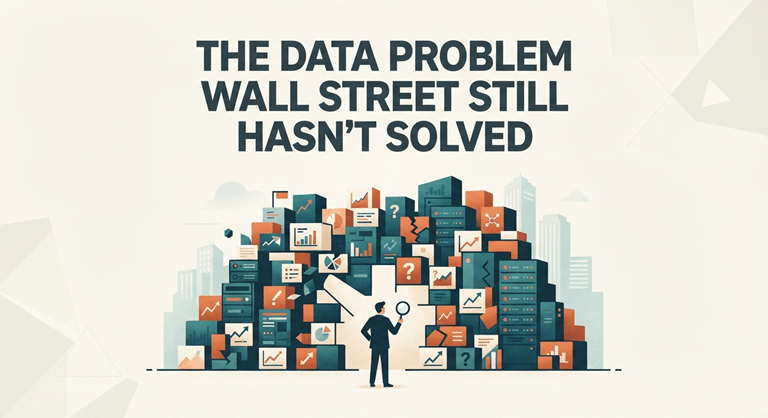
Data Fragmentation Across Multiple Sources
Dozens of vendors. Multiple exchanges. Countless internal systems. It’s what a typical Wall Street shop has to deal with. All sources publish data at their own timing, and have their own formats and refresh frequencies. We have prices on stocks, bonds, economic indicators, and “alternative data” from somewhere else. All of them and reconciling them is a headache that can’t be solved. Over time, the gaps and mismatches compound to create what insiders call data silos. Equity feeds can refresh as often as a millisecond; credit ratings can be updated weekly. Attempt to create a sensible picture of the risks in real time from that.
Validation and Quality Assurance Challenges
Raw market feeds are unclean. Errors, duplicates, and anomalies must be detected before the first analysis goes out. With billions of records a day, it is a real challenge to ensure consistency of the quality controls. Inaccuracies cascade through downstream models from human entry error, system glitches, and transmission hiccups. Data validation is not a one-time task; it’s a continuous process of running your business, and that’s why organizations such as Dechtman Wealth are aware of it. Throw away all the strict quality control, and even the most advanced analytical models begin to spew garbage — and that manifests itself in poor investment decisions.
Legacy System Integration Barriers
The following is something that’s not often talked about: Many of Wall Street’s key trading and risk systems were developed decades ago. They were never meant to communicate with the modern data infrastructure. It causes a whole lot of custom workarounds, incompatibilities, and bottlenecks to retrofit. Doing away with old platforms altogether? Too disruptive. Too expensive. But parallel systems are running side by side – old and new – held together by manual patches. Those patches increase maintenance costs. They bring security holes. Then they put even ambitious institutions in a straitjacket of technology decisions that were taken long before the modern markets even came into being.
Real-Time Processing Demands
The markets march – and march – and march – in microseconds. Data processing? Lags seconds or minutes. High-frequency traders and algorithmic strategies have little time for stale feeds; they need instant feeds. Aggregating, validating, and distributing this much data in real time (RT) is a challenge for most architectures. Processing terabytes of market data and running thousands of analytical queries at once requires serious computational power and engineering skills. Many companies don’t have both.
For professionals working in Denver investment management, navigating these constraints means being selective about partnerships — specifically, aligning with firms that have genuinely invested in modern data infrastructure rather than just talked about it. Some of the processing burden has been relieved by cloud-based solutions, of course. They come with their share of challenges, though – security concerns, regulatory issues, vendor lock-in. One of the most intractable issues in the industry is the speed of data processing and the speed of the market.
Regulatory Compliance and Data Governance
The regulators want to see detailed records. Audit trails. Evidence for transparency and defensibility of decision-making processes. That’s a lot of extra complexity added on to an already challenging data management situation. Firms need to maintain accurate historical data, set access controls for different data, and record the flow of information throughout the firm. All of these delay the pipeline, with data reaching analysts and traders after the fact. The consequences of non-compliance are high, driving investment in improved governance systems. However, that investment takes away resources from innovation. Speed versus compliance. That’s a constant, day-to-day compromise.
Conclusion
There is no quick and easy solution here. There is no single data issue on Wall Street; it’s several data issues all intermingled. Speed versus accuracy. Legacy systems and modern infrastructure. Compliance conformity versus operational agility. This challenge will continue to fuel the delays in decision-making efforts until better tooling is available for meaningful integration, validation, and governance within the industry. It will continue to give opportunities to the firms with the acumen to control their information more effectively than others.
Popular on OTW Right Now!




About The Author

Gagan Bhangu
Founder of otechworld.com and managing editor. He is a tech geek, web-developer, and blogger. He holds a master's degree in computer applications and making money online since 2015.