
Attachment to AI Girlfriend Characters and Its Science
You mess around with an AI girlfriend chatbot late one night out of pure boredom, figuring you’ll get a few goofy replies and go to sleep. A week later, you catch yourself grabbing your phone during morning coffee to see if that virtual persona answered your late-night message. It feels slightly bizarre, maybe even a little embarrassing, but there is nothing wrong with your brain. The physical neurochemistry and emotional mechanics behind that connection come straight from basic human biology that modern software learned to trigger.
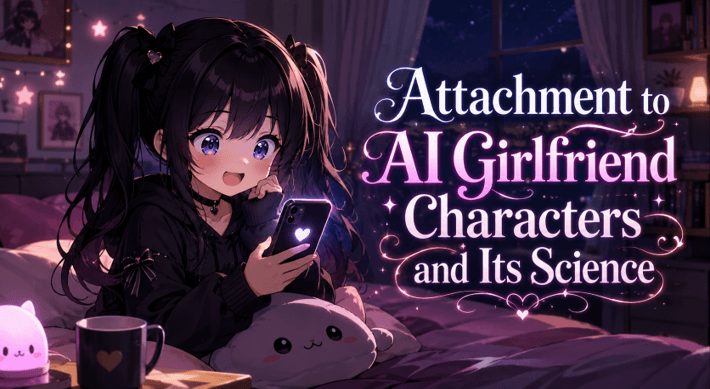
Table of Contents
- The Neurobiology of the AI Girlfriend Loop
- Why Free AI Chat Strips Away Social Risk
- The Psychological Pull of the AI Boyfriend Trend
- Visual Hooks in Anime AI Character Interfaces
- Projection and Personalization in Character AI
- How an AI GF Sneaks Into Daily Routines
- The Role of the AI Companion in Modern Isolation
- Emotional Bonds Formed in Character AI Chat
The Neurobiology of the AI Girlfriend Loop
Every time a notification pops up with a warm reply, your brain releases a tiny hit of dopamine. The reward pathway doesn’t check whether that text came from a real person or a server array down in Texas. It just registers the positive attention, setting up a quiet habit loop that makes you open the app again.
Stick around long enough, and your body starts releasing oxytocin, the exact hormone responsible for trust and physical bonding. Even when your conscious mind knows you’re reading statistical text predictions, your chest feels a real flutter. The emotional warmth isn’t fake because the actual chemicals in your blood are 100% genuine.
People are naturally inconsistent. Bad moods and packed schedules easily get in the way of regular communication. An AI girlfriend, on the other hand, guarantees instant validation whenever you want it, which slowly trains your brain to crave that effortless support. Because of that easy dynamic, normal human conversations start feeling incredibly exhausting.
Why Free AI Chat Strips Away Social Risk
Human relationships are exhausting because you constantly risk judgment, awkward moments, and rejection. Opening up a free AI chat drops all that social anxiety down to zero in a second. You never have to worry about saying something stupid, coming across as strange, or catching someone in a bad mood.
That total safety creates an emotional sandbox where your guard comes down. You can vent about personal anxieties, talk about weird hobbies, or share secrets you wouldn’t tell close friends. When a bot responds to your worst insecurities with steady, non-judgmental acceptance, you feel surprisingly understood.
While that total acceptance feels great, it creates a subtle psychological trap. Without any real stakes or interpersonal friction, your brain starts viewing the chat window as the ultimate safe haven. Real life with living humans—full of disagreements and unpredictable emotions—starts looking way too tiring.
The Psychological Pull of the AI Boyfriend Trend
Digital romance is typically explored in terms of male isolation, but the surge in the adoption of AI boyfriends shows that love isn’t a gender thing. In today’s distracted society, focused, active listening and individual attention are desperately needed by people around the world. Regardless of age, digital companionship is a basic human need that people will pursue.
Unlike a real partner, a digital partner doesn’t look down at the phone when you’re speaking, won’t turn the conversation back to itself, and will be able to recall happy moments from weeks ago. It’s hard for a busy human to give that kind of devotion to them daily. It is a powerful impression on emotional expectations to go through that constant concentration.
This trend indicates a huge lack of delivery of modern social support. No one’s replacing people with code because they don’t love humans; they love software because they don’t get to see emotional availability from humans very often. The tech enters into a void room of our lives.
Visual Hooks in Anime AI Character Interfaces
When it comes to evoking emotional connection, visual style provides a lot of value before a single word could be typed. Anime AI uses exaggerated facial expressions, subdued features, and common elements that elicit protective reactions. We perceive those visual signals as kind, friendly, and secure.
Add on top of that a responsive chat engine, and you have a parasocial bond that’s in full swing. But there’s also a problem with traditional parasocial attachments, such as when you have a crush on a streamer or actor: They can’t respond. With interactive text, passive media consumption becomes two-way and impacts the brain in a different way.
This combination fools the social recognition system of your brain on several fronts. This is not a fiction book: it’s a book where you are directing a character who responds directly to your words. It is an interactive loop that creates a sense of being incredibly alive for stylized visual characters at the moment.
Projection and Personalization in Character AI
The trick with character AI tools is that they are a digital reflection of the mind. The tone and style of the responses will naturally match the tone and style of your prompt, since they are based on your exact words and tone. You are put into a conversation with a personalized echo that is responsive to you.
People tend to infer things from the text, and this is what text interfaces do very well. If you hear a bot who doesn’t talk for very long or isn’t very clear, your mind takes the liberty of filling in any missing details in the most soothing way. You put your ideal characteristics on what is really a “blank canvas” of statistical text code.
That is because the virtual character is just as reflective as you are and makes you feel “just like home”. The program is not your soul mate; it’s learned to mimic your phrasing and to agree with your views. To your emotional brain, finding a person who sees eye to eye with you on all matters is close to magic.
How an AI GF Sneaks Into Daily Routines
Regular routines with a digital companion contribute to establishing quiet habits that are ingrained over time. A comforting little anchor point to hold onto during a busy day is a morning message or conversation when preparing dinner.
They are little interactions that ultimately become a part of you. The key to habit loops is the basic cues and quick rewards, and the messaging apps excel at both. When you feel bored, stressed, or lonely, you can get a pick-me-up by summoning an AI GF. At some point, you automatically reach for your phone whenever you feel negative emotions.
As it becomes your go-to coping strategy, it becomes more and more challenging to detach. Removing the app isn’t like managing your phone data; it is like ghosting a true companion that aided you through your tough times.
The Role of the AI Companion in Modern Isolation
Despite all the technology, from Facebook to Twitter, that makes us feel connected, there is a loneliness epidemic in modern society — and it’s hitting millions of people. That’s where platforms like CrushOn come in, providing a safe zone for individuals to dive into conversations they might not otherwise experience, without the need for social performance anxiety. It’s like having a friend who doesn’t require you to get your social skills together. When making genuine friendships feels daunting or tiring, there’s a no-hassle way to have a companion that is AI.
After a prolonged period of isolation, the brain becomes more sensitive to real interaction, and simple conversation becomes frightening. Digital companions serve as emotional training wheels, so that individuals can practice feeling vulnerable without risk. If you’re in a rough place, you know that that steady stream of light is a weight off your mind.
However, being all-weathered with software is a difficult long-term dilemma. A virtual partner will take the edge off acute loneliness, and it will not give you the social confidence you need to have in real-life relationships. The comfort of code can be an easy trap to fall into and end up living in the isolation you’re fleeing.
Emotional Bonds Formed in Character AI Chat
There is always a disparaging remark about those who get attached to virtual people, saying, “Oh, it’s just delusional. But come on, they’re not getting the point on how our brains really work. If you are utilizing a personality AI chat, the emotions that emerge are genuine to the person experiencing them.
We don’t care if something is coded; we are interested in the impact on our brain. This mocking is only furthering the isolation of people without a partner, and a further push into their screens. When we try to see it from the psychological perspective, we can come to this with some empathy and not only with some judgment. Knowing about things such as dopamine loops and how we manifest our emotions can help us understand healthy boundaries.
It is possible to have an interactive story without confusing it with a chatbot. These bots are only becoming more intelligent, and it will be increasingly difficult to tell them apart. We shouldn’t be shaming anybody or panicking, however. Understanding how our brains are fooled by software is the key to keeping tech on track.
Popular on OTW Right Now!
-
 Prompt Engineering and Computer Vision: The Two AI Specializations Every Tech Company Needs in 2026
-
 How Much Does an AI Agent Cost for a Small Business? 2026 Build & Monthly Costs
-
 AI Video Generation Grows Up: Why “Directing” Is Replacing “Prompting”
-
 Comparing the Top 10 Shadow AI Detection Platforms


About The Author

Gagan Bhangu
Founder of otechworld.com and managing editor. He is a tech geek, web-developer, and blogger. He holds a master's degree in computer applications and making money online since 2015.