
Can You Use a Portable EV Charger at Home and on the Road?
Yes, a portable EV charger can support both routine home charging and travel use, provided that the charger, vehicle, input plug, and electrical supply are compatible. At home, it can provide regular charging from a suitable power source. When needed for a trip, the same charger can be stored in the vehicle and used at an appropriate destination.
This dual purpose is one of the main advantages of a portable EV charger. It is not limited to emergencies, and it does not have to remain permanently installed in one location. However, portability does not mean that the charger can be connected safely to every available outlet. Drivers still need to check the electrical conditions wherever they plan to charge.
What Does “Portable” Mean for an EV Charger?
A portable EV charger is designed to be moved between charging locations rather than permanently wired into one property. It normally includes a vehicle connector, charging cable, control unit, and an input connection for a compatible power source.
The word “portable” describes how the equipment can be carried and stored. It does not mean that every charger is small enough to keep in a glove compartment, nor does it mean that it works with every outlet. Models vary in size, cable length, power rating, input plug, connector standard, controls, and environmental protection.
Portable chargers can serve several roles:
- A regular home charging solution
- A charger that moves between two properties
- A travel charger for overnight destinations
- An additional charging option kept in the vehicle
- A temporary solution for drivers who cannot install a fixed wallbox
The right role depends on the charger configuration, the vehicle, and the available electrical supply.
Using a Portable EV Charger at Home
A portable charger can be used for routine home charging when the electrical installation can handle the required continuous load. For some drivers, it may be their main home charging solution. Others may use it alongside a permanently installed wallbox.
At home, a portable model can be connected to an approved outlet or other compatible power source and used while the vehicle is parked overnight. This can be convenient for renters, people who expect to move, or households that want charging equipment that is not tied permanently to one location.
A wall-mounted holder or cable storage accessory can keep the charger and cable organized when they are used regularly at home. This can create a tidier charging area without changing the portable unit into a permanently hardwired wallbox.
However, EV charging places a continuous electrical load on the circuit. Before using a portable charger regularly at home, drivers should confirm:
- The outlet and input plug are compatible.
- The circuit has sufficient capacity.
- The wiring and outlet are in good condition.
- The electrical system has suitable grounding and protection.
- The selected charging current is within the circuit limit.
- The installation meets applicable local electrical requirements.
A plug that fits into an outlet does not necessarily mean the outlet is safe for use with an EV. Where the wiring condition or ability is in doubt, a qualified electrician should conduct an assessment.
Taking the Same Charger on the Road
A mobile charger can be stored in the vehicle and used in trips as long as weekends or family visits, business trips, or longer trips. The chief value for traveling is typically when the driver has arrived at his destination, where the vehicle is parked for a couple of hours.
A private property or holiday home may not have a particular charging station, for instance. If there is an appropriate and adequate power supply, it may be possible for the driver to charge the vehicle while it is parked overnight.
When drivers are at an unfamiliar property, they should check the type of outlet, the voltage, circuit rating, grounding condition, and the charging current allowed by the outlet. They should also ask for permission before using electricity at a hotel, rental property, or at work or any other property they don’t own.
Drivers should not assume two electrical systems will be compatible based upon an adapter. All adapters and interchangeable input plugs must be approved for use with the charger, and their parameters must comply with the voltage and the continuous current required. Extension cords and adapters not approved for the job can add to the electrical and overheating hazards.
Portable AC Charging vs. Public Fast Charging
Portable AC charging and public DC fast charging serve different purposes. One does not automatically replace the other.
| Charging method | Most suitable use | Typical parking situation |
| Portable AC charger | Home charging, overnight destinations and longer parking periods | Several hours or overnight |
| Fixed home charger | Regular charging at one property | Daily or overnight parking |
| Public AC charger | Workplaces, hotels, shopping areas and destination charging | Medium to long parking periods |
| Public DC fast charger | Adding range during a long-distance journey | Shorter charging stops |
During a highway journey, a public DC fast charger will usually be more suitable when the driver needs to add substantial range quickly. A portable AC charger generally works more slowly and depends on a suitable external power source.
This means the portable charger is frequently most useful at the start and end of a trip: It can be used to charge regularly in the home before the trip and for destination charging after the trip. The public fast chargers will provide faster charging options on the way.
What Must Match Before You Plug In?
It isn’t enough to find an outlet with the right shape when using one portable charger in multiple locations. The charging system requires a number of components to function.
Vehicle Connector
The charger should be compatible with the charging inlet and charging standard of the vehicle. Drivers should always check compatibility by using the same model and market version of vehicle as the original owner.
Input Plug
The input plug plugs the charger into the power source. Plug types can differ between countries, outlets, voltage, and current ratings. A similar physical size does not necessarily mean that the entire electrical installation is capable of the desired charging capacity.
Voltage and Phase
The charger shall accommodate the voltage and phase provided at the charging site. One electrical system’s charger may be incompatible with a different one.
Circuit Capacity
The outlet, wiring, circuit breaker, and other protective devices should be appropriate for continuous EV charging. The charging current should not exceed the permitted continuous load of the circuit.
Vehicle’s Onboard AC Charging Limit
The amount of AC power that the car can charge is determined by the onboard charger. If the vehicle or electrical supply has a lower limit, then a portable charger with a higher maximum rating will not necessarily charge the vehicle faster.
Charging Current
Some portable chargers offer multiple current-setting options that the driver can choose from. This can be useful when using other approved power sources but will not make an improper circuit safe. The chosen setting has to be within the limits of the charger, plug, outlet, wiring, and electrical installation.
Cable Length and Storage
The charging cable should not be stretched across any unsafe areas, and should reach the vehicle. If you will be moving the unit on a regular basis, you will want to take into account size, weight, storage case, cable organization, and protection during transport.
Safety and Environmental Protection
Drivers should check out the safety features, enclosure rating, operating conditions, certifications, and manufacturer’s directions of the charger. Weather resistance is not an indication of the ability to operate the equipment in standing water or at operating limits beyond those specified.
Choosing a QIAO Charger for Home and Travel
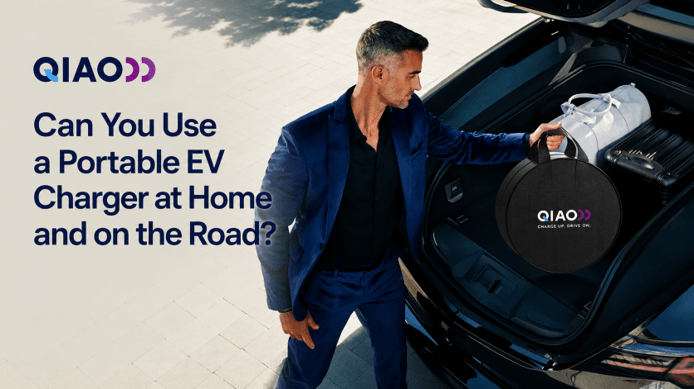
QIAO Charger provides mobile EV charging solutions for daily use at home and on the go. The same portable unit can be used to charge from a compatible home power source, and then stored in the vehicle while the driver is en route to a compatible power source.
When comparing QIAO portable chargers, drivers should consider:
- Vehicle connector and regional charging standard
- Input plug and available power source
- Voltage, phase, current, and charging power
- Vehicle onboard AC charging capacity
- Cable length, handling, and storage
- Safety protections and environmental rating
- Controls and connected features available on the selected model
Specs and features are subject to change depending on the model and configuration. So drivers should not only consider the highest possible power or cosmetics but also the type of electrical equipment they are likely to use in their vehicle.
Final Thoughts
While a portable EV charger can be connected at home and in the car, the usefulness of this device relies on the correct electrical and vehicle compatibility. It can be used at home to provide regular charging from a suitable power supply. It can be transported to an appropriate location for use while parked.
It should not be considered as an alternative to all other charging methods. There is still a better use for public DC fast charging for situations when there is a long distance to travel and a significant amount of range to gain while on the highway. A fixed wallbox can also be a better option for drivers wishing to have a permanent and dedicated home installation.
However, for those who appreciate flexibility, a single well-chosen portable charger can link the two worlds of EV driving: reliable charging at home and mobility options out on the road.
Popular on OTW Right Now!
-
 Touchstone Digital Solutions Redefines School Recognition with Its Interactive Digital Hall of Fame Platform
-
 Never Miss a Moment: How London’s Same-Day Florists Save the Day
-
 The Distributed Lab: Benchmarking the Infrastructure of Remote Engineering Retreats
-
Fiber Laser Engravers for Small Business ROI and Setup 2026



About The Author

Gagan Bhangu
Founder of otechworld.com and managing editor. He is a tech geek, web-developer, and blogger. He holds a master's degree in computer applications and making money online since 2015.