
What Open Source Can Teach Us About Intelligence: Rethinking the Digital IQ Test
Open-source software is often described as a technical philosophy.
The source code is available for inspection, modification and redistribution. Communities can examine how something works, identify weaknesses, propose improvements, and build something new from what already exists.
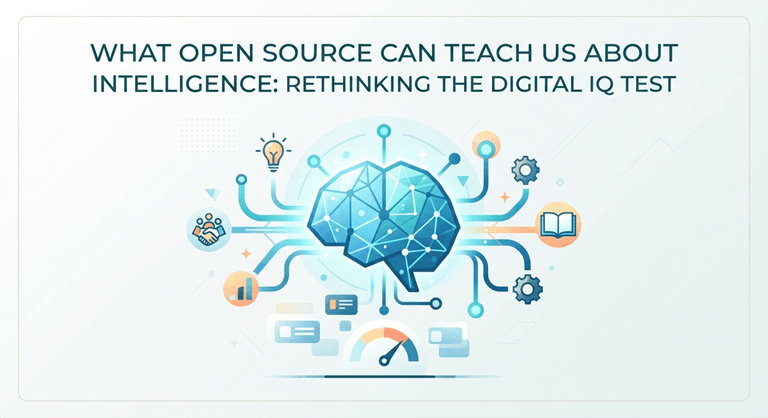
But there is a less obvious idea hidden inside the open-source movement:
Good technology depends on people who are willing to question how things work.
That makes open source an unexpectedly interesting lens for examining intelligence.
The same curiosity that motivates a developer to inspect unfamiliar code can motivate someone to solve a difficult logical puzzle. Both activities involve experimentation, pattern recognition, and the willingness to admit that the first solution may not be the best one.
This connection offers a different way of thinking about online IQ testing — not as a competition for the highest number, but as an exploration of cognitive habits.
Intelligence Is More Than Knowing the Answer
Programming provides an excellent example.
It’s rare for a developer to face a problem for which the right answer is immediately apparent. Rather, they divide the problem into smaller parts, test their hypotheses, find their mistakes, and do it again.
This process resembles several abilities commonly explored by cognitive assessments:
- Logical reasoning
- Pattern recognition
- Problem-solving
- Working memory
- Analytical thinking
An IQ test does not measure programming ability specifically, nor does it capture everything that makes a successful developer.
However, some of the underlying cognitive processes can overlap.
The “Why?” Behind the Result
Let’s say that a person comes across a challenging thought pattern recognition problem.
What is interesting isn’t just that they do get it right.
What was their strategy for accomplishing it?
Were they able to see a connection between the elements right away? Were there a number of hypotheses tested? Were they able to correct their error and change their strategy?
The questions are similar to debugging.
The objective is not merely to reach the correct output, but to understand why the system behaves the way it does.
The Open-Source Principle of Inspectability
Inspectability is one of the best of open-source ideals.
When the result is unexpected, the developers can check its structure and not just the result.
There is an interesting parallel to this idea in cognitive assessment.
It is also important to encourage users to consider content that is beyond the number they receive.
A score is what results from the outcome.
The more important questions are:
- What abilities were tested?
- How was the result calculated?
- What does the score actually represent?
- What limitations does the assessment have?
For people comparing different platforms, an IQ test review can provide useful context by examining how online assessments differ in structure, features, and overall user experience.
This is especially significant in a space where slick design can lead to a perception of greater authority than is justified by the originality of the methodology.
Why Transparency Matters in Cognitive Software
Open-source developers are used to questioning black boxes.
It’s easier to figure out why a program produces an unexpected result if it’s transparent.
The same is true of digital cognitive testing.
The number offered by a platform could be very accurate, but precision doesn’t necessarily equate to accuracy.
The quality of an assessment depends on the way that it is constructed, how it is scored, the reference population, and assessment circumstances.
What Users Should Look For
| Feature | Question worth asking |
| Test design | What cognitive abilities are being examined? |
| Scoring | How is the final result generated? |
| Explanation | Is the result put into context? |
| Transparency | Are limitations clearly stated? |
| Additional exercises | Can users engage with cognitive challenges beyond one test? |
These questions encourage a mindset familiar to open-source communities: inspect before you trust.
MyIQ and the Idea of Continuous Cognitive Engagement
MyIQ is interesting in this context because it does not position cognitive testing solely as a one-time event.
In addition to assessment by IQ, there are mental exercises on the site that stimulate the user to keep taking the tests in various aspects of the brain.
That’s an unorthodox strategy, but there’s something unexpected about it that’s similar to open-source development.
Most software developers never “finish” learning software.
A project changes. Dependencies evolve. New problems appear. Solutions which are successful today might need to be restructured the next day.
The same attitude can be taken towards cognitive skills.
Tests may not be used for the purpose of demonstrating intelligence.
It can be learning about areas where their thinking is solid, where it is not as efficient, and what types of problems might impede their typical thinking.
Open Source Is a Culture of Intellectual Humility
However, another connection should be considered.
The best open source projects are not based on the premise that one person has the answers.
A patch is submitted by a developer. Someone reviews it. Someone else recognizes a problem—the code changes.
A very strong example of intellectual modesty.
Cognitive ability is often referred to as being right, but that is not what intelligence is.
Often intelligent thinking requires the ability to know when one is wrong.
Three Habits Worth Borrowing
Question assumptions.
When a solution “tells itself” the why behind it.
Test hypotheses.
Don’t mistake an appealing explanation for a valid proof.
Revise conclusions.
New information ought to be able to alter your mind.
These habits are useful in programming, science, and everyday decision-making alike.
The Problem With Treating IQ Like a Scoreboard
The concept of open-source culture tends to be more geared toward the potential of the software than to the people who created it.
A similar attitude could be useful with IQ testing.
It is possible to score a score that is interesting, but it’s not possible to rank a human’s worth.
An IQ assessment can measure some of the cognitive or reasoning powers, but cannot measure creativity, emotional intelligence, motivation, or a person’s ability to work collaboratively or make practical judgments.
This doesn’t mean that a high score necessarily represents brilliant programming.
A small rating doesn’t mean that someone can’t make something amazing!
Human ability is a lot more complex than a single measure.
Could Cognitive Testing Become More “Open”?
There’s a tantalizing question about the future of digital assessment.
Particularly as technology evolves, users might start to want more transparency regarding the workings of automated assessments.
Instead of simply receiving a score, they could receive clearer explanations of:
- Which abilities were examined.
- Which tasks influenced the result.
- Where performance was strongest.
- Which areas presented more difficulty.
- How uncertainty affects interpretation.
This way would not result in a scientific perfection of all the assessments.
It might just make users more informed players than mere recipients of a number, however.
The Deeper Connection Between Code and Cognition
Complex systems are easier to comprehend when people are able to inspect, test & improve them, as is open source software.
A software project is much simpler than a human mind!
However, the attitude can be beneficial.
An IQ test can become more valuable when approached with the same curiosity a developer brings to unfamiliar code:
Don’t just ask whether it works. Ask how it works.
This is one of many digital cognitive tools that will make such self-exploration possible online through a growing ecosystem of digital tools, known as MyIQ. Independent review resources will be useful to users for comparing those tools and the value they can provide.
It just may be that intelligence isn’t about knowing the answer all of the time; it’s about being curious and wanting to figure it out.
It’s a principle that’s well understood by programmers.
And it might be one of the most significant things that open source can teach.
Popular on OTW Right Now!


About The Author

Gagan Bhangu
Founder of otechworld.com and managing editor. He is a tech geek, web-developer, and blogger. He holds a master's degree in computer applications and making money online since 2015.