
5 Common Cloud Management Challenges and How to Overcome Them
In most cases, problems in cloud environments don’t appear suddenly; they develop gradually as teams add more workloads to existing services and introduce more cloud services. IT departments are left to manage a complex infrastructure that has grown almost unnoticed and that, because of its distributed nature, is hard to get an overview of, secure, and control.
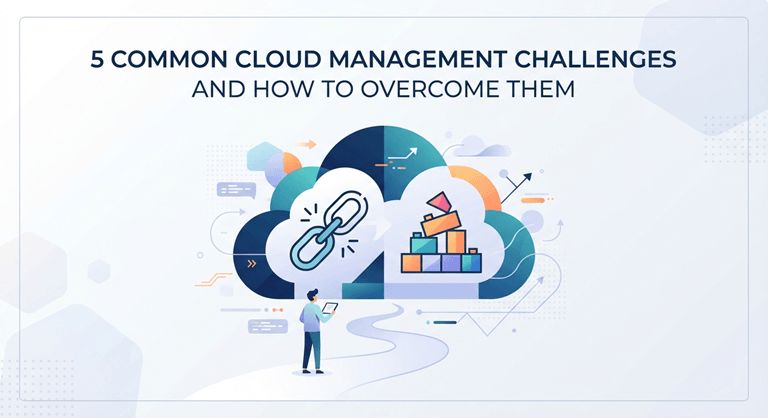
Simply using the cloud is not enough. Managing the cloud requires an operating model for using and managing it. As the cloud environment grows, it becomes more complex and harder to manage without a strong operating model.
Here are five common cloud management challenges and practical ways to address them.
1. Limited Visibility Makes Problems Harder to Find
Cloud infrastructure can spread across accounts, subscriptions, regions, applications, and teams. When information is fragmented, even basic questions can become difficult to answer.
Which resources are running? Who owns them? Which applications are consuming the most capacity? Are there security issues that need immediate attention?
Monitoring Cloud Services. Many Cloud Services offer their own monitoring tools such as Azure Monitor, Amazon CloudWatch, and Google Cloud Monitoring.
As Microsoft’s documentation explains, Azure Monitor collects and analyses telemetry from cloud and on-premises environments.
You don’t need to collect every metric. Figure out what your IT team needs to make decisions, then go from there.
2. Cloud Costs Can Grow Without Clear Accountability
Cloud billing is flexible, so it’s hard to predict. Development teams can easily add more resources to their environments. Often, teams leave resources running after a project changes direction.
The solution starts with ownership.
All resources in a Cloud environment should be associated with a team, project, or business function and tagged and account-structurally organized consistently. Then budgets and spending alerts can detect early if usage moves beyond expected levels.
Budgets and spending alerts can also be enabled with Cost Management, for example, by enabling cost analysis with budgets, anomaly detection with alerts, and costing by allocation.
This is also where FinOps can help. The FinOps Foundation describes FinOps as a collaborative practice of engineering, finance, and business functions that creates financial accountability and responsibility for technology use in the organization. Organizations building this practice from scratch often bring in FinOps consulting to establish the right governance structures and reporting cadence from day one.
This is true Cost Management when the people creating the cloud resources can also see the costs of those Resources.
3. Security Gets Harder as the Environment Expands
A simple cloud environment can be secured quickly and easily. However, adding users, workloads, connections, and environments soon creates problems for IT. Misconfigured permissions, exposed resources, weak access controls, and inconsistent policies all contribute to potential cloud issues.
Left unmanaged, a growing cloud environment can become a security nightmare, with exposed resources, misconfigured permissions, weak access controls, and other risks waiting to be exploited.
The answer is to implement security rules consistently across an organization’s cloud services, rather than relying on manual checks. The key is to establish an identity and access control system, data encryption, cloud monitoring, network policies, and other measures that automatically deliver and check compliance across all of an organization’s cloud services.
Cloud governance tools, including Azure Policy, can ensure cloud services follow policies and enforce them across cloud service scopes. That way, IT professionals can focus on getting value from the services while the tool ensures the necessary protection is in place.
Continuous security monitoring is also required, as a policy that was correct six months after implementation may no longer be correct for today’s changing environment.
4. Hybrid and Multi-Cloud Environments Create Operational Complexity
Of course, using multiple cloud providers is no problem for technical, regulatory, or business reasons. However, management becomes more complicated.
Support for multiple cloud providers in terms of interfaces, terminology, services, and – last but not least – pricing and security means that IT organizations are forced to use different tools and switch between them whenever they access and analyze their cloud-based services and applications.
When managing cloud environments, a uniform approach across the organization’s cloud systems can greatly simplify operations. Such an approach would include the common application of the following: identity and monitoring of cloud services, naming conventions for cloud resources, tagging cloud resources, security and cost management.
For hybrid or multi-cloud environments, the organization can engage hybrid cloud consulting services to help set up proper governance and operational processes for the various cloud environments within the organization.
The end goal of managing multiple cloud environments isn’t to create identical cloud environments. Your goal is to manage them using the same practices.
5. Manual Management Does Not Scale Well
The above processes work well for small cloud environments; however, as a cloud environment grows (more users, more workloads, more integrations, etc.), managing all these processes manually becomes very difficult.
As the number of workloads an IT department manages increases, the time available for each task drops dramatically. In addition to the increased risk of error from the increased workload, there is also a higher risk of inconsistent configurations across resources.
Infrastructure-as-code tools, such as Terraform, can support cloud provisioning, and cloud-native automation can handle most provisioning and scaling on an ongoing basis. Automated scaling of services and systems, for example, can be a powerful technique to manage cloud-based systems.
Automate tasks, such as provisioning cloud resources and policies, and even scaling cloud-based services in and out. Microsoft’s Azure Architecture Center describes how to use automation in cloud environments to improve efficiency and reduce errors.
Automation does not have to mean completely removing humans from a decision-making process. In reality, humans should be involved only when they add value. In most cases, this is a decision-making process where a human has to make a judgment call.
A Better Approach to Cloud Management
These problems are amplified for organizations with growing, dynamic cloud-based infrastructure, and a number of interrelated problems arise.
Treat operational cloud management as an ongoing operational discipline rather than a set of ad hoc technical tasks that lose value once completed.
To build a solid foundation for managing your cloud infrastructure, establish clear ownership of the different environments. Monitor environments on an ongoing basis and use automation for repetitive tasks. Regularly review costs and the security policies in place to build a solid foundation that can adapt to your business’s changing needs.
Popular on OTW Right Now!



About The Author

Gagan Bhangu
Founder of otechworld.com and managing editor. He is a tech geek, web-developer, and blogger. He holds a master's degree in computer applications and making money online since 2015.