
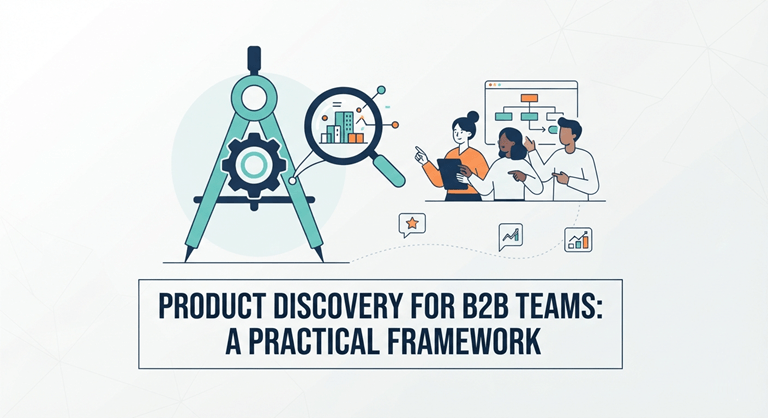
Product Discovery for B2B Teams: A Practical Framework
Most product discovery advice was written for consumer apps with millions of users, and a test panel one click away. B2B teams have twelve accounts, a customer success manager guarding access to each one, and a buyer who never opens the product.
Product strategy consulting for B2B software hits those constraints on every engagement. This product discovery framework is built around them: six steps that each name what breaks and how to handle it.
1. Anchor Discovery to One Business Outcome You Can Move
Pick the number before you pick the research. Every product discovery cycle should start with one business outcome, written as a measurable change over a fixed window. Lifting seat activation from 38 percent to 50 percent in a quarter gives the team something concrete to test against, and “improve onboarding” gives them nothing.
Two failures can show up at this stage.
The first is an outcome the team has no power to move, like total company revenue, which leaves everyone doing research that never connects to a decision they own.
The second is three outcomes stacked onto one product discovery cycle, splitting attention across questions that all get answered badly. Limit the number of outcomes in each cycle to one and have it owned by the people constructing the product.
2. Gather Signals From Sales, Support, and the People Using the Product Daily
B2B companies sit on more evidence than they use. Before booking a single external interview, mine what your teams already recorded:
- Lost deal notes, which name the objection that ended the contract.
- Support ticket clusters, grouped by the task the user was attempting when they got stuck.
- Recorded sales calls, where prospects describe their current workaround out loud.
- Renewal and churn fields in the CRM, especially free-text reasons.
- Screen shares with a daily user completing a real task from start to finish.
This last one is of crucial significance. When she tries to recreate her weekly report in your product, you’ll hear some issues she finds that no feature request mentions.
Before you do anything based on it, here are a few words of caution. Requests are a solution that someone has already selected and passed on within the internal teams. This is because when three reps report a need for a custom export button, it takes too long to report, and then a single button is one guess at a fix.
3. The Buyer and the End User Want Different Things
This division is one of the reasons why it is more difficult to find B2B products than consumer products. The party that signs the contract and the person who puts out the product in the morning are two people who will look at it from different perspectives, and both have veto power over your roadmap.
| Economic buyer | Daily user | |
| What they measure | Cost per seat, reporting depth, audit trails, security posture | Clicks per task, speed, steps that block them |
| How much they see | Demos, dashboards, quarterly business reviews | Every screen, every working day |
| What loses them | Procurement friction, weak compliance answers | A workflow they have to fight |
Have individual conversations with each group, taking individual notes. Software designed only for the buyers means software that people have to use and grudgingly accept. Creating for the “daily user” results in something no budget authority person would sign off on.
Get input from weight buyers for pricing, permissions, compliance, etc., and user input for anything within the daily workflow.
4. Frame the Problem in a Single Sentence Your Team Can Defend
Research becomes a decision at the moment someone writes the problem down. A usable sentence carries four parts, naming who has the problem, what they are trying to finish, what blocks them, and what it costs.
“Users find reporting difficult” fails all four. A defensible version reads more like this: “Operations managers at accounts above 200 seats spend two hours every Monday rebuilding the same utilization report by hand, and three of them named it when they started evaluating a competitor.”
Run a quick test. Ask two team members to write that sentence, using the same research notes. Other sentences indicate that you have collected material and don’t know what the problem is. The matching sentences allow you to then move to solutions.
5. Put Rough Prototypes in Front of Customers Before Engineering Starts
This is where you either save a lot of engineering weeks or actually lose a lot of time: make the cheapest artifact that tests the riskiest assumption. For the majority of B2B teams, this is a clickable flow, a fake and fake dashboard, or a report you put together and email to one account.
Sketch two or three directions.
If you’ve got one idea ahead of any other in the team, then you’re covering up the other ideas that every team member didn’t consider.
Load it with their reality.
Utilize their account design, their job permissions, their information measures. If there’s a prototype that displays 40 tidy rows, then you have no idea what 8,000 rows of records across four regions might look like.
Give a task, then stay quiet.
When you tell your own design, you get agreement each time! Give him something to do, and observe where he shows hesitation.
The feedback of B2B customers is more polite because they’re in a business relationship with you, and they want to be in one next quarter. Behavior will compensate for that. It sounds better than asking what they think when you ask for a pilot, a start date, and/or two hours of their team’s time.
6. Score Opportunities Before Your Largest Account Sets the Roadmap
Product discovery in B2B most often gets wrong when a customer at 20 percent of ARR can redirect all the engineering resources for a quarter towards an account that hadn’t raised a request. This is done by scoring, which involves giving reasons for rejection. Mark each opportunity out of 5 points and place the numbers in a place that stakeholders will be able to see them:
- Frequency across accounts: How many distinct customers hit this, and in which segments.
- Workflow impact: Time or steps recovered per user, per week.
- Evidence strength: Five conversations or fifty, and how recent.
- Build cost: engineering weeks, including the maintenance you inherit.
- Outcome fit: How directly it moves the number you named in step one.
Visible scores make a political debate a papered-over negotiation. When the Account Exec escalates, you’re giving them a comparison based on the evidence and the discussion ends up somewhere constructive.
Keep the Cadence Small Enough to Survive a Busy Quarter
When teams see product discovery as something that stops at the kickoff, it’s a dead end. It’s intentionally small – containing one customer conversation per week, one open question per call, and the same three individuals from product, design, and engineering on each call throughout the shipping crisis.
Access is the most limiting factor for most B2B teams, and technique is second. Set up the calendar first. Contact your top customers’ customer success leads and make two appointments a month to recur that you haven’t known what you will want to ask, with them. Staff who have solved scheduling can continue product discovery beyond the first busy month.
Popular on OTW Right Now!

About The Author

Gagan Bhangu
Founder of otechworld.com and managing editor. He is a tech geek, web-developer, and blogger. He holds a master's degree in computer applications and making money online since 2015.