
Static vs rotating proxies — which one should you use for social media, scraping and automation?
Choosing a proxy is not simply about finding an IP address in the right country. One of the most important decisions is whether that IP should remain stable or change as your workflow progresses.
That is the practical difference between static and rotating proxies.
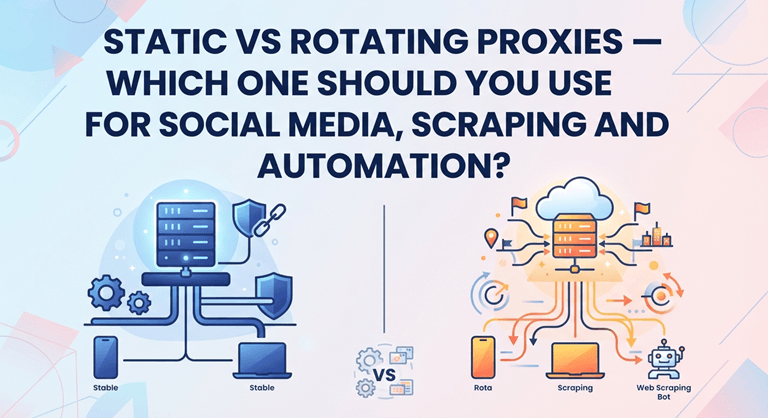
A static proxy keeps the same IP address for an extended period. A rotating proxy uses a pool of addresses and changes the exit IP according to a defined rotation strategy, such as after each request, after a set period, or when a new session begins.
Neither is automatically better.
Static proxies are generally better when a workflow depends on continuity. Rotating proxies are usually better when a workflow involves many independent requests and needs distribution across a larger IP pool.
The right choice depends on what you are actually trying to do.
Static vs rotating proxies: what is the difference?
A static proxy provides the same IP address during a session or for a defined rental period.
This makes static infrastructure useful when a website, authorized account, application, or automated workflow benefits from seeing a consistent network identity.
A rotating proxy works differently. Instead of relying on one address, requests are distributed across a pool of IPs.
Rotation may occur:
- After every request
- After several requests
- At fixed time intervals
- When a new session starts
- When the user manually requests a new IP
Rotating residential proxies are particularly useful for public web scraping, search monitoring, price collection, and other workloads where thousands of independent requests may need to be distributed.
A simple rule is:
Choose static proxies when continuity matters. Choose rotating proxies when scale and distribution matter.
Static vs rotating proxies example: how the choice changes by workflow
Looking at real examples makes the distinction easier to understand.
Social media example
Consider an agency managing an authorized brand account.
The account is already logged in, cookies have been established, and the team wants the session to remain predictable.
Changing the IP address every few seconds would provide little benefit. In this situation, a static residential, ISP, or appropriate mobile connection is generally a more logical choice.
Now consider a separate team analyzing publicly visible social media trends across several regions.
That research does not necessarily require one persistent authenticated session. Rotating infrastructure may be more useful because the task involves many independent public-data requests.
Scraping example
Suppose a retailer wants to monitor publicly listed product prices across thousands of pages.
Sending every request through one static address concentrates all of the traffic on a single network identity.
A rotating proxy pool distributes those requests.
For that reason, rotating residential proxies are commonly used for public web scraping, price monitoring, SEO research, marketplace analysis, and other distributed data-collection workflows.
Automation example
Imagine an automation that logs into an authorized company dashboard every hour and performs a predefined task.
That session benefits from consistency, making a static IP a sensible starting point.
A different automation might crawl thousands of public product pages. Because those pages are independent of one another, rotation becomes more valuable.
The word “automation” therefore does not tell you which proxy to choose. The session requirements do.
Static vs rotating proxies: pros and cons
Both options involve trade-offs.
Static proxy pros
Static proxies provide:
- Consistent IP addresses
- Better continuity for persistent sessions
- Predictable regional identity
- Easier troubleshooting
- A natural fit for authorized account-based workflows
- Stable network conditions for long-running tasks
Static proxy cons
The disadvantages include:
- All requests originate from one IP
- Less suitable for large distributed scraping jobs
- One blocked or unavailable IP can interrupt the workflow
- Scaling often requires assigning multiple static addresses
Rotating proxy pros
Rotating proxies provide:
- Access to a larger pool of IP addresses
- Better distribution for large request volumes
- Flexible geographic targeting
- Strong suitability for crawling and public-data collection
- Easier scaling for independent requests
- Rotation strategies that can be adjusted to the task
Rotating proxy cons
Potential drawbacks include:
- Less session consistency
- Poorly configured rotation can interrupt authenticated workflows
- Different IPs can have different performance characteristics
- Some tasks still require sticky sessions rather than constant rotation
This is why rotation should be controlled rather than treated as something that must happen as frequently as possible.
Static residential proxy vs rotating proxy: which should you choose?
A static residential or ISP proxy is usually the stronger fit when one task needs the same IP for an extended period.
Examples include:
- Persistent regional sessions
- Authorized business-account access
- Long-running automation
- Website QA
- Localized testing
- Workflows where an unexpected IP change would interrupt the process
An ISP proxy is particularly useful when a workflow needs the consistency of a static IP together with an address associated with an Internet Service Provider.
Rotating residential proxies are better suited to workloads such as:
- Large-scale public web scraping
- Search-result collection
- Price monitoring
- Product research
- SEO analysis
- AI data collection
- Public marketplace monitoring
- Distributed automation
In many organizations, the correct answer is not one or the other. Static and rotating infrastructure can operate side by side.
Static vs rotating proxies for social media
For authorized social media operations, session stability is usually important.
A business operating regional social accounts may need cookies, login information, device settings, and network location to remain reasonably consistent.
Static ISP, residential, or mobile infrastructure can therefore be useful for persistent social workflows.
Rotating proxies serve a different purpose. They make more sense for permitted research involving large volumes of publicly accessible content rather than for maintaining one continuing account session.
Mobile proxies are also worth distinguishing from both categories. They route traffic through carrier networks and may be suitable for mobile-first environments where the network type itself matters.
Static versus rotating describes IP behavior.
Residential, ISP, mobile, and datacenter describe more about where the IP originates.
The two concepts should not be confused.
How CyberYozh approaches proxy selection
CyberYozh takes a proxy-first infrastructure approach rather than presenting one proxy type as the universal answer.
Different workflows can require mobile LTE/5G, static ISP/residential, rotating residential, or datacenter infrastructure.
The practical decision comes down to the task:
- Persistent session: prioritize stability.
- Large public-data workload: prioritize scalable rotation.
- Mobile-first environment: consider mobile network infrastructure.
- Speed-focused infrastructure task: datacenter proxies may be sufficient.
CyberYozh also combines proxy infrastructure with related automation, API, verification, risk-checking, SMS, number, and virtual-card tools where those services are relevant to a broader workflow.
The goal is not to use more tools. It is to use the right infrastructure at the right stage.
FAQs about static vs rotating proxies
Which proxy type is the best?
There is no single best proxy type for every workload. Static ISP or residential proxies are often better for persistent sessions, rotating residential proxies for scalable public-data collection, mobile proxies for carrier-network workflows, and datacenter proxies for speed and cost-efficient tasks where residential characteristics are unnecessary.
Which rotating proxies are best for residential use?
For residential workloads, look for a rotating residential proxy network with reliable location targeting, sufficient pool diversity, configurable sticky sessions, predictable rotation controls, transparent traffic terms, and suitable performance for the target application.
The best configuration depends on whether the project requires rapid rotation or temporary session persistence.
Which proxy is best, HTTP or SOCKS5?
HTTP proxies are generally well suited to web browsing, scraping, and HTTP-based requests. SOCKS5 provides broader protocol flexibility and may be better when an application needs to route traffic beyond HTTP.
Neither protocol is universally better. The correct choice depends on the software and traffic being routed.
Is SOCKS5 better than VPN?
SOCKS5 proxies and VPNs solve different problems.
A SOCKS5 proxy routes traffic from a configured application through a proxy server but does not inherently provide the same whole-device encrypted tunnel associated with a typical VPN.
A VPN is generally the better choice when the goal is encrypting and routing most device traffic. SOCKS5 is often more suitable when an application needs flexible proxy routing.
Which static residential proxy is the best?
The best static residential or ISP proxy should provide a stable IP, the required country or region, reliable uptime, sufficient bandwidth, appropriate protocol support, transparent sourcing, and a session duration that matches the task.
Instead of choosing solely by provider rankings, test the proxy against the exact website, application, or automated workflow you intend to use.
Choosing between static and rotating proxies
Static and rotating proxies solve different infrastructure problems.
Static proxies prioritize continuity. They are a strong fit for persistent sessions, authorized account operations, regional testing, and automation where changing the IP could interrupt the workflow.
Rotating proxies prioritize distribution. They are better suited to scalable public-data collection, crawling, market research, SEO analysis, price monitoring, and other jobs built around large numbers of independent requests.
The most useful question is therefore not “Which proxy is best?”
It is:
What needs to remain stable, what can change, and how much traffic does the workflow need to handle?
Once those three questions are answered, the choice becomes much clearer.
Popular on OTW Right Now!


About The Author

Gagan Bhangu
Founder of otechworld.com and managing editor. He is a tech geek, web-developer, and blogger. He holds a master's degree in computer applications and making money online since 2015.