
Red Light Therapy at Home: How to Choose a Panel That Is Actually Worth Buying
Red light therapy panels have quietly become one of the fastest-growing categories in home wellness hardware. The concept is simple enough: an array of LEDs emits specific wavelengths of red and near-infrared light at intensities meant to influence cellular processes, a field researchers call photobiomodulation. The hardware market around that concept, however, is anything but simple. Prices run from under $150 to well over $5,000, spec sheets are inconsistent, and marketing language does a lot of heavy lifting.
Two kinds of reading are worth an evening of time before opening any product page. The first is first-person testing: a gadget reviewer’s candid eight-week at-home trial shows what a realistic adaptation curve looks like, including the weeks where nothing seems to happen. The second is the underlying evidence: a survey of what the photobiomodulation research actually shows walks through the mechanism, the stronger studies by area, and the limitations that still apply. With expectations calibrated, here are the specifications that separate serious hardware from decorative glow, in the order they matter.
Start With Wavelengths, Then Check the Distribution
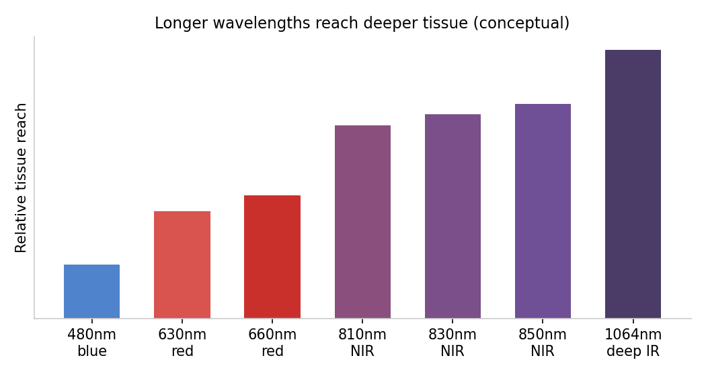
What the light can plausibly reach is determined by its wavelength. This means that wavelengths of red light (630-660nm) are absorbed close to the surface of the skin and are therefore the focus of skin care research. The near infrared wavelengths (810-850 nm) penetrate deeper into the muscle and joint tissues. The far end of the spectrum is deeper, which is the band studied for the deepest applications, and is still not common in consumer panels: 1064-nanometer deep infrared.
The trap that most buyers fall into is the notion that the seven wavelengths listed on a panel’s technical specifications would be evenly distributed. They will be evenly distributed, but the majority of the light will be at just two of those wavelengths – typically 660 and 850 nanometers – while the rest will be at token amounts. That’s not the story on the box. The distribution is. If brands display per-wavelength density percentages (or LED counts per band), then this can be verified. Brands that supply only a wavelength list invite being sold on their promise.
Irradiance: The Spec Where Measurement Method Is Everything
Irradiance is the amount of light energy received on a specified area at a specified distance from the source, and is measured in milliwatts per square centimeter. It’s the number in this category most manipulated. This is because the instrument – solar power meters detect a wider spectrum of light than an LED can emit and always read more accurately than a laboratory spectrometer aimed at the same panel. Some panels boast an average headline number that is roughly twice what a spectrometer would record.
The rule of thumb: search for a specified method of measurement, and a specified distance – preferably a spectrometer reading at a distance of 6″. If there are a large number on a product page but no instrument mentioned, then assume that it is not comparable to any spectrometer figure. Keep an eye on whether it is a peak reading or an average reading over the whole face of the panel since it can vary by up to 15-20% on the same instrument.
LED Chip Design: Single, Dual, or Quad
Within each LED, the light can be emitted by a single diode, a dual diode, or a quad diode in the same package. A single-chip design will deliver the full rated power at one wavelength, generating a sharper spectral peak and higher power per wavelength. A multi-chip design distributes power across the wavelengths, yielding a more uniform output across the panel surface but reducing the output per wavelength. They’re not scams; these are two engineering philosophies. A shopper who is comparing two panels by comparing the number of wavelengths is not comparing like with like, however, because they haven’t considered the design of the chips.
Size, LED Count, and Density
The size of the panels determines the size of the product(s) that can be treated in a single session. Substantial coverage to width of a standing adult is achieved by a panel that is about 12 inches wide and 48 inches or taller or with multiple panels when the body width is less than this. A panel that is about 12 inches wide and 48 inches or taller will cover most of the width of a standing adult; a panel that is 8 or 9 inches wide will cover the width of a standing adult regardless of how many panels are stacked. In addition to the size of the LED, divide by the size of the panel. Two modules of nearly identical size can have an LED-to-square-inch ratio of 25 percent or greater; when more LEDs are in a smaller area, it creates a more even light field.
The Quiet Specs: Flicker, EMF, and Beam Angle
Careful engineering is different from commodity assembly by three secondary specifications. Flicker-free operation is important for a device that users are gazing at for 10 minutes at a time. The reasonable standard for a device used up close is that its output is close to zero at typical usage distance. And beam angle determines the amount of light that reaches the user—a narrow beam (30°) will keep intensity on the body, while a wider beam (60°) will generate some light into the room.
The Paperwork: Trial, Warranty, and Return Terms
In this category, results come over the course of weeks – not days – and that’s a part of the return path. The best deals are available with the stronger and have a 60-day warranty duration with no restocking charge. The weaker end consists of 30-day windows, restocking fees (15-20 percent), deductions for returns from refunds (as in at least one instance, none), and at the very least, 30-day windows. The warranty period is grouped within 2-3 years, some brands have extended. Before the checkout page, read the returns page.
Another paper note: home panels of this sort are generally FDA registered, a listing of the device (and manufacturer), and not clearance or approval. Medical grade is a marketing term not included in a regulatory classification and should not be used as a factor differentiating between two devices.
Frequently Asked Questions
How much should a good red light therapy panel cost?
Entry-level panels for specific applications begin at about $150 and go up to $500. The cost of mid-size panels, with a wider spectrum, is $600-$1,200, and true full-body panels are about $1,500-$5,000. The specs above are relevant at all levels – price follows size and spectrum above all else.
Are cheap no-name panels worth trying?
On occasion, as an initial experiment. Equally constant compromises are reduced wavelengths, unverifiable claims of irradiance, limited or non-existent warranty assistance, and increased flicker. If the buyer is already certain that they are going to use the device regularly, they are more likely to be better off purchasing it once from a brand that provides verified specifications.
What is the single most important spec?
Wavelength distribution, backed up by published density figures and measurement-method-stated irradiance not far behind. All others are refinements upon these two.
This article is general wellness information, not medical advice. Speak with a qualified healthcare provider before starting any new therapy.
Popular on OTW Right Now!



About The Author

Gagan Bhangu
Founder of otechworld.com and managing editor. He is a tech geek, web-developer, and blogger. He holds a master's degree in computer applications and making money online since 2015.