
What Your Car Already Knows: EDR and Telematics Data in a Crash Case
Your car was recording before the crash happened. In the seconds before impact — five seconds in most vehicles, longer in some — the event data recorder was logging speed, brake application, throttle position, steering input, and whether the seatbelt was fastened. That data exists right now in nearly every vehicle on American roads, and it is among the most consequential evidence in serious crash litigation. The people who know this best are accident reconstruction engineers and defense attorneys. Understanding the importance of preserving evidence after a crash — including what the vehicle itself recorded — is the first step toward making sure that data works for you rather than against you.
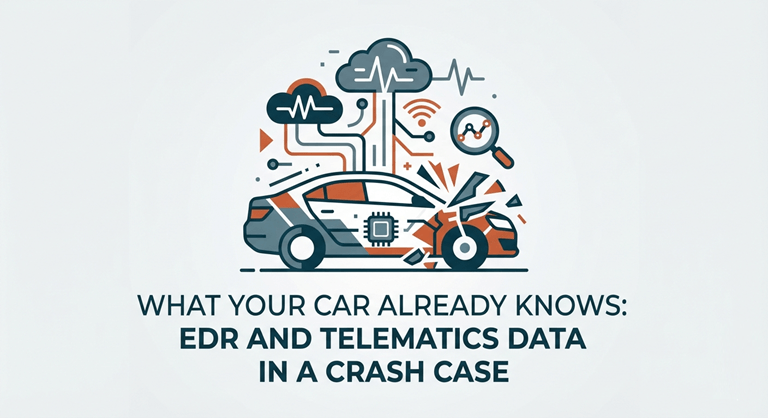
The technology has been standard equipment for decades, and the legal framework around it is more developed than most drivers realize.
What the EDR Actually Captures
The event data recorder — sometimes called a black box, though that term more accurately describes aviation recorders — is a module embedded in the vehicle’s airbag control unit or a dedicated crash sensing system. Federal regulations required EDRs in most new passenger vehicles beginning in 2014, and nearly 95 percent of current vehicles carry some version of the technology.
What the EDR records depends on the vehicle and the nature of the event. In a deployment event — meaning airbags deployed — the data is typically locked permanently. In a non-deployment event, where the crash was serious enough to trigger recording but not serious enough to deploy airbags, the data may be overwritten after a certain number of ignition cycles. Driving the vehicle a few more times after a minor crash can erase the pre-crash data entirely.
Most EDRs record data such as the second-by-second speed at the time of impact, whether the brake is applied or not, the level of force applied to it, the throttle position, the steering angle, the RPM of the engine, and the use of the seat belts by the driver and front passenger. Other systems record information from stability control, traction control, and anti-lock braking systems. The end result is an objective, time-stamped log of what the vehicle was doing rather than what was being claimed by the drivers.
This is a huge difference when both drivers are in dispute in court. When the driver says they were driving at 45 miles per hour in a 45 zone, but the EDR shows they were traveling at 72 miles per hour, it’s not a he said/she said. A written record that is made by the vehicle at the time of impact, and was never subjected to an after-the-crash “let’s think about that” period.
Who Owns the Data and Who Can Access It
Ownership of EDR data is not as clearly defined as the technology, and it differs from jurisdiction to jurisdiction. Passed by the federal government, the Driver Privacy Act rules that EDR data is the property of the vehicle owner, but does not prohibit access through the legal system.
Access is typically via vehicle owner consent, preservation letters, and subpoenas. Attorneys can also request that the vehicle be disclosed via the legal discovery process, usually by issuing a spoliation letter, a formal letter demanding that the vehicle not be repaired, sold, or altered until the data can be accessed, and then requesting a subpoena for the data.
The process of extraction is complicated. The manufacturers make specialized tools available under federal rules to download the EDR contents in a forensically sound manner. A certified technician physically connects to the vehicle’s EDR port with this equipment to download the crash data report. The raw data is saved to secure media, and a duplicate is generated for analysis. Reports are prepared in a manner that keeps the original content and enables expert interpretation without changing anything.
With other vehicles that have extensive onboard logging, it’s not just the EDR. Tesla has collaborated with subpoenas in litigation and has yielded thorough crash logs that have included information on the engagement of Autopilot, video from the cameras, and vehicle telemetry data beyond the scope of the EDR. Log data is subject to alteration or overwriting in vehicles that are still connected to Wi-Fi after a crash can occur via over-the-air software update, making physical preservation of the vehicle as a priority before it reconnects to Wi-Fi.
Telematics: The Ongoing Record
The EDR is a snapshot of activity that surrounds a particular event. Telematics systems record something different — a history of the vehicle’s operation over time.
Today, connected vehicles are used to transmit driving behavior data on a continuous basis. Whereas an EDR can only store data if it detects a collision, telematics systems will keep a history of speed, acceleration, hard braking events, cornering behavior, and location. This information can create patterns that indicate negligence that one crash photo cannot.
If the driver who caused a collision was in a usage-based insurance program like Progressive Snapshot, State Farm Drive Safe and Save, Allstate Drivewise, or some others that tracked in-depth driving habits, then it was capturing hard braking, rapid acceleration, nighttime driving habits, phone use, and speed. A series of months of hard braking and acceleration is proof of at-fault drivers’ aggressive driving, and not a momentary lapse.
The most extensive telematics data is being gathered on fleet vehicles. Fleet programs for commercial trucks, delivery vehicles, and company cars frequently include telematics, which automatically record location data, idling occurrences, driver identification, and route history. A fleet telematics system is one of the first resources that a defense attorney will turn to when evaluating a commercial vehicle crash — and one that should be preserved immediately by a plaintiff’s attorney.
The Overwrite Problem and Why Speed Matters
Not all EDR data is always saved. The data collected during a minor crash may be discarded if the vehicle is driven following a crash in the event it is still operational. The pre-crash buffer may be lost and cannot be retrieved if a well-intentioned first responder ignites the vehicle to remove it from the scene of a crash. This is the one thing in terms of automotive evidence preservation which is most critical and imperative – the clock begins at the scene, not the courtroom.
Spoliation is directly applicable to this. The duty to preserve all relevant evidence begins shortly after a serious crash and by the time litigation is reasonably expected, it has begun. If data is overwritten during the continued operation of a vehicle, or the vehicle is driven to a salvage yard without any data being downloaded, it can be considered spoliation. The intentional or negligent destruction of electronic evidence is considered a serious matter and will result in adverse inference instructions or sanctions.
A preservation response is tailored. If litigation is expected, it is best to secure the vehicle as soon as possible and not operate the vehicle to avoid overwriting EDR memory—stabilization of physical damage and minimization of environmental exposure. If the at-fault party is involved, a preservation letter should be sent to them and their insurance provider, asking them not to repair, sell, or change the vehicle. The EDR download should be performed by a certified technician prior to any other vehicle work.
The Colorado Context: Statute of Limitations Versus Data Retention
Colorado has three years to file an auto accident claim, which means injured parties have a meaningful period of time in which to file a claim. That window makes people think they’re OK with evidence preservation.
The legal deadline is a different time frame than the preservation data window. A plaintiff who waits 18 months after speaking with an attorney before filing a claim might be surprised to discover that the EDR data they needed is missing—they’ve been deleted or lost during repair and replacement of the vehicle’s control module. The statute of limitations sets a limit on how much time can pass before a lawsuit can be filed. It will not apply where the evidence to support that lawsuit must be preserved.
This mismatch is where cases that could have been won on objective vehicle data get litigated instead on witness credibility and reconstruction inference. The vehicle knew exactly what happened. The data that would have proven it no longer exists because no one sent a preservation letter in time.
Anyone seriously injured in a Colorado crash should treat evidence preservation as an immediate priority rather than something that can wait until they have recovered. The Denver car accident attorneys at Zaner Law handle evidence preservation from the earliest stages of a case — including EDR data requests, telematics subpoenas, and fleet vehicle data preservation — because the window for securing that evidence closes long before the legal deadline to file a claim.
Popular on OTW Right Now!
-
 Your Firm’s Future: Why Strategic Partnership in Cyber Maturity is Non-Negotiable
-
 5 Key Technologies for Strengthening the Surface of Aluminum
-
 The Tech Behind Your Bottled Drink: How Sensors and Smart Filtration Keep Every Batch Identical
-
 Can You Sue for Injuries Caused by Falling Merchandise in Boynton Beach Stores?



About The Author

Gagan Bhangu
Founder of otechworld.com and managing editor. He is a tech geek, web-developer, and blogger. He holds a master's degree in computer applications and making money online since 2015.