
RAG Service Providers vs In-House Development: Which Option Works Better?
Building a RAG system requires decisions about data infrastructure, model selection, and long-term maintenance before a single line of code gets written. Some organizations bring in a specialized team to handle that work end-to-end.
Others build the capability internally, hiring for the roles and absorbing the learning curve directly. Neither path is universally correct. The right choice depends on internal expertise, timeline, budget, and the centrality of RAG to the core product.
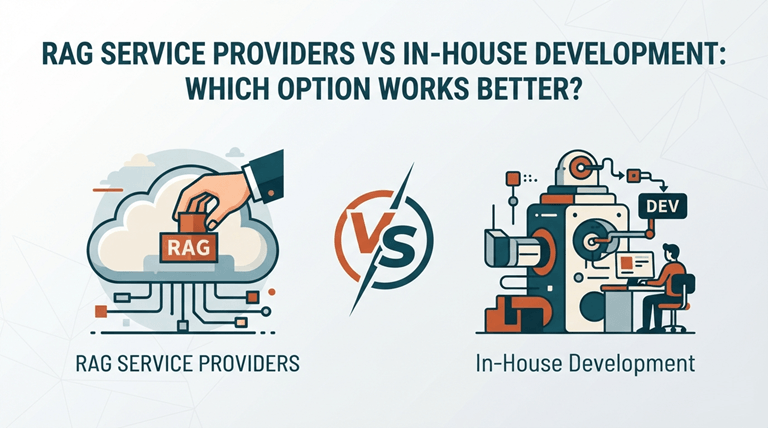
Understanding RAG Service Providers
Outsourcing RAG development shifts the technical burden to a team that has already solved most of the common implementation problems.
What Are RAG Service Providers?
RAG service providers are specialized teams or agencies that design, build, and maintain retrieval-augmented generation systems on behalf of a client organization. What they generally do is from the beginning to the end, that is, ingestion of data, setting up a vector database, defining a logic to retrieve the vectors, and then integrating with the language model that the client selected.
Most RAG service providers operate under one of two engagement models:
- Fixed-scope projects — a defined system built to specification, handed off at completion.
- Ongoing managed service — continuous development, tuning, and maintenance under a retainer or subscription.
Key Benefits of Using RAG Service Providers
With an existing development services team, the organization avoids the trial and error of an in-house team creating a RAG for the first time. The design of chunking strategy, embedding model selection, and retrieval architecture were already determined for several previous projects that the provider participated in.
This experience builds on practice. A provider who has seen the same types of failures in their dozen different client deployments knows the signs of failure faster than a team that’s seeing them for the first time, making the road that much shorter from initial build to a stable system in production.
In-House RAG Development Explained
Internally built pipelines include all aspects of the pipeline,e including the staffing and infrastructure decisions.
What Does In-House RAG Development Involve?
The development of RAG in-house involves creating a team that spans from data engineering to machine learning and infrastructure, and implementing and sustaining the RAG system in-house. This typically includes:
- Hiring or reassigning engineers with vector search and LLM integration experience.
- Selecting and provisioning infrastructure, including vector databases and compute resources.
- Building data pipelines specific to internal systems and formats.
- Establishing an ongoing process for monitoring and retraining.
Advantages of Building RAG Solutions Internally
It is a type of knowledge that is built over the course of an engagement by an outside provider, but that is acquired directly by an internal team as it works with the organization’s data and systems. However, without outside coordination or contract negotiation, decisions regarding architecture and priorities proceed more quickly.
For organizations where the role of RAG lies at the heart of the product, ownership also has its own importance. If a company building retrieval is part of its core product, it will likely want to retain this service in-house, as it will be a longer-term differentiator and not just something they ultimately built once.
Comparing RAG Service Providers and In-House Development
Four factors tend to drive this decision most directly: cost, scalability, available expertise, and the speed at which the system needs to launch.
Cost Considerations
Outsourcing is easy to budget because you know what the cost will be per project or within the retainer fee. The costs of in-house development include hiring costs, salaries, expenses for infrastructure (harder to predict exactly prior to the commencement of the project), and the time invested by engineers learning new environments.
Scalability and Flexibility
RAG service providers can often be scaled up or down according to the stage of the project because they have a greater number of specialists available from various projects. In-house teams grow with a project’s size, but they have to hire the team at a slower pace and with higher risk because of the project scope changes during the construction process.
Expertise and Resource Availability
A RAG application development company possesses specialists that design systems as their core business, across different data types and sectors. Developing the same depth of knowledge in-house requires time before it becomes part of the organization’s knowledge, especially if the organization does not have a machine learning infrastructure.
Time to Market
| Factor | RAG Service Providers | In-House Development |
| Initial setup time | Weeks, using existing frameworks and experience | Months, including hiring and onboarding |
| Cost structure | Fixed project fee or retainer | Salaries, infrastructure, and training costs |
| Scalability | Flexible, draws from a larger talent pool | Limited by internal hiring pace |
| Long-term ownership | Shared or transferred at contract end | Fully retained internally |
| Best fit | Time-sensitive projects, limited internal ML expertise | Core product features, long-term strategic investment |
When to Choose RAG Service Providers
Outsourcing is likely to be cost-effective when speed or budget predictability are important, or the company does not have the expertise in-house.
Ideal Scenarios for Outsourcing RAG Solutions
RAG services are ideal for organizations that do not have the machine learning team already in place, requiring several months to develop and implement. Outsourcing is also a good fit for a well-defined project, with a deadline, like a search tool for a customer service line, that must go live during a specific quarter. Just as in the real world, an open-ended internal capability is a different type of commitment.
How to Select the Right RAG Service Provider
Choosing a RAG service provider comes down to a few concrete checks:
- Request examples of production deployments with measurable outcomes, not proof-of-concept demos.
- Confirm their approach to data security and compliance requirements relevant to the industry.
- Ask what post-launch support looks like and whether ongoing tuning is included in the engagement.
- Verify their experience with the specific data types involved, such as technical documentation or regulated records.
When In-House RAG Development Makes Sense
If RAG is not a key part of the product roadmap, and more of a supporting feature, then the trade-offs of building in-house often do not work out.
Situations Favoring Internal RAG Teams
If an organization already has a machine learning team, they will have a head start in the development of RAG applications, as they already have the infrastructure and hiring process in place. In-house development is also the best choice for companies where retrieval quality is a direct competitive edge, so that the company can keep the know-how inside and that it cannot be easily duplicated by competitors with the same external service provider.
Building a Successful In-House RAG Team
A functional internal team typically needs the following roles covered, either as dedicated hires or shared responsibilities:
- A data engineer to manage ingestion pipelines and preprocessing
- A machine learning engineer familiar with embedding models and retrieval tuning
- An infrastructure engineer to handle vector database scaling and uptime
- A product owner to prioritize which use cases the system supports first
Conclusion: Making the Right Choice for Your Business
Choices regarding whether to use RAG service providers or build in-house depend on the time frame, budget restrictions, and whether central retrieval is a key part of the product. For organizations that require a working system without any machine learning system up and running, they reap more benefits from an external supplier. Firms that invest internally to create retrieval as a key, long-term product differentiator believe the investment is worth the slower ramp-up.
Popular on OTW Right Now!


About The Author

Gagan Bhangu
Founder of otechworld.com and managing editor. He is a tech geek, web-developer, and blogger. He holds a master's degree in computer applications and making money online since 2015.