
How Electronic Component Lifecycle Changes Affect Sourcing and Excess Inventory
Changes in electronic component lifecycles can create two opposing supply-chain risks. A discontinued part can become hard to source, and a last-time purchase to avoid a shortage can lead to overstock for a company.
Companies that know the lifetime of their parts can prepare for changes before they become issues. They will not have to deal with production delays, avoid unnecessary costs, and can make better purchasing decisions. Companies holding excess electronic components may also recover value from unused inventory before demand, packaging condition, or traceability deteriorates.
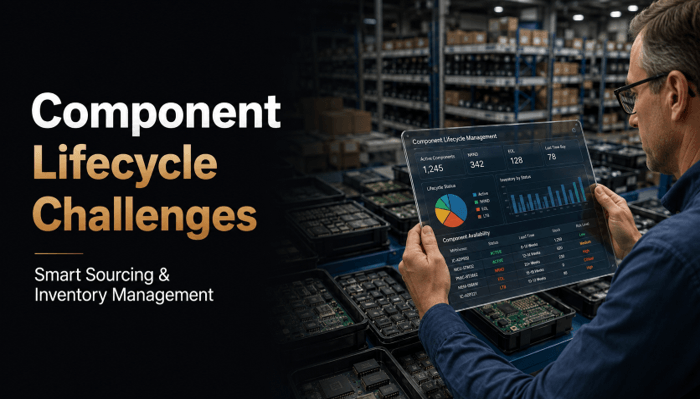
What Is a Component Lifecycle?
The lifecycle of an electronic component typically comprises the stages of introduction, growth, maturity, and discontinuation. This product may no longer be available and/or manufacturer-supported as it approaches the end of its commercial life.
Electronic components typically enter active production, transition to a mature phase, and then become Not Recommended for New Designs (NRND) before the manufacturer’s product discontinuation notice. Electronic components typically go through a series of stages before the manufacturer issues a product discontinuation notice: active production, mature, and Not Recommended for New Designs (NRND). Notice can have a “last time buy” date and a “final shipment” date. Once the production is over, the component could be deemed obsolete.
As soon as a piece of the component reaches this point,t it becomes more difficult to locate. Supply could be reduced, certain distributors could run out of inventory, and prices might be less stable in the market.
An understanding of the life cycle of a component can help businesses anticipate and mitigate the risk of supply chain disruptions.
How Lifecycle Changes Affect Component Sourcing
A manufacturer’s decision to terminate a product or component should prompt buyers to move promptly. Buyers must be quick to respond when a manufacturer tells them that a product or component is being discontinued. However, after a long time, it may be hard or impossible to locate the part.
A few companies decide to purchase additional stock before production ends. A last-time purchase can help to assure continuity of production. Still, it can also result in over-production if demand drops, a product is redesigned, or an alternate component becomes qualified earlier than planned. Others restructure their products with more up-to-date components. Either option is a great choice, but requires careful planning.
Purchasing excess parts can result in unnecessary stock on hand. However, a delay of too long a period could disrupt production, delay delivery, or incur the extra expense of obtaining replacement goods.
That’s why many companies will keep a close eye on product lifecycle updates and keep in touch with suppliers.
Because a suffix may identify package type, temperature grade, packing format or compliance status, buyers should consult an integrated circuit sourcing guide and verify the complete manufacturer part number before approving stock or an alternative device.
Why Excess Inventory Becomes a Problem
While it may sound prudent to have a large stock of spares, excessive stock can cause additional problems.
Wasted parts occupy storage space in the warehouse, and company finances are wasted. Those components could become obsolete before being used, as technology evolves.
Excess inventory can also lead to:
- Higher storage and handling costs.
- Working capital tied up in unused stock.
- Additional counting, inspection, and record-keeping.
- Greater risk of packaging deterioration or lost traceability.
- Lower resale demand as products and platforms change.
Businesses can avoid such costs and maintain sufficient inventory for production by managing inventory carefully.
Better Planning Makes Sourcing Easier
One of the most effective solutions to minimize problems in the supply chain is to plan well.
Businesses should continually consider their stock levels, take into account future production requirements and inform suppliers of potential lifecycle modifications.
Reviews should consist of the full manufacturer part number, the approved BOM application, the life cycle status, the available quantity, the package type, date code, storage history and traceability records.
Having time to plan early allows purchasing teams to identify replacement parts or to place orders ahead of time to avoid shortages.
Numerous businesses are dealing with more than one supplier. Having qualified sourcing options may help to minimize disruption if an authorized supplier runs out of stock of a component or the manufacturer stops producing it.
Companies can also conduct regular inventory checkups to identify any parts that are not moving or being used and take measures to prevent them from becoming a significant cost burden.
What to Do With Surplus Components
Sometimes companies end up with surplus electronic components, despite careful planning. Customer demand can fluctuate, projects can be canceled, or product designs can be altered. This causes the need for parts to be eliminated.
Before selling the unused stock, businesses need to determine if the parts are suitable for other BOMs, facilities, suppliers, or other authorized repairs or warranties. Surplus inventory that has been verified as being truly surplus can then be assessed for sale. This recovers a portion of the original investment and provides much-needed space in the warehouse.
Excess components may also be used by other manufacturers as part of their search for discontinued or hard-to-find components. This could help to sustain legacy equipment and maintain useful components in circulation for a longer time.
It’s essential to have a control plan for additional inventory in place as a part of a healthy supply chain.
Conclusion
When components are discontinued, it can lead to a shortage of components and excess inventory. By paying attention to lifecycle notices, making careful calculations of last-time-buy quantities, ensuring full part numbers, and regularly checking unused stock, companies can mitigate both of these risks. If any components remain, consider internal reuse, supplier returns, resale, and responsible recycling before further value is lost in the inventory.
Popular on OTW Right Now!




About The Author

Gagan Bhangu
Founder of otechworld.com and managing editor. He is a tech geek, web-developer, and blogger. He holds a master's degree in computer applications and making money online since 2015.