
10 Ecommerce Link Building Tactics to Boost Your Online Sales
High-quality backlinks are still one of the most reliable growth levers you’ve got in e-commerce search engine optimization (SEO). Think about what a good link actually does. It passes authority to your domain. It nudges your product and category pages up the rankings. And it sends you referral traffic that’s already halfway to buying. When you’re an online store going head to head with marketplaces and big-name brands, that backlink profile is often the only thing standing between a product page stuck on page three and one that catches shoppers right when they’re ready to pay.
So what is link building, exactly? At its simplest, it’s the process of acquiring backlinks from other websites, and search engines read those high-quality backlinks as votes of confidence in your online store. Easy to say, hard to do at scale. It takes repeatable systems, some prospecting discipline, and outreach that doesn’t waste people’s time. That’s the whole point of a structured approach to e-commerce link building: it turns a pile of scattered, one-off efforts into a pipeline of authoritative referring domains you can actually predict. What follows are ten tactics, with the workflows, filters, and email templates you can start using this quarter to build your store’s link equity and, in the end, your online sales.
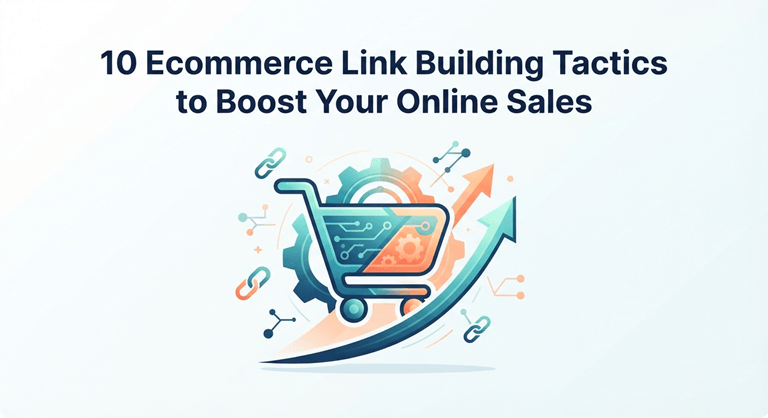
How Ecommerce Works and Why Backlinks Drive Online Sales
Quick bit of grounding before the tactics. E-commerce, or electronic commerce, is really just the buying and selling of products online. It wraps up online shopping, mobile commerce, and electronic payments, and it hands an e-commerce business a global audience that no brick-and-mortar store could ever match. Your online store never closes. It runs 24/7, usually on lower operating costs than traditional retailers pay, and it leans on tools like secure payment gateways, inventory management, and customer relationship management software to keep the online shopping experience from falling apart.
So how does e-commerce work once you strip away the jargon? An e-commerce website enables businesses to sell products online through a flexible e-commerce platform, take payments so customers can pay online, and fulfill online purchases across multiple channels. Every online business sells something. The tricky part is turning a business idea and a business plan into real online sales, and that comes down to one thing: visibility. Which is why the storefront is only half the job. The other half is the daily grind of market research, digital marketing, social media marketing, and online advertising, paired with the right e-commerce tools, some social media management, and a genuine eye on customer data, customer engagement, and customer satisfaction.
And the numbers keep climbing. Industry forecasts put global e-commerce sales at roughly $8.09 trillion by 2028, and e-commerce already eats up a growing slice of total retail sales, with mobile and social commerce doing much of the heavy lifting as more people shop online from mobile devices. This digital commerce boom runs through mobile shopping (m-commerce) and social media platforms in equal measure. All that money flowing through online transactions means the competition among e-commerce platforms and online marketplaces isn’t letting up, and one of the sharpest e-commerce challenges is simply getting noticed, whether you sell goods down the street or run an international business. That, in a sentence, is why organic traffic from backlinks is worth the effort.
Ecommerce Business Models: B2C, B2B, C2C, C2B, and B2G
Most online business activity slots into a handful of e-commerce business models, and knowing yours tells you who you should be chasing links from:
- Business to consumer (B2C): Businesses selling straight to consumers. It’s the classic online storefront, with everything from apparel to pet food, and plenty of brands now sell direct-to-consumer (D2C) through direct sales.
- Business to business (B2B): Businesses selling to other businesses, usually with custom pricing and bigger order volumes.
- Consumer to consumer (C2C): Consumers selling to other consumers, typically over online marketplaces.
- Consumer to business (C2B): Consumers selling products or services to businesses. Think freelancers or influencers.
- Business to government (B2G): Businesses that sell goods and services directly to government agencies.
Whatever your model, and whether you move physical goods, software as a service, or subscriptions, the link-building playbook below still holds.
Why Backlinks Matter for Your Online Store
Here’s why links pull so much weight in commerce specifically. Search engines read a link from a relevant, authoritative website as a signal you’re trustworthy, and stores with strong backlink profiles tend to rank higher because of it. There’s a revenue angle too. A backlink sitting inside a gift guide or product roundup drops a ready-to-buy visitor straight onto a checkout-ready page so that referral traffic is basically doing your selling for you. Links also speed up indexing: when reputable sites point at your new product and collection pages, those pages get found and crawled sooner. Over time, they build real brand authority, one credible source at a time. And they’re a moat, honestly, because a backlink profile is painfully hard to copy and keeps compounding in a way no paid channel ever manages.
Here’s the catch, though. Building backlinks to an e-commerce site is genuinely hard because product pages rarely earn links on their own. Who links to a checkout page? Nobody. So the trick you’ll see all through this guide is to earn links to informational content, then let contextual links and smart internal linking carry that authority down to the pages that make you money. That’s the “why.” Now the ten workflows.
1. Automated Unlinked Brand Mentions for Your Online Store
Of every outreach play, this one converts best: find places that already mention your brand by name, then get those mentions turned into live links. The writer already knows you and typed your name, so you’re not asking for a favor, just a tiny formatting tweak.
The Workflow
- Set up daily alerts for your brand, your product names, and any high-profile executives, using a tool like BuzzSumo, Ahrefs Alerts, or Google Alerts.
- Then trim the list hard. Drop anything under a Domain Rating (DR) of 30, along with sites that already link to you.
- Read what’s left by hand. You want mentions that read positive, or at least neutral.
- Reach out to the author or webmaster, thank them, and hand over the exact URL that fits, whether that’s your homepage or a matching collection page.
Email script:
Subject: Link update for [Site_Name] / Mention of [Your_Brand_Name]
Hi [Author_Name],
You mentioned [Your_Brand_Name] in your recent piece on [Topic_Of_Article], thanks for the shoutout! Any chance you’d make it a clickable link? Here’s the URL: [Your_URL]
Thanks, [Your_Name]
Pro Tips
- Recency moves reply rates, so chase posts from the last 90 days first.
- Quote the exact sentence your brand shows up in, and the editor finds it in seconds.
2. Advanced Broken Link Building for Ecommerce Websites
This one swaps dead external links on resource pages and niche blog posts for a working link to a matching page on your e-commerce website. You’re fixing a real problem for the webmaster, so it lands as helpful, not salesy. Patching broken links elsewhere is a dependable way to generate relevant, high-authority backlinks.
The Workflow
- Drop competitor domains or industry resource blogs into an SEO tool like Ahrefs Site Explorer, open the Broken Links report, and filter for 404s.
- Find the broken pages that used to host something close to your live blog posts, buying guides, or category pages.
- Curious what the dead page actually said? Paste the URL into the Wayback Machine and check.
- Run that broken URL back through your SEO tool to pull every external site still linking to it.
- Now reach out, flag the broken link, and offer your live page as the drop-in fix.
Email script:
Subject: Broken resource on [Their_Site_Name]
Hi [Name],
Reading your guide on [Topic], I hit a broken link: the one pointing to [Broken_URL] throws a 404. We just published an updated guide on that exact subject: [Your_URL]. Might make a clean replacement.
Best, [Your_Name]
Pro Tips
- The closer your replacement matches the original page’s intent, the better your odds.
- Lead with the broken link, not the pitch. Even the folks who say no appreciate the heads-up.
3. Digital PR Campaigns to Earn Links for Your Ecommerce Business
Original, data-driven research turns your brand into a primary source, and journalists link to primary sources when they quote the numbers. Digital PR and unlinked mentions feed the same backlink strategy, and one strong campaign can pull in dozens of high-authority links off one dataset.
The Workflow
- Start with the data: mine anonymized customer purchase data, run a public survey through something like Pollfish, or pull public trend data from your niche.
- Shape it into a clean report. High-resolution charts and infographics matter here because infographics are shareable enough to attract backlinks on their own.
- Build a media list in Muck Rack or Cision focused on the journalists, editors, and contributors already covering your space.
- When you pitch, lead with the single most surprising number in the set, and offer an exclusive quote from your founder.
Email script:
Subject: DATA: [Shocking_Statistic_From_Study]
Hi [Journalist_Name],
Given your recent coverage of [Industry_Trend], this new data might be up your alley. We looked at [Sample_Size] data points on [Topic] and found that [Key_Insight/Statistic].
Full dataset and charts: [Your_URL]. Our founder’s around for a quote too.
Best, [Your_Name]
Pro Tips
- One counterintuitive stat beats ten predictable ones, so hunt for the number that breaks the pattern.
- Ship a ready-to-use embed code with your infographic so linking back takes zero effort, then fold the findings into your wider marketing strategies to stay the go-to source across nearby online markets.
4. Strategic Sample Pitching to Product Reviewers
Send free inventory to the right bloggers and editors, ask for an honest review, and earn high-intent referral traffic plus authoritative contextual links. Influencer product reviews throw off valuable backlinks, and because shoppers trust independent reviews, these placements often convert better than a homepage mention.
The Workflow
- Prospect with Google operators like “[Your_Niche] product review” or “best [Product_Type]” to build a list of independent bloggers, niche influencers, and review sites.
- Vet ruthlessly. Cut sites with thin organic traffic, or ones leaning entirely on unindexed affiliate networks that don’t pass link equity.
- Make the offer simple: a free, full-sized product, no money and no strings.
- Once it’s delivered, confirm it arrived and ask whether they’ll feature it in a roundup or a dedicated review.
One compliance note that genuinely matters. If you’re handing over free product for coverage, the reviewer has to disclose that relationship. The FTC guidelines on endorsements are clear that a material connection, like a gifted product, must be revealed clearly and conspicuously. Bake that into your outreach from the start, because it protects your brand, protects the publisher, and keeps the link from getting yanked later.
Email script:
Subject: Complimentary [Product_Name] for review?
Hi [Name],
Love your breakdowns on [Their_Site_Name], especially your take on [Category_Product]. We just launched [Your_Product_Name], which features [Unique_Selling_Proposition], and I’d love to send you a free sample. No obligation to write anything, I just value your take. If you’re up for it, what’s the best shipping address?
Best, [Your_Name]
Pro Tips
- Open with a specific, recent piece the reviewer published, because generic openers get deleted.
- Never ask for a good review. Ask for an honest one; real reviews earn more trust and outlive the paid kind.
5. The Lifestyle “Gift Guide” Insertion
The holidays, Father’s Day, Mother’s Day, and Valentine’s Day all open a door to slot your products into curated lifestyle gift roundups packed with ready-to-buy readers. Done right, creative buying guides attract backlinks just as well when you’re the one being featured.
The Workflow
- Extract targets with seasonal searches like site:*.com “gift guide for tech lovers” or “holiday gift guide” + [Niche].
- Mind the timing. Big publications need three to four months of lead time, while independent lifestyle blogs are fine at four to six weeks out.
- In the pitch, say plainly why your product fits their list’s demographic, and attach high-resolution, transparent images plus a unique discount code for their readers.
Email script:
Subject: Pitch for your [Year] [Holiday_Name] Gift Guide
Hi [Editor_Name],
I came across your excellent [Holiday_Name] Gift Guide from last year. If you’re refreshing it, I’d love you to consider our [Product_Name], a [Brief_Description] built for [Target_Audience]. Details: [Your_URL]. Happy to set up an exclusive [X]% code for your readers if you feature us.
Cheers, [Your_Name]
Pro Tips
- Editors lock holiday content early, and missing the window is the number one reason these pitches die.
- Hand over an exclusive discount code; it gives the editor a reason to say yes, and it lets you track the sales.
6. Supplier and Manufacturer Directory Backlinks for Online Stores
Resell third-party brands or source materials from established manufacturers? Those suppliers usually keep “Where to Buy” directories on very authoritative domains. Vendor and manufacturer links boost your site authority, and building relationships with your suppliers hands you some of the easiest, most relevant backlinks around.
The Workflow
- Audit your inventory first: list every commercial brand, component manufacturer, and raw material vendor you buy from.
- Comb each manufacturer’s site for pages titled “Store Locator,” “Our Retailers,” “Authorized Distributors,” or “Where to Buy.”
- Confirm your storefront isn’t already on the list.
- Then go straight to your account rep or sales manager and ask to be added as a verified digital storefront.
Email script:
Subject: Retailer Directory Update – Account #[Your_Account_Number]
Hi [Rep_Name],
Hope you’re well. I’m with [Your_Ecommerce_Store]; we stock and actively sell the [Brand/Product_Line] line, but we’re not on your official “Where to Buy” page yet ([URL_Of_Manufacturer_Directory]). Could you pass this to your web team to add us as an authorized online retailer? Our site: [Your_URL].
Thanks, [Your_Name]
Pro Tips
- Route it through your existing sales contact, since internal intros move faster than cold forms.
- Check that you meet any minimum-order or authorized-reseller rules before you ask.
7. The Skyscraper Technique for Your Ecommerce Site
You can’t safely fire a huge volume of direct links at your commercial product pages, so don’t. Build links to meaty informational guides instead, then funnel that authority down with exact-match internal linking. Creating genuinely link-worthy content is the most dependable way to attract backlinks at scale.
The Workflow
- Research the top informational keywords in your niche, say “how to care for leather boots,” and see who’s ranking.
- Run those top URLs through an SEO tool to confirm they carry enough referring domains to be worth chasing. Poking through competitor backlink profiles surfaces more opportunities, too.
- Publish something that flat-out beats the current leader: deeper, with video tutorials, custom diagrams, and fresher data.
- Wire contextual internal links from the new guide to your transactional product and category pages, since contextual links inside informational content lift product-page visibility.
- Finally, hit every site linking to the weaker resource and pitch yours as the upgrade.
Email script:
Subject: Better resource for your article on [Topic]
Hi [Name],
Saw you linked out to a resource on [Topic] in your article. We just published a guide that goes a lot deeper, with updated data for [Current_Year] and a step-by-step video: [Your_URL].
If it’s more useful for your readers, it could be a good addition or a swap.
Best, [Your_Name]
Pro Tips
- “Better” means more useful, not just longer, so add your own visuals, tools, or expert input.
- Map those internal links on purpose so the equity lands on revenue pages.
8. Strategic Guest Blogging to Reach Your Target Audience
Publish sharp, educational columns on non-competing sites in your vertical, and you get to place outbound links back to relevant guides or product categories without it feeling forced. Guest blogging builds authority and earns backlinks while putting you in front of a fresh but relevant target audience.
The Workflow
- Look sideways for non-competitors. Selling high-end coffee beans? Target blogs about espresso machines, mugs, or kitchen decor with queries like [Adjacent_Niche] + “write for us”.
- Screen for quality: real organic traffic, low spam scores, and contextual outbound links that aren’t stuck on rel=”nofollow” or rel=”ugc”.
- Sketch three specific article ideas that solve an audience problem and tie back to your store naturally.
- Pitch short, with your ideas and a couple of writing samples to prove you can deliver.
Email script:
Subject: Guest post ideas for [Their_Site_Name]
Hi [Editor_Name],
I’m head of content at [Your_Brand_Name] and loved your recent piece on [Recent_Topic]. I’d love to write a free article for you. Three angles your audience might like:
- [Topic_Idea_1] – one line on why it’s useful.
- [Topic_Idea_2] – one line on why it’s useful.
- [Topic_Idea_3] – one line on why it’s useful.
Samples: [Link_To_Sample_1] and [Link_To_Sample_2]. Do any fit your calendar?
Best, [Your_Name]
Pro Tips
- Pitch the reader’s problem first, your link second, because editors take value, not ads.
- Point your author-bio link at something genuinely useful, not just the homepage.
9. Reclaiming Competitor 404 Value for Your E-commerce Site
When a rival store shuts down, rebrands, or kills off a popular product line, it leaves behind high-authority dead URLs that are still holding links. Your live product can step in as the natural replacement.
The Workflow
- List the stores in your space that have folded, been acquired, or gone through a big domain migration lately.
- Feed those defunct domains into an SEO tool, open the Best by Links report, and filter by response code to surface dead pages with lots of referring domains.
- Find the pages that once sold something matching an item you stock today.
- Then reach the external webmasters still linking to the gone product and offer your active page as the fix.
Email script:
Subject: Outdated link on [Their_Site_Name]
Hi [Name],
In your article on [Topic], you recommend a product that seems to be gone; the company shut down, and the page ([Dead_URL]) is dead. We make a very similar product with [Mention_Key_Benefit]: [Your_Product_URL]. Swapping in our live page would keep the piece current.
Best, [Your_Name]
Pro Tips
- Move fast once a competitor exits, because other stores are hunting the same links.
- Match the discontinued product’s use case closely so the swap feels natural, not opportunistic.
10. Podcast Interviews to Grow Your Online Business
Guesting as an expert on niche business, lifestyle, or industry podcasts is a tidy way to earn high-authority links from the show-notes pages hosts publish per episode, and it spreads the word about your online business at once.
The Workflow
- Dig through Apple Podcasts, Spotify, and podcast databases for shows in your niche, business category, or lifestyle vertical.
- Make sure the host actually publishes a per-episode blog post or show notes page on an indexed site and links out to guests.
- Frame your founder or lead designer as someone who can teach the audience a real skill, like “how sustainable manufacturing lowers consumer costs.”
- When you pitch, sell the value of a 30-minute interview, not your products.
Email script:
Subject: Interview Pitch: [Founder_Name] for [Podcast_Name]
Hi [Host_Name],
Big fan of [Podcast_Name], especially your episode with [Past_Guest_Name] on [Episode_Topic]. Are you booking guests? Our founder, [Founder_Name], has spent [X] years building [Your_Brand_Name] and has a different take on [Niche_Topic]. They could walk listeners through [Actionable_Takeaway_1] and [Actionable_Takeaway_2].
Short clip: [Link_To_Video_Or_Article]. Let me know if it fits.
Best, [Your_Name]
Pro Tips
- Open with a real, specific callback to a past episode, because hosts smell a template instantly.
- Have two or three tight, quotable takeaways ready so producers see the value before you record.
Core Metrics for Ecommerce Link Building Success
Track these monthly, so you know which tactics deserve more time:
- Email Response Rate: (Total Replies / Total Outreach Emails Sent) x 100. Aim for above 10%.
- Link Conversion Rate: (Live Earned Backlinks / Total Outreach Emails Sent) x 100. Aim for 2% to 5%.
- Average Link Velocity: new referring domains per month. Aim for a steady, upward line.
- Quality Cutoff: the lowest domain strength you’ll pursue. Keep it above DR 30 or DA 30.
How to Read These Numbers
A low response rate almost always comes down to weak personalization or bad targeting, not a bad offer. Strong replies but low conversions usually means the pitch oversells what you actually deliver. Flat link velocity for months is a warning that the prospecting well is drying up, so go dig new sources. And steady high-DR placements are the ones that compound, which is why you protect the quality cutoff even when the raw volume looks tempting.
Common E-commerce Link-Building Mistakes to Avoid
Even well-funded teams trip over the same avoidable stuff. A few worth watching before they cost you rankings or relationships:
- Chasing volume over relevance. One link from a respected site in your niche is worth more than dozens from random low-quality domains, because relevance is what actually carries authority to your product pages.
- Pointing everything at commercial pages. Flood your transactional pages with links, and it looks fake. Send most external links to informational assets, and pass the equity around internally instead.
- Over-optimizing anchor text is a classic own-goal. Hammering the same exact-match keyword reads as a spam signal, so keep the profile varied and lean on branded, natural-language anchors.
- Generic outreach just gets trashed. Templates that ignore what the recipient actually does are an instant delete, and personalization remains your single biggest lever on response rate.
- Skipping the follow-up. Most of the yeses land after a polite second email, and one well-timed nudge routinely doubles conversions without annoying anyone.
- Buying links. Paid schemes break search engine guidelines and risk your whole domain, so stick to tactics that earn links that stay earned.
Sequencing Your First 90 Days of Ecommerce Link Building
Trying to run all ten tactics at once will stretch a small team until nothing gets done well. Phase it instead. Early wins build momentum and pay for the slower work later:
- Weeks 1 to 4 are for grabbing the easy stuff: unlinked brand mentions, supplier directory listings, and broken link swaps. Barely any production involved, and you’ll often see your first live links inside a week.
- Weeks 5 to 8, with those quick wins banked, are when you pour effort into the informational guides and proprietary data campaigns that anchor the long game.
- Weeks 9 to 12 are about scaling relationships, so kick off guest blogging, product sampling, and podcast pitching together, since all three run on relationships, and relationships compound.
Across all three phases, keep the tracking sheet current and glance at your metrics weekly. Then let strategic internal linking do its job and squeeze the SEO value out of every external link you’ve earned.
Bringing It All Together
No single tactic builds a durable backlink profile alone. The stores that win treat link building as an always-on habit: start with fast wins like unlinked mentions, supplier directories, and broken link swaps; layer in scalable assets such as data campaigns, skyscraper guides, and podcast spots; and let the metrics tell you where to lean in.
Do it consistently, and these ten workflows stop feeling like a scramble and start working like an engine, one that keeps producing organic traffic, referral revenue, and online sales. Pick two or three that fit your resources right now, run them weekly, and widen the program as the pipeline matures.
Popular on OTW Right Now!


About The Author

Gagan Bhangu
Founder of otechworld.com and managing editor. He is a tech geek, web-developer, and blogger. He holds a master's degree in computer applications and making money online since 2015.