
How Ongoing Cloud Partnerships Help Businesses Avoid Cloud Waste After Migration
Introduction
Migrating to the cloud is a major milestone, but it is only the beginning of the journey. Many organizations invest significant time and resources into moving their infrastructure, expecting immediate savings and smoother operations once the migration is complete. Instead, they often discover rising cloud costs, underutilized resources, and new security challenges that were not part of the original plan.
The reality is that cloud environments require continuous attention. If not optimized and governed regularly, costs slowly start to get higher, and security and performance levels start to suffer. Industry research shows that enterprises will spend around 21% of their cloud infrastructure budget in 2025 due to wasted resources and inadequate cost management. Industry research indicates that in 2025, enterprises are projected to lose approximately 21% of their cloud infrastructure expenditure due to inefficiencies in resource usage and cost management. This is as important as planning for the migration itself is planning for what happens after the migration.
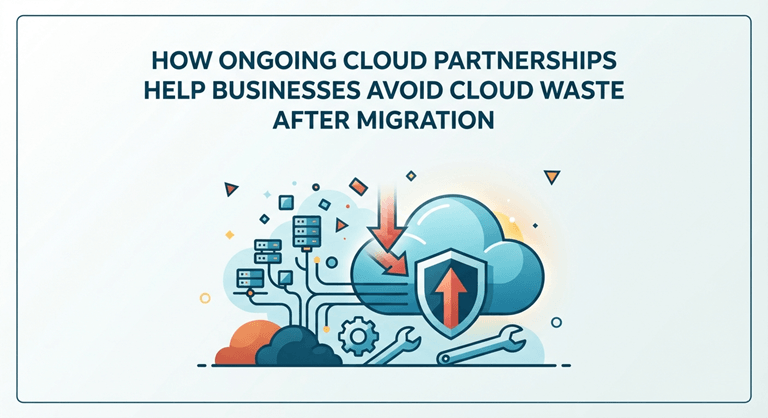
By taking a cloud management process approach rather than a project approach, organizations are much more likely to maximize performance, improve security, and realize lasting value from their cloud management investment.
Why Migration Alone Isn’t Enough
A lot of organizations only get to celebrate the successful outcome of cloud migration once after a couple of months, when they are confronted with hard questions. When it comes to cloud spending, which was supposed to save on operations, leadership starts asking a lot of questions: How come spending on cloud keeps going up?
The most frequent one is the “lift and shift” method. This approach takes workloads from on-premises infrastructure to the cloud without redesigning or optimizing the workloads. It accelerates migration, but it can also have some of the same inefficiencies that were there in the first place.
In the cloud, servers are still too big because they are expected to sustain peak loads. Servers are still too big to sustain peak loads in the cloud. When no one’s using the development environments, they’re still running. Those storage volumes grow when virtual machines are deleted, and slowly creep up on the bill month after month.
While the cloud is flexible, when organizations fall into old infrastructure ruts, they have to be proactive in managing and provisioning resources to meet actual usage.
Experts in the field are still stressing the importance of ongoing governance over cloud, as opposed to deployment. Efficient cost management practices can assist organizations in staying efficient in an ever-changing workload. A study by the Boston Consulting Group suggests that companies need to move towards long-term governance plans for cloud to boost financial performance and operational resiliency.
Understanding Cloud Waste
The waste in the cloud grows insidiously, so you may not realize it’s happening until you get your bills and they’re significantly higher than they should be. The vast majority of unnecessary spending is on resources that are still running, but are not adding much, if any, business value.
Common examples include:
| Source of Cloud Waste | Description | Potential Impact |
| Idle Resources | Development or testing environments that remain active outside business hours. | Paying for resources that are rarely used. |
| Oversized Infrastructure | Virtual machines with more CPU or memory than applications actually require. | Higher monthly infrastructure costs. |
| Unused Storage | Detached storage volumes and outdated snapshots that were never removed. | Ongoing charges that steadily increase over time. |
But with dynamic workloads, evolving customer needs, and the swift uptake of AI applications, cloud spend is now even more unpredictable. Organizations lose around 29% of their IaaS and PaaS investments due to a lack of ongoing monitoring and optimization of resources.
Because they have no idea of how resources are being used, businesses tend to overorder the resources they require.
Infrastructure Drift Creates Hidden Risks
It’s not just a matter of money. As the environment evolves, cloud infrastructure may become more challenging to secure and manage.
The issue of infrastructure drift is when the live cloud infrastructure is no longer deployed as per the desired configuration or Infrastructure as Code templates. Changes that are done by hand, often as a result of troubleshooting or maintenance during an emergency, may be left without being entered into the system. If a small manual change is made during troubleshooting or emergency maintenance, it is often not documented and left in the system.
An administrator can, for instance, temporarily change some of the firewall rules to restore service during a service outage. If those changes are not incorporated into the organization’s configuration management process, they could be completely ignored by future deployments.
Over time, these unauthorized changes result in inconsistencies throughout the organization’s infrastructure. Security teams have a hard time ensuring configurations, audits of compliance are harder to conduct, and there is a higher risk of accidental exposure.
Compliance challenges like those that could be imposed by regulations like HIPAA or PCI DSS can be due to configuration drift that has not been monitored and may have been avoidable by having it continuously monitored.
Continuous Governance Protects Cloud Investments
Cloud optimization isn’t a matter of making tweaks every once in a while. It needs to be continually monitored, analyzed, and refined to ensure that the resources are kept in step with the business.
One of the most popular models to help achieve this is FinOps. The financial accountability and engineering and operational practices come together in FinOps to enable organizations to gain a better understanding of exactly where cloud spending is going and how to save on it where possible.
With continuous governance, organizations can:
- Automatically scale resources based on demand.
- Identify idle infrastructure before it generates unnecessary expenses.
- Allocate cloud costs across departments for improved budgeting.
- Monitor performance while maintaining security and compliance.
- Receive ongoing reporting that supports better operational decisions.
Rather than dealing with unanticipated bills, businesses can make more precise expense estimates and constantly improve their efficiency.
Why Long-Term IT Partnerships Deliver Better Results
You need to have technical skill, dedicated staff, and ongoing monitoring for managing cloud infrastructure insourcing. It is hard for many organizations to keep all of these capabilities and at the same time be able to support their day-to-day business operations.
What is of value is long-term technology partnerships here.
Strategic IT partners not only deliver a migration project and then move on, but also continue to optimize the environments even after the deployment. They are responsible for keeping an eye on infrastructure, pinpointing cost reductions, enhancing security measures, and supporting businesses to remain agile with evolving technology and business needs.
For businesses looking to maximize long-term value, partnering with experienced providers of cloud services in Denver can provide the continuous support needed to reduce waste, maintain compliance, and keep cloud environments operating efficiently.
When performance problems or unforeseen costs arise, internal IT teams can prioritize business initiatives without having to deal with these problems on their own, as the experienced cloud specialists handle the optimization.
Conclusion
The transition to the cloud is a significant one, but it is not a certainty that this will reduce costs or increase performance. Wasted resources, configuration drift, and needless security risks are inevitable in cloud environments without constant monitoring.
Businesses that continuously optimize, govern costs, and take a proactive approach to security are well on their way to getting the most from their cloud investments. It is critical to monitor and manage all the resources involved with this process regularly, through automation and effective guidance, to avoid small inefficiencies from evolving into long-term issues.
The more successful cloud strategies are much more than just migration. Cloud management isn’t a one-time undertaking, and it’s easier to handle with expert assistance, enabling businesses to have secure, efficient, and cost-efficient environments that continue to fuel growth even after migration is finished.
Popular on OTW Right Now!


About The Author

Gagan Bhangu
Founder of otechworld.com and managing editor. He is a tech geek, web-developer, and blogger. He holds a master's degree in computer applications and making money online since 2015.