
Building Cloud and Network Security to Protect Financial Assets from Stealth Data Exfiltration
Introduction
Financial institutions manage some of the world’s most valuable and sensitive information, making them a constant target for sophisticated cyberattacks. As firms continue to move workloads to the cloud and support hybrid operations, protecting customer data has become more challenging than ever. A single successful breach can lead to regulatory penalties, financial losses, and lasting reputational damage. Recent industry research shows that the average cost of a data breach in the financial sector has climbed into the millions of dollars, making proactive security planning a business necessity rather than simply an IT priority.
Today’s attackers rarely rely on disruptive ransomware campaigns alone. Instead, they quietly exploit stolen credentials, cloud misconfigurations, and trusted network traffic to extract sensitive information without immediately raising alarms. Traditional perimeter defenses often struggle to detect these subtle tactics, making layered security strategies essential for financial organizations. Throughout this guide, we’ll explore how financial firms can strengthen cloud and network security through Zero Trust principles, AI-driven threat detection, stronger identity controls, and continuous validation to reduce the risk of stealth data exfiltration.
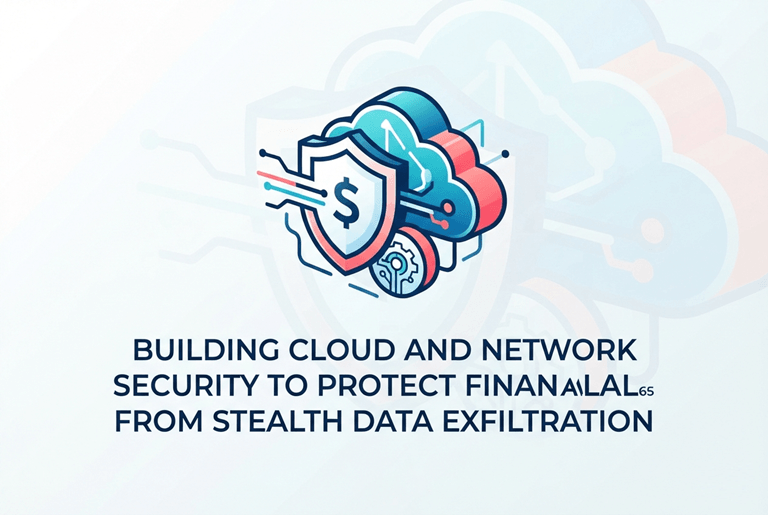
The Anatomy of Stealth Data Exfiltration in Financial Cloud Environments
How Threat Actors Bypass Traditional Perimeters
Stealth data exfiltration occurs when attackers quietly move confidential information outside an organization’s environment without triggering traditional security alerts. Rather than relying on disruptive ransomware attacks, cybercriminals often transfer small amounts of data over extended periods, allowing their activity to blend into legitimate network traffic.
These attackers frequently exploit cloud configuration errors, weak third-party integrations, or compromised user credentials to gain initial access. Once inside, they move carefully through the environment while avoiding actions that would trigger conventional security monitoring. Security experts continue to report a steady increase in attacks targeting financial organizations as cybercriminals exploit increasingly complex cloud environments.
Much of this activity begins with stolen usernames and passwords obtained through underground marketplaces or phishing campaigns. Because attackers authenticate using legitimate credentials, they can often bypass traditional firewall protections without drawing attention. As cloud adoption expands, identity has effectively become the new security perimeter, making strong authentication and access management more important than ever.
The AI Arms Race: Accelerating the Attack Timeline
Artificial intelligence has dramatically changed how cyberattacks are carried out. Threat actors now use AI to automate reconnaissance, generate convincing phishing campaigns, identify vulnerable systems, and accelerate exploitation. Tasks that once required significant manual effort can now be completed within minutes.
This increased automation leaves security teams with far less time to detect and respond. Modern attack campaigns can progress from the initial compromise to data exfiltration much faster than traditional security operations were designed to handle. Once attackers obtain valid credentials, sensitive information can begin leaving the network almost immediately.
This narrow response time is insufficient to conduct a manual investigation. Automated monitoring, behavioral analytics, and intelligent threat detection are becoming the preferred tools of financial institutions to detect suspicious activity before an attacker can accomplish its goals.
Architecting Defense: Multi-Layered Security for Financial Assets
Multi-Layered Data Security and VPC Controls
No single security control can protect today’s financial environments. Cloud security depends on multiple layers of defense that continue to protect the system even if one layer is circumvented. This defense-in-depth approach will considerably reduce an attacker’s freedom of movement in the environment.
| Security Feature | Traditional Perimeter Defense | Multi-Layered Cloud Security |
| Boundary Focus | Single firewall protecting the corporate network. | Virtual Private Clouds (VPCs) with micro-segmentation and isolated workloads. |
| Trust Model | Users are trusted after successful login. | Zero Trust with continuous identity verification. |
| Data Protection | Encryption focused primarily on stored data. | Encryption for data in transit, at rest, and during processing where applicable. |
| Threat Detection | Signature-based alerts and manual log reviews. | Behavioral analytics with automated threat detection and response. |
To prevent the unauthorized flow of sensitive information, Virtual Private Cloud (VPC) Service Controls are used to establish logical boundaries around cloud resources. These controls can limit an attacker’s ability to send confidential information from an internal account to an external cloud environment if they compromise the account.
A strong perimeter segmentation is not sufficient. Financial institutions should also encrypt sensitive data, maintain a thorough audit trail,, and always monitor activity in the cloud. Together, these security measures can mitigate the effects of breached accounts, assist with regulatory compliance, and aid in incident investigations.
Strict Access Management and Identity Security
Identity management is an integral part of today’s cybersecurity solutions. Role-Based Access Control (RBAC) allows the employee to access only the systems and information needed to perform their role. If someone gains access to the employee’s account, they are not unnecessarily exposed to other information or systems. The smaller permissions also make it more difficult for attackers to move horizontally across the network.
AI technologies are also being embraced at a fast pace, posing new access management challenges. Even organizations that have embraced AI tools fail to implement appropriate identity controls and governance policies, leaving their sensitive business information at risk of unauthorized access.
Financial institutions are increasingly adopting a Zero Trust security model that continuously validates users, devices, and applications wherever they are located to thwart these risks. When used in conjunction with multi-factor authentication and ongoing session checking, it can help prevent bad guys from getting in and minimize the impact of stolen credentials.
AI-Driven Threat Detection and Proactive Validation
AI Firewalls and Real-Time Mitigation
Existing firewalls are not effective at detecting attacks using stolen credentials or attacks that mimic normal network traffic. AI-powered firewalls, intrusion detection systems (IDS), and intrusion prevention systems (IPS) can monitor user behavior rather than relying solely on predefined rules or signatures. That means that security teams can detect suspicious behavior much sooner in the attack lifecycle.
These systems are constantly trained to recognize the typical behavior in a financial setting. The platform detects if an authenticated user suddenly tries to copy a substantial amount of sensitive client information to an unknown location. The platform detects if an authenticated user suddenly tries to copy a substantial amount of sensitive client information to an unknown location. It can automatically isolate the session and prevent the transfer of confidential data while it waits for manual review, rather than waiting to be reviewed manually.
This level of automation is essential when responding to attacks that unfold within minutes rather than hours. Organizations investing in cybersecurity for financial services can strengthen their AI-driven monitoring capabilities with security strategies tailored to address the compliance, data protection, and operational challenges unique to financial institutions. Together with behavioral analytics, these safeguards can alert to stealthy threats before they turn into costly breaches.
Continuous Penetration Testing in Cloud Environments
Creating secure cloud environments is just the first step. Financial institutions must ensure their security measures remain effective as their infrastructure, applications, and configurations evolve. Historically, annual penetration tests were enough to ensure that an organization’s cloud environment was secure. Still, nowadays these environments are constantly evolving,g and new risks are emerging with every deployment and configuration change.
Security testing should be conducted using the same methods that today’s attackers use. Rather than just testing for common vulnerabilities, tests should be conducted as though the credentials were stolen, the API was abused, the privilege was escalated, or the data exfiltrated at low volume. These realistic exercises expose weaknesses that a typical vulnerability scan would not.
Automated penetration testing enhances this with a continuous stream of misconfigurations, exposed services, es and access control issues found as they occur. Organizations need to address these findings promptly to maintain a more robust security posture and prevent attackers from finding and exploiting those weaknesses first.
Navigating the Regulatory Landscape for Cloud Security
The financial sector, one of the most heavily regulated in the world, has stringent requirements for cybersecurity and compliance. Compliance with regulations, such as the European Union’s Digital Operational Resilience Act (DORA) and the SEC’s revised cybersecurity rules, requires companies to keep their cloud environments resilient, protect sensitive customer data, and respond quickly to security incidents. These requirements will not be met with technical measures “of the kind only. It must be governed continuously and have documented security practices.
In today’s compliance landscape, organizations are required to have a robust encryption policy, comprehensive audit trails, ongoing monitoring, and multiple security segments for all workloads in the cloud. These measures can help protect against unauthorized access and provide regulators with assurance that the organization is capable of effectively detecting, containing, and recovering from cyber incidents.
It’s a difficult balance to strike between regulatory compliance and innovation, especially for companies that operate in complex hybrid environments. Many companies hire a specialist in financial regulations and cloud security best practices to complement their own staff and provide more comprehensive security. This extra expertise enables organizations to stay compliant and sustain their growth and continuous digital transformation.
Conclusion
The threats to financial institutions are continually becoming more sophisticated and can bypass firewalls to reach the financial institution’s perimeter defenses in alarming time. Sensitive asset protection can’t be achieved with individual security products. It requires a multi-layered approach that integrates AI-driven threat detection, the Zero Trust model, robust identity management, encryption, and ongoing cloud validation.
A proactive approach to continually assessing and improving security significantly increases an organization’s chances of detecting stealthy attacks before they escalate into costly data breaches. Routine testing, proactive monitoring, and governance also enable organizations to meet evolving regulatory requirements and maintain customer confidence.
With the ongoing modernization of the financial services industry, cybersecurity is not just an IT concern, but a key business enabler. By adopting resilient cloud and network security, firms can continue to innovate, protect sensitive financial data, and foster growth and sustainability without jeopardizing compliance or operational resilience.
Popular on OTW Right Now!
-
 Why Growing Businesses Should Replace PTO Spreadsheets With Cloud-Based Leave Management
-
 Why Data Room Software is More Than a Document Management Tool
-
 OneGrowthRise.net Reviews and the Reason Why Investing Remains Relevant in 2026
-
 Reilaa Content Confidence Framework: Understanding Reports, Similarity, and Safer Writing



About The Author

Gagan Bhangu
Founder of otechworld.com and managing editor. He is a tech geek, web-developer, and blogger. He holds a master's degree in computer applications and making money online since 2015.