
How to Deploy a Healthcare LLM Securely: On-Premise, Private Cloud, and HIPAA Considerations
Healthcare providers are increasingly adopting artificial intelligence to enhance patient care, streamline administrative work, and help physicians make better decisions. LLMs for healthcare are among the most intelligent inventions, enabling hospitals, clinics, research organizations, and healthcare providers to manage large volumes of medical data easily. From the production of clinical documentation to support of medical research and patient engagement, these sophisticated language models are revolutionizing 21st-century medicine.
That said, integrating an AI model in a healthcare setting is not as simple as picking the strongest model. Security, patient privacy, regulatory compliance, and infrastructure design are all part of a successful implementation. Healthcare systems and hospitals handle very sensitive patient data, so ensuring security during deployment is paramount. Whether they are deploying on-premises infrastructure or a private cloud environment, they need to be confident that their approach to AI is HIPAA-compliant — and that doesn’t come at the cost of performance or reliability.
Private Cloud Deployment Offers Flexibility and Scalability
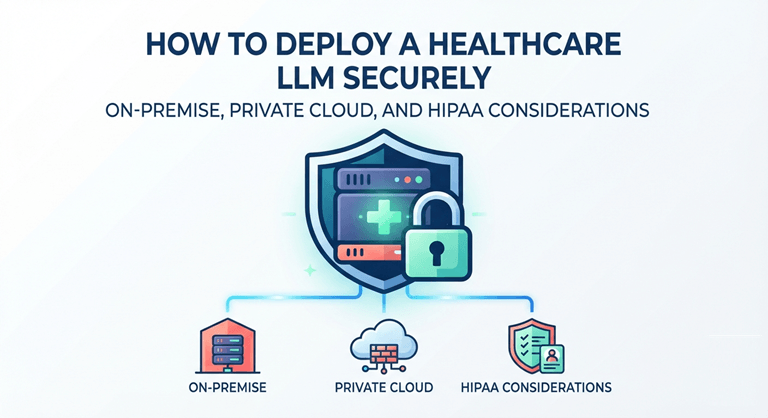
While on-premises deployment offers the greatest level of control, private cloud environments are becoming more popular among healthcare providers for their robust security and modern scalability. An LLM for healthcare in a private cloud is a solution that allows an institution to deploy an LLM for healthcare within a dedicated infrastructure, rather than sharing the system with other users of the public cloud; it represents a good trade-off between flexibility and compliance.
With private cloud computing, the computing capacity can swiftly scale up as the AI workloads grow. Medical imaging, clinical documentation, research assistance, and patient care applications can all be computationally heavy. Private cloud systems can tap into additional processing power when needed, without the expense of buying and maintaining large amounts of physical hardware.
Why On-Premise Deployment Remains a Strong Choice
For many healthcare providers, on-premises deployment remains one of the most reliable options for delivering an AI solution. Hosting an LLM for healthcare on-premises gives the organization full control over its infrastructure, data storage, security policies, and network access. Many institutions regard such a model as the best way to manage sensitive patient data because private medical records never leave the organization’s internal infrastructure.
On-premises deployment also enables healthcare IT staff to adjust security settings in accordance with the organization’s own policies. Firewalls, access control systems, encryption schemes, authentication methods, and monitoring utilities may all be customized to the company’s specific needs. This type of authority also greatly diminishes the risk of external threats; the product’s administrators have absolute control over the entire deployment.
Another benefit is predictable system performance. The in-house infrastructure provides a reliable means of running the AI process on-premises, rather than relying on an internet connection. This is a boon for multi-case hospitals, as they can rest assured that, with thousands of patient interactions, clinicians will be able to invoke AI-generated assistance when they need it, without that pesky cloud latency.
Understanding HIPAA Considerations for Secure AI Deployment
The Health Insurance Portability and Accountability Act (HIPAA) compliance continues to be one of the top concerns when using an LLM in healthcare. HIPAA requires stringent protections for PHI, patient privacy, and the secure handling of sensitive medical information.
The best AI is deployed with the least amount of patient information accessed. AI systems need to be designed to process as little data as possible. Minimizing data exposure also decreases the risk of noncompliance.
Encryption is a key component of complying with HIPAA regulations. With more stringent regulations and patient expectations, there should be no doubt that patient data is still encrypted – both at rest and in transit between systems. Current encryption standards do protect sensitive medical records from being remotely accessed by unauthorized persons, and, in doing so, enhance the IT infrastructure.
Access, control, and enhance the organization’s necessary infrastructure. Organizations should also establish role-based access controls that will permit physicians, nurses, researchers, administrators, and information technology (IT) staff to view only the data pertinent to their job functions. Multi-factor authentication adds an extra layer of protection to your accounts by requiring additional proof of identity before you can log in.
Conclusion
Securely deploying an LLM in healthcare is a balancing act among innovation, robust security, and regulatory compliance. While organizations may opt for on-premises infrastructure for maximum control or a private cloud for greater scalability, in either case, sensitive patient data can be safeguarded by implementing appropriate encryption, access controls, audit logging, and HIPAA-compliant procedures. With a commitment to secure deployment methodologies and sustained oversight, healthcare providers can confidently harness AI to streamline clinical operations, improve patient outcomes, and develop a robust, forward-looking healthcare ecosystem.
Popular on OTW Right Now!



About The Author

Gagan Bhangu
Founder of otechworld.com and managing editor. He is a tech geek, web-developer, and blogger. He holds a master's degree in computer applications and making money online since 2015.