
How to Use a Messaging App Across Mobile and Desktop More Efficiently
Mobile and desktop devices serve different communication needs. A phone is ideal for quick replies and alerts on the move, while a desktop is better for long messages, file review, group organization, and focused work. Cross-device messaging becomes efficient only when each device has a defined role.
Without a workflow, users may receive duplicate notifications, download the same file several times, lose track of important documents, or leave old computers connected. These small problems gradually reduce productivity and can expose private conversations or attachments.
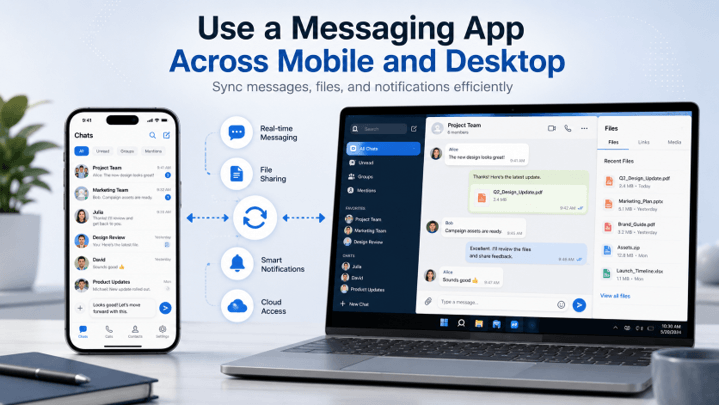
This guide explains how to organize mobile and desktop messaging as one system, including installation, device roles, notifications, file storage, cache, and active sessions for users and teams in Hong Kong, Taiwan, and other multilingual environments.
Choose Primary and Secondary Device Roles
The first step is deciding how each device will be used.
For most people, the mobile phone works best as the primary device for immediate communication. It is always nearby, can receive instant alerts, and is more convenient for short replies while traveling, walking, or moving between meetings. A desktop computer or laptop usually works better as the secondary device for more detailed tasks.
Typical role separation may look like this:
- Phone: quick replies, urgent alerts, voice notes, two-factor codes, and communication on the move
- Desktop or laptop: long messages, file handling, group management, search, and multitasking during work
This distinction helps reduce unnecessary duplication. If users understand that the phone is for responsiveness and the computer is for deeper work, they are less likely to perform every task twice.
It is also useful to decide:
- Which device will store most downloaded files
- Whether large media files should be opened mainly on desktop
- Which device will be used for group administration
- Which device should remain logged in all the time
- Whether work-related conversations should be handled more often on desktop
Cross-device efficiency improves when each device has a practical purpose instead of doing everything in the same way.
Install the Mobile Messaging App Safely
Before connecting multiple devices, make sure the mobile application itself is installed properly.
When reviewing a 土豆app下载 resource, users should confirm the developer information, application permissions, update history, supported system, and download source.
The mobile app is often the foundation of the account, especially when the phone is used to receive verification codes or approve new logins. That means the installation source matters. Users should avoid downloading from unverified links or pages that provide unclear publisher information.
During installation, review:
- Developer or publisher details
- Supported Android or iPhone version
- Application permissions
- Update history
- App-store listing quality
- Whether the app has been updated recently
- Whether the app description matches its function
Users should also think carefully about permissions. A messaging app may request access to contacts, photos, microphone, notifications, and files. Some permissions are reasonable for normal use, but they should still be reviewed deliberately instead of accepted automatically.
After installation, it is helpful to confirm that the app opens normally, shows the expected branding, and behaves consistently with a standard messaging application.
Connect and Verify the Desktop Device
Once the mobile app is ready, the desktop device can be connected.
This stage often includes:
- Choosing the correct desktop version
- Signing in with a code or linked authorization
- Confirming the device name
- Reviewing the session after login
- Allowing or adjusting desktop notifications
- Waiting for the first message and file synchronization
Users should know in advance how login works. Some apps deliver a verification code by SMS, some show it inside an already logged-in device, and some support QR or link-based confirmation. Understanding the expected login flow prevents confusion and reduces the risk of trusting fake prompts.
After the desktop app is connected, check the account’s active-session area. The new device should appear clearly, and its name should match the computer being used. If the newly added session looks unfamiliar, it should be reviewed immediately.
Desktop notifications should also be configured during the initial setup. A desktop device is usually more helpful when it is available for work-related communication, but too many alerts can quickly become distracting. Early configuration prevents overload later.
Organize Messages Across Mobile and Desktop
Once both devices are active, message organization becomes important.
Without some structure, users may waste time looking for the same conversation on different screens. Cross-device messaging works best when chats are kept organized intentionally.
Helpful practices include:
- Pinning important chats
- Using folders or categories when available
- Archiving less important conversations
- Marking unread messages for later review
- Muting noisy groups
- Using search rather than scrolling
- Separating personal and work conversations mentally or structurally
Pinned chats are especially useful on desktop, where the screen is large enough to manage several important conversations at once. On mobile, pinned chats reduce the time needed to reach critical groups or direct messages.
Search should become part of the normal workflow. Instead of browsing endlessly through message history, users should learn how to find messages by keyword, sender, or file type. This is particularly valuable when switching between mobile and desktop during the same day.
Group chats also need control. A high-traffic group may be useful on desktop for review and file collection, but not as a constant source of mobile interruptions. Muting or archiving groups without leaving them can make the overall communication environment more manageable.
Manage Shared Files and Download Locations
Cross-device file management is one of the biggest advantages of using a messaging app on both phone and desktop—but it is also one of the most common sources of clutter.
Users should avoid creating multiple unnecessary copies of the same file. When a document is downloaded on the phone and again on the desktop and then saved again into another folder, confusion grows quickly.
Better habits include:
- Setting one main desktop download folder
- Avoiding unnecessary repeat downloads
- Renaming important files clearly
- Moving permanent files out of temporary chat folders
- Using cloud-storage links when appropriate
- Keeping sensitive files in approved locations
- Cleaning outdated files regularly
For many people, the desktop is the better place to manage documents, spreadsheets, images, and work attachments. The phone can remain the place for quick previews and urgent review, while the desktop becomes the place for structured storage.
Important files should not live only inside a chat thread. If a file matters, it should be moved to a proper folder, backed up when necessary, and given a meaningful name. This is especially important for work documents, client information, contracts, or shared project materials.
Control Cross-Device Notifications
One of the biggest cross-device frustrations is repeated notifications. A message arrives, the phone vibrates, the desktop shows a pop-up, and perhaps the browser also sends an alert. Without control, the same event interrupts the user several times.
Good notification management involves deciding which device should act as the main alert channel in different situations.
Users may want to configure:
- Mobile alerts for urgent communication
- Desktop alerts during work hours
- Group mute settings
- Mention-only notifications
- Quiet hours at night
- Keyword-based alerts when supported
- Focus mode or do-not-disturb integration
For example, a user may allow direct messages and urgent mentions on both devices but mute large groups on mobile. Another user may prefer strong mobile alerts outside the office and more visible desktop alerts during work sessions.
The goal is not simply to silence everything. It is to ensure that important communication is visible without letting every group message interrupt concentration. A well-configured cross-device setup supports both awareness and focus.
Review Cache, Downloads, and Storage
Messaging apps often store local copies of media, documents, previews, and cached content. When both mobile and desktop are used regularly, storage can grow quickly.
Users should understand the difference between:
- Temporary cache
- Downloaded files
- Media saved by the user
- Cloud-based message history
- Local copies kept for quick access
Key settings to review include:
- Automatic image downloads
- Automatic video downloads
- Document auto-download behavior
- Cache size
- Media retention
- Cleanup frequency
- Default storage location
A phone with limited storage may need more aggressive cleanup than a desktop computer. On the other hand, a desktop used for group communication may accumulate a large number of files over time. Both environments need periodic review.
It is also helpful to remember that deleting cache is not always the same as deleting the message or the original cloud-based content. Users should understand what the app removes and what it keeps before cleaning storage.
Test Real Cross-Device Messaging Tasks
Many users assume the setup is complete once both devices are logged in. In practice, it is better to test the workflow through real tasks.
The Potato Chat app should be evaluated through real tasks such as switching devices, finding earlier messages, opening files, managing groups, and removing an old session.
A useful test may include:
- Reading a message on mobile and replying on desktop
- Downloading a file on desktop after previewing it on phone
- Searching for an older message on both devices
- Pinning or archiving a chat
- Muting a group and checking whether the setting feels practical
- Logging into a new device and reviewing the session list
- Logging out of an old device
Testing reveals issues that may not be obvious during installation. For example, notifications may still be too frequent, the download folder may be confusing, or message history may be harder to search than expected. Fixing these problems early makes the app much easier to use in real life.
Protect and Review Active Device Sessions
Cross-device convenience also means more devices can retain access to the account. That is why session management is essential.
Users should regularly check:
- Which devices are logged in
- Whether an old computer still has access
- Whether a lost or replaced phone is still active
- Whether the most recent login was expected
- Whether recovery settings are current
- Whether a screen lock protects the device
If a phone is lost, old sessions should be reviewed immediately. If a desktop device is replaced, the old session should be removed instead of forgotten. If an unfamiliar session appears, it should be terminated and the account’s security settings should be reviewed at once.
Login codes should never be shared, and recovery information should be kept secure. A convenient cross-device workflow is only safe when access is limited to devices the user still recognizes and controls.
Cross-Device Messaging for Hong Kong and Taiwan Workflows
Users who communicate in both English and Traditional Chinese should test search, contact names, file names, voice messages, and notifications on every connected device. A conversation that is easy to find on mobile may be harder to locate on desktop if the search term, spacing, or language differs.
Define where formal files belong. The desktop may be the preferred place for downloading spreadsheets, PDFs, or presentations, but the final version should move to approved cloud or project storage. This prevents chat history, phone storage, and Windows download folders from becoming competing archives.
Mobile and Desktop Messaging Checklist
Before treating the setup as complete, confirm the following:
- The phone and desktop have clear primary and secondary roles.
- The mobile app came from a trustworthy source.
- App permissions were reviewed carefully.
- The desktop login method was understood and completed safely.
- The new device appears correctly in active sessions.
- Pinned, archived, and muted chats are organized.
- A consistent file-download strategy is in place.
- Important files are not stored only in temporary chat folders.
- Notifications are tuned for both urgency and focus.
- Cache and storage settings are understood.
- Real cross-device tasks have been tested.
- Old or unfamiliar sessions have been removed.
Frequently Asked Questions
Which device should receive the main notifications?
Choose the device that matches the current work context. During office hours, the desktop may handle priority alerts; outside work, the phone may become primary. Mute duplicate low-value alerts on the secondary device.
How can I avoid duplicate files across devices?
Assign one primary download location, use descriptive filenames, move important attachments into structured storage, and delete temporary copies after confirming that the final file is saved safely.
How often should I review active sessions?
Review them after adding a device, using a shared computer, traveling, or noticing unusual login activity. A regular monthly check is also a practical habit for accounts used across several devices.
Conclusion
Cross-device messaging works best when mobile and desktop are assigned complementary roles. Notification control, structured file handling, cache review, and session security turn two separate clients into one manageable communication workflow.
For Hong Kong and Taiwan users, testing mixed-language search and file behavior adds another layer of reliability, especially when the same account supports personal, community, and work communication.
Popular on OTW Right Now!




About The Author

Gagan Bhangu
Founder of otechworld.com and managing editor. He is a tech geek, web-developer, and blogger. He holds a master's degree in computer applications and making money online since 2015.