
The Hidden Costs of Outdated Point of Sale Systems in the Hospitality Industry
Your POS is bleeding you dry — and you probably don’t see it on any invoice. I’ve watched restaurant and hotel operators defend legacy systems for years, convinced that “if it ain’t broke, don’t fix it,” while quietly absorbing costs that don’t show up as a single line item anywhere. For practical context on what modern payment integration actually looks like for hospitality, check out microsintegratedpayments.com — but first, let’s talk about what your current setup is actually costing you. Research from 2025 puts the number at 2–3 times higher annual operating cost for an outdated POS versus a modern one. That’s not a rounding error. That’s a second rent.
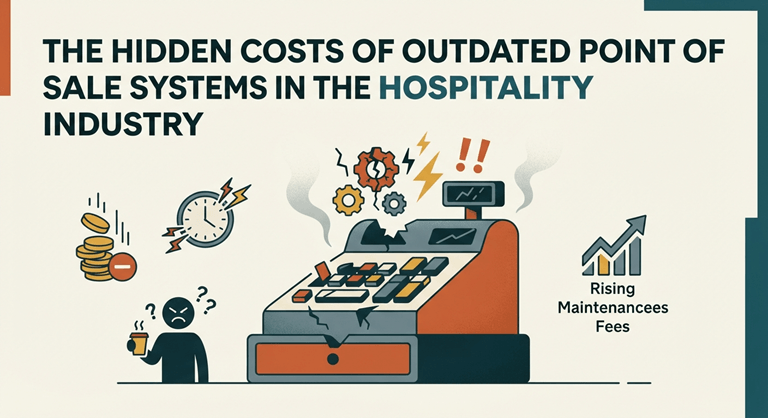
Why an Outdated POS System Quietly Drains Your Margins
The damage isn’t dramatic. It’s death by a thousand cuts. Slow checkout during a Friday dinner rush. A payment failure at the bar when the tab is $200. Manual reconciliation at 1 am because the system won’t sync with your accounting software. Each of these feels like a minor annoyance. Stack them across 365 days,s and you’re looking at serious lost revenue, wasted labor hours, and frustrated guests who don’t come back.
Lost sales are the most underreported cost category in hospitality POS discussions. When your terminal freezes mid-transaction, guests don’t wait — they walk. During peak hours, that walkaway effect compounds fast. Same story with contactless payment gaps: if your hardware doesn’t support tap-to-pay in 2026, you’re creating friction for a growing share of your customer base who simply expect it.
Wasted labor is the second drain. Manual reconciliation — cross-checking end-of-day reports by hand because your POS won’t export clean data — routinely burns an hour or more of manager time per shift. That’s a direct payroll cost with zero upside.
Operational Signals Your System Has Already Crossed the Line
There’s a difference between a system that’s aging and one that’s actively hurting your operation. Here’s how to tell which side you’re on:
- Frequent downtime or terminal freezes during service — especially during peak hours when you can least afford it
- Gateway fee spikes with no corresponding change in transaction volume (classic sign of a legacy processor relationship that’s repricing you quietly)
- Support fee increases for hardware that the vendor is slowly sunsetting — you’re paying more for less
- Staff training delays because new hires can’t find documentation, the interface is non-intuitive, or replacement hardware isn’t compatible.e
- EMV liability exposure — if your terminals don’t process chip cards correctly, you absorb chargeback liability that would otherwise sit with the card networks
- Contactless payment gaps — no NFC support means you’re turning away tap, Apple Pay, and Google Pay transactions
- Reporting that requires manual exports or third-party workarounds to get basic sales data into a usable form.at
If three or more of these hit close to home, you’re past the “monitor it” stage.
The EMV and Contactless Problem Is Not Optional in 2026
This one deserves its own section because, to this day, I see operators still using this as a “nice to have. It’s not. Years ago, the liability for fraudulent transactions was transferred, and now it will fall on you and not the card network if it happens on a non-EMV terminal. This exposure sits on legacy hospitality point-of-sale (POS) configurations, especially those that are older MICROS systems, and on bar POS configurations that were never fully upgraded. Until you’re hit, you will not realize it.
With contactless, it’s all the same but slower. Those who tap their phone and/or watch are no longer a niche group. They’re the mainstream. If your terminal is not NFC compatible, then it is a sure sign that your operation is outdated and inconvenient for your customers who are expecting a speedy operation.
It doesn’t need to be a complete system replacement. It’s here that many operators resort to changing everything: replacing all the legacy payments. It doesn’t. In many instances, payment integration can be added on top of existing infrastructure, making the ROI calculations quite different.
MICROS Specifically: What to Check Before You Decide Anything
A hospitality standard that has been around for decades, MICROS has been around for decades. Satisfactory building quality, table management, and kitchen display integration. Not dismissing it, but . . . . The payment layer in older MICROS deployments, however, is frequently the root of the cost issues: obsolete gateway connections, processors taking markup fees the initial installer did not inform about, and integration shortcomings that create awkward or impractical ways of conducting payments with the latest iteration of payment methods.
Before you commit to either keeping or replacing your MICROS setup, run this check:
- Pull your last 6 months of processing statements and look for gateway fees, monthly minimums, and any line items labeled “network access” or “authorization fees” — these are often where legacy setups hide margin erosion
- Test your EMV compliance — run a chip card transaction and verify it’s processing as EMV, not magnetic stripe fallback
- Check NFC capability on every terminal — tap a phone and see what happens
- Ask your current processor when their last rate review was — if they can’t answer, that’s your answer
- Identify which parts of your MICROS config are actually serving you well (table management, kitchen flow) versus which parts are just legacy drag (payment gateway, reporting exports)
The goal is surgical, not scorched earth. Fix the payment layer. Keep what works.
How to Approach Modernization Without Chaos
Operators that succeed with the operators don’t do it all in one. They audit first – actual numbers, actual fee structures, actual downtime logs. Then they determine the top cost failure points. Payment processing almost always ranks high in that list as it is involved in nearly all transactions.
A 10-second terminal delay per transaction over 40 covers results in a really significant 400-second delay during breakfast rush. If you don’t reconcile at 9 p.m. close, then your manager is making manual fixes but not doing anything productive. As the front desk receives a declined tap payment, they are forced to ask the guest to manually swipe — slow, awkward, and unpalatable to guests in 2026.
Modern payment integration solves these workflow problems without requiring a full POS replacement. That’s the framing shift most operators need. You’re not buying a new system — you’re fixing the most expensive broken component of the one you have.
This is exactly where Micros Integrated Payments fits into the picture. The emphasis is not on a complete platform transformation but on embedding modern payment processing, such as EMV-compliant and NFC-enabled, as well as having a clean, structured data flow, into current hospitality point-of-sale (POS) systems, even in legacy MICROS environments. No chaos. Not training all employees to use a new interface. Real payments that really pay, reasonable fees, and easy compliance – that’s what we offer you.
The Real Cost Calculation You Should Be Running
Here is one exercise that I like to encourage all operators to undertake prior to their next budget cycle. Use your existing annual fees. Include a realistic estimate of the number of hours manager(s) spent manually reconciling, and their hourly rate. Include any chargebacks you felt from the past 12 months. Include a guess at the number of transactions lost (caused by walkaways, failed payments, rejected taps, and so on).
That total is your “status quo” cost. Compare to a modernized payment system that it would operate. These statistics are from industry data, and show that the gap is 2-3x in favor of modern systems, on an annualized basis. It’s a real difference, and for most operators, it’ll be more apparent than they realize when they start performing the calculations.
The old-fashioned POS system issue for hospitality is quite a non-technology issue. This is a margin play. Each slow terminal, each manual recon, each tap payment you can’t accept represents a direct impact on your bottom line, and is just spread thin enough that you’re able to accept it. Don’t ignore it.
Popular on OTW Right Now!
-
 What Hazardous Tree Conditions Can Reveal Before Severe Weather Arrives
-
Telehealth Is Entering Its Next Phase: Why Remote Patient Monitoring Could Matter More Than Video Visits
-
 How is Dallas Emerging as a Hub for Travel Technology Innovation?
-
 Exploring Custom Shoulder Boxes and Their Structural Design



About The Author

Gagan Bhangu
Founder of otechworld.com and managing editor. He is a tech geek, web-developer, and blogger. He holds a master's degree in computer applications and making money online since 2015.