
How AI Is Changing the Relationship Between SEO, UX, and Customer Acquisition
For a long time, search engine optimization, user experience, and customer acquisition operated like three separate teams working in their own corners. SEO focused on rankings, UX focused on how a website felt to use, and customer acquisition focused on turning visitors into paying customers. Each team had its own tools, its own goals, and often its own reasons to blame the others when results fell short. Artificial intelligence is quietly erasing those old boundaries, forcing all three disciplines to work as one connected system instead of three separate departments chasing three separate scoreboards. What used to feel like three different jobs is quickly becoming one shared responsibility.
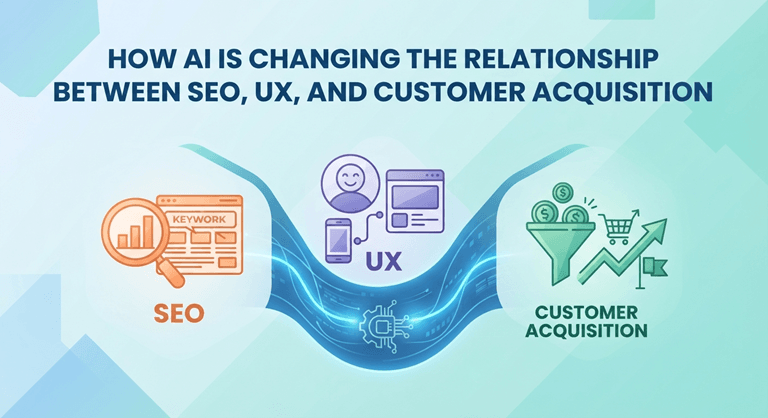
This change is not just theoretical. Businesses that once hired separate specialists for search, design, and conversion strategy are now looking for people and tools that understand how all three pieces fit together. A great ranking means very little if the page behind it confuses visitors. A beautifully designed page means very little if nobody can find it in search results. AI is the force pulling these once-separate worlds into the same conversation.
This shift is happening because AI has changed how people actually search for things. Instead of typing a few keywords into Google and clicking through a list of blue links, more people now ask full questions to AI-powered search tools and chat assistants. These tools often answer the question directly, without sending the person to a website at all. That single change forces businesses to rethink everything, from how content gets written to how a webpage should feel the moment someone finally does land on it. Ranking high on a search results page used to be the finish line. Now it is often just the starting point.
At the same time, AI is making it dramatically faster to build, test, and improve both content and design. Tasks that used to take weeks, like researching keywords, writing content, or producing marketing visuals, can now happen in a fraction of the time. This speed is not just a convenience. It is reshaping how quickly a business can learn what works and adjust course. Companies that once waited months to see if a strategy paid off can now test ideas in days, gathering real data and making changes before a competitor even finishes their first draft.
This new pace changes the relationship between planning and action. In the past, teams spent enormous amounts of time planning a strategy before ever testing it in the real world, simply because testing was expensive and slow. Now, testing itself has become fast and cheap enough that businesses can learn directly from real visitor behavior instead of relying purely on guesswork. This shift rewards businesses willing to experiment often, rather than those still clinging to lengthy planning cycles built for a slower era.
As the field of SEO has come to merge with UX and customer acquisition, it is no longer possible for SEO specialists to work alone. If you’re an SEO expert who isn’t considering the real experience of your visitors,s then you’re optimizing for a visit that won’t result in a conversion. If a designer doesn’t understand how to structure AI search tools’ content reads and content summaries, then the designer may be creating a beautiful page that never gets discovered. The businesses that are thriving today are doing so as a unified business effort – working together with shared information, a shared objective, and a shared, unified page to get to and a shared and unified set of tools to help them get things done once they get there.
Speed Is Reshaping How Businesses Get Discovered
The most noticeable impact of AI on search has been the speed at which it can process information. Whereas months used to be needed to make any noticeable impact for a business to start ranking, they can now be discovered much quicker, particularly when they know what gaps are in the current content. This change is requiring marketers to change their tactics that seemed permanent only a few years ago.
While speed is not everything, it is a key feature that businesses would notice as soon as they begin implementing AI into their search strategy. Rather than a slow, uncertain process, it is now more akin to a system that can be tested, measured, and improved almost as soon as it has been posted.
Vlad Ivanov, Founder of Search GAP Method, has built his entire approach around using AI to find and fill content gaps before competitors even notice them.
“AI completely changed how fast a website can find its audience, and I have seen it firsthand with our own tests. We used AI to spot content gaps and published articles that ranked on page one within 48 hours, with zero backlinks. That speed used to be impossible before AI could scan thousands of search results in seconds. Founders no longer need months of waiting to prove whether their content actually matches what people are searching for.”
But speed alone does not guarantee success, especially as AI tools change what happens after someone finds a page in search results. Miguel Salcido, Founder of Organic Media Group, has watched firsthand how AI search features are changing what ranking success actually means for businesses today.
“One of my clients ranks for over 460 search features, yet their organic traffic keeps declining every single month. AI Overviews and featured snippets now answer questions directly inside Google, so ranking alone no longer guarantees a visit. We had to shift our entire strategy toward pages that earn clicks even when AI tries to answer the question first. Traffic used to be the finish line, but now conversion and user experience decide who actually wins.”
Design and User Experience Are Catching Up to AI Speed
The pace of content creation and search visibility has accelerated to unprecedented levels, and now it’s design and user experience that are required to catch up. It doesn’t matter how clever the SEO behind the page is; if it looks dated and confusing, it will have a hard time converting visitors to customers. This is forcing creative teams to start thinking about how fast they can possibly create good design.
Design has traditionally been one of the slowest steps in the marketing process. A campaign might be drafted and written in a few days, only to have the visuals follow in weeks. That’s where AI is finally filling the void, enabling creative teams to catch up with the content and the search engine that are already attracting the audience to their creations.
James Rigby, Founder of Design Cloud, has spent recent years integrating AI directly into his creative team’s workflow to help design keep up with the speed of modern marketing.
“We used to measure design speed in days, but AI-powered workflows have pushed that down to hours without losing quality. Our team now uses AI to handle first drafts and repetitive tasks, freeing our designers to focus on strategy and polish. One client needed a full campaign refresh in 48 hours, and AI-assisted workflows made that turnaround realistic instead of stressful. Great user experience still needs a human eye, but AI lets that eye move much faster.”
The Real Lesson Behind This Shift
With a diverse mix of search strategy, creative production, and diverse backgrounds, these three experts are from all over the digital marketing world, all of whom point in the same direction. AI doesn’t take the place of the basic principles of SEO, UX, or customer acquisition. Rather, it has eliminated the tedious and time-consuming aspects from each of those jobs, leaving humans to make decisions that require human judgment. Today’s successful companies are the ones that are not fighting three battles for search visibility, page design, and conversion strategy, but rather taking them as a unified system.
In the future, the speed difference between the fast and slow movers will probably increase. Companies that master the opportunities of AI at the content, design, and strategy levels simultaneously will continue to uncover new opportunities at a much quicker pace than those still operating in silos, working on content, design, and strategy separately. The bottom line of each of the stories in this article is straightforward. A speedy result is fine, but only if it is accompanied by a genuine attempt to attend to the visitor on the other side of the screen – a result that is not going to last if it is not done in a way that is genuinely focused on the visitor.
The lesson learned for any company attempting to stay current with this change is not to follow all the new AI tools. It’s to ensure search strategy, page design, and customer experience are finally on the same page, based on the same data, and working toward the same goal. More than technology, that’s what will distinguish the businesses that will continue to succeed in this new era from the ones that will wonder why their old playbook is no longer working.
Popular on OTW Right Now!



About The Author

Gagan Bhangu
Founder of otechworld.com and managing editor. He is a tech geek, web-developer, and blogger. He holds a master's degree in computer applications and making money online since 2015.