
The Tech Behind the Table: How Virtual Tabletop Simulators Are Changing How We Play
Board games have always been about bringing people together because today, people are rarely in the same room anymore. The packed schedules have made it harder to sit around a physical table, and that gap has pushed a wave of developers to build something that could fill it.
Virtual tabletop simulators are impacting not only the way that games are played, but also how they are designed and shared. So, what makes these tools effective and why are they successful? Read this article and get to know more about the tech used in the table.
More Than a Digital Scan
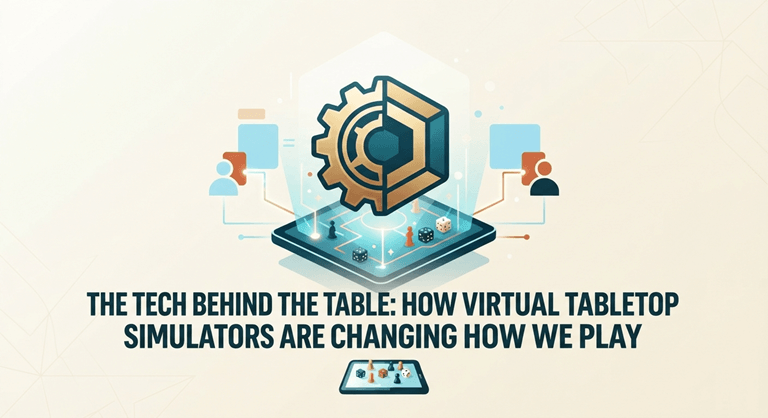
A virtual tabletop simulator is not a photocopied tabletop game. In essence, these are physics engines with asset management systems included. Cards are not just lightweight; they’re stackable, too. Tokens will “snap” into the grid position.
The best virtual tabletop simulators run on a client-server model in which one player hosts the game session, and others connect to that instance.
Most of the state management is handled by the host machine, and the platform synchronizes all positions of objects, reveals of cards, dice values, et,. between all connected clients in real-time.
Scripting and Automation
Embedded scripting (usually Lua or a similar lightweight scripting language) is supported for the more sophisticated virtual tabletop platforms. This enables designers to add behaviour (a script) directly to game objects. You can script a card to be able to draw 2 other cards when it is played. Some faces on a die can be locked according to the state of the game.
Scripting is a way to reduce the time spent with all those little and complicated rules, and spend more time playing. For designers, it can mean that the virtual version of a game can enforce rules – that’s a lot of value when you’re playtesting and want to isolate a particular rule.
Synchronisation and State Management
It is always a technical challenge to have all players in the game in the same place. However, that’s not the challenge the developers aren’t taking up, though.
Virtual tabletops do this by storing the persistence of the game state in files, which are updated whenever an object’s position changes, a card is flipped, or a die rolls. The majority of platforms check this state on a regular basis, so that in the event that a player leaves the game, they can log back in without the game breaking.
Some make use of peer-to-peer architecture, re while others route all traffic via centralised servers. Each has tradeoffs. Peer-to-peer is cheaper, but is subject to the quality of the connection between the host and the client. Server-based routing will incur costs on infrastructure, but provide more consistent experiences for players that are distributed over a range of regions.
The Social Layer
If it is a tabletop game, without speaking, there is no game. In response, virtual platforms have either integrated voice chat features or added them to the platform. Overlays are becoming more popular with video, allowing players to view the other players in a small window while the game board is prominent.
This social layer matters more than it might seem. Research into remote collaboration consistently shows that non-verbal communication affects group dynamics, and games are no exception. The platforms that have invested in reducing friction between the game space and the social space tend to hold players longer.
How This Has Affected Game Design
Virtual tabletops have had a great impact on game development. Previously, designers would require a print-and-play prototype to test a new concept, but now they can upload assets and conduct a session in hours.
This practice has allowed the game design to be opened up to more creators. Now, studios and individual designers can get their playtesters to see their designs without physically sending parts of the design all over the world to playtesters.
The Accessibility Angle
Now, players in the most remote areas, with some games that may not be available or too expensive,e can interact in communities surrounding those games.
There are varying degrees of accessibility features, and this needs to be improved, for example, by providing better support for screen readers and a more scalable interface. The tone, though, is promising, and the discussion of inclusive design in virtual tabletops is jumping compared to a few years ago. Now players can just set up a game like D&D with friends and enjoy it to the fullest.
What Comes Next
The directions where most observers are looking are: Augmented reality and mixed reality. Initial testing has been conducted in which AR overlays are used to place virtual game pieces on real surfaces, thus creating an AR table as a digital equivalent of a physical table.
Today, AI-powered gaming is also a field of activity. There are some systems capable of managing the non-player characters or even changing the story beats that could further the capabilities of virtual tabletops.
Popular on OTW Right Now!

About The Author

Gagan Bhangu
Founder of otechworld.com and managing editor. He is a tech geek, web-developer, and blogger. He holds a master's degree in computer applications and making money online since 2015.