
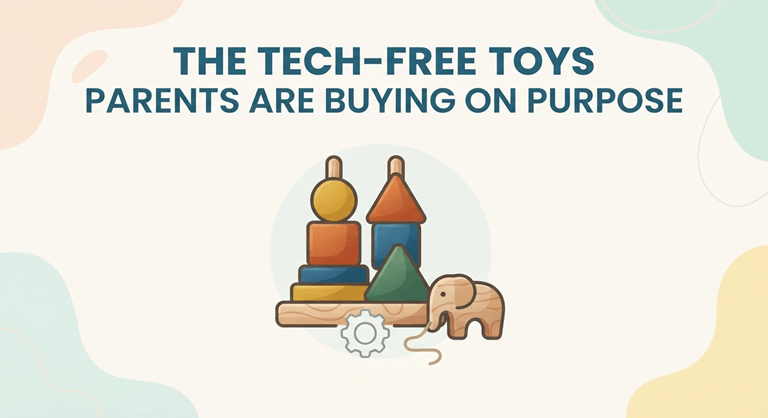
The Tech-Free Toys Smart Parents Are Buying on Purpose
Every year brings a fresh wave of “smart” toys promising to teach coding, track development milestones, or sync with an app. Some of that innovation is genuinely useful.
However, there are more and more tech-savvy parents who are making conscious decisions to opt for simpler, screen-free toys for their children, a group comfortable with smart homes and wearables. The decision is not as nonchalant as it sounds.
The Screen-Time Math Doesn’t Add Up
Parents whose families work with or around technology are often more attuned to the problem of screen fatigue than most are, as they can relate to it firsthand. The awareness is influencing their decisions about their children.
A no-screen,no-app, pairing, no-charging-cable toy eliminates a whole class of ‘noise’ and overstimulation from play, and is a much more enjoyable experience! No more tech is now seen as a feature rather than the lack of it.
It is by no means an “anti-technology” attitude. A more intentional way to think about the value of and the need for the screen to add value versus noise.
Interactive Doesn’t Have to Mean Digital
In toy marketing, the term interactive has almost become synonymous with ‘screens’ and ‘apps’. However, there are some of the most truly interactive toys available that are based only on motors and sensors.
FurReal robotic pets respond to touch, sound, and motion using simple embedded technology, without ever requiring a screen, an app, or an internet connection to function. That’s a meaningfully different kind of “smart” than what most tech marketing implies.
That is important to parents who have a working knowledge of the distinction between engagement and stimulation. A screen-time friendly toy need not be a screen itself, but can be responsive and dynamic in ways that don’t increase overall screen-time.
Durability Gets a Different Kind of Scrutiny
Techy parents may have a product-review mentality when they go to the toy section of the store, carrying the same mentality with which they read spec sheets before purchasing a router or laptop.
It can be seen in their attention to build quality, durability of the materials, and whether or not a toy will last the test of time or fall apart within weeks. It’s just the same as you would do with any other purchase.
When parents with a penchant for technology are at the helm, toys that are truly constructed to stand up to anything will gain repeat sales and greater word-of-mouth in the same communities.
Sensory Toys Fill a Gap Screens Can’t
After a bit of screen time, there is a certain type of energy that children feel that a lot of parents have come to understand and make efforts to subdue. “Hands-on toys” are a solution that has come to be the standard.
Needoh’s fidget toys offer exactly the kind of grounding, low-stimulation engagement that helps kids transition out of screen time without a meltdown, giving restless hands something satisfying to do instead.
Increasingly, parents who set rules around screen time have one of these in their home just for that transition time – not just a toy or a game in the toy box.
Data-Driven Parenting Meets Its Limits
Tech-savvy parents are typically at ease watching theirkids’s sleep and feeding habits, and also milestones using apps and wearables. But that drive for data that can be measured doesn’t always transfer easily to the game.
Unstructured, open-ended play refuses to be measured, quantified, and predictable, unlike other aspects of parenting. No interactive dashboard to offer imaginative play, and more and more, this is considered a feature instead of a missing element.
Others, again, some of the same parents, will consciously decide not to instrument playtime and will want to leave it analog and untracked among the few remaining spaces that do not need the current state of technology.
Word of Mouth Still Beats Algorithms
Even as they’ve been using and working with recommendation engines and personalized ads throughout the day, many tech-savvy parents report that they have been able to buy the best toys from their fellow mothers or fathers, rather than from a targeted ad or a trendy list.
The sentiment is not unique, however, to algorithmic recommendations for their own children, even among those who work professionally on creating or using algorithms for others.
What’s interesting to note about this particular category is that targeted ads are not the top-performing channel of communication compared to parent forums, group chats, or direct recommendations—trust and the real capabilities of technology are at play.
The Irony of Tech Parents Going Low-Tech
The most digitally savvy parents leading the way to digital-free play are somewhat ironic. But it does make sense when you realize that it’s the ones who know the pros and cons best that will be making the decisions.
Those who create and utilize technology on a regular basis are often the ones who can see through the limitations of technology, as they see how engagement-driven design works firsthand. In that view, they’re not about to let just anything tech get into their children’s hands.
The result is a countertrend that goes on under the smart-toy hype, one of the most technologized homes is one that is most on purpose being un-tech at play times.
What This Means for Toy Shopping Going Forward
This doesn’t mean that smart toys are in any way negative or that screen-free toys are automatically positive. It’s an increasing sense of intentionality all around.
When parents are considering a new toy, they are more likely to question, and question more intensely, what this is going to do, what exactly it is replacing, and whether the technology it has is really helping solve a problem, or is it just added complexity.
This kind of attention is a healthy one on the whole for the toy industry. It’s the smart and simple toys that are using their design to better explain what they do, rather than relying on buzzwords.
The parents spearheading this change are not technology’s critics, but rather its advocates. They are using the critical thinking skills they use when making any decision about a product in their life when making the decision on a toy bin.
This is probably the most technologically sophisticated way of all, when the smartest thing to do is to do without a chip.
Sometimes it’s the most sophisticated decision that a parent can make: shutting it out entirely.
It’s not to say that there’s no advancement in the world. It’s not to deny advancement in the world. A more grown-up attitude towards it, one that could be emulated by many other industries.
The most suitable toy in the box at the moment could be the one that doesn’t require any charging.
No firmware upgrade and no “dead battery” at the wrong time, it’s a reliable thing that does exactly what it is supposed to do and does it the same way every time.
Popular on OTW Right Now!



About The Author

Gagan Bhangu
Founder of otechworld.com and managing editor. He is a tech geek, web-developer, and blogger. He holds a master's degree in computer applications and making money online since 2015.