
How Indentation Plastometry Software Builds Stress-Strain Curves
Indentation plastometry software interprets a stress-strain curve through an inverse analysis. It receives the load-displacement data obtained when a hard indenter is pressed into a metal sample, contrasts this measured profile with a finite element model of the same indentation, and modifies the hypothetical material properties until the simulation corresponds to the actual situation. The result is a complete true stress-strain curve, the very kind you would obtain from a destructive tensile test.
What enables this is that an indentation is not a point measurement. While the indenter goes deeper, the material around it goes through a very large variety of strains, from almost zero at the edges of the contact to a very large plastic deformation right under the tip. That variety in strain states, all documented in one continuous loading curve, brings the right amount of information to deduce a metal’s hardening as it is deformed. The software’s role is to decipher it.
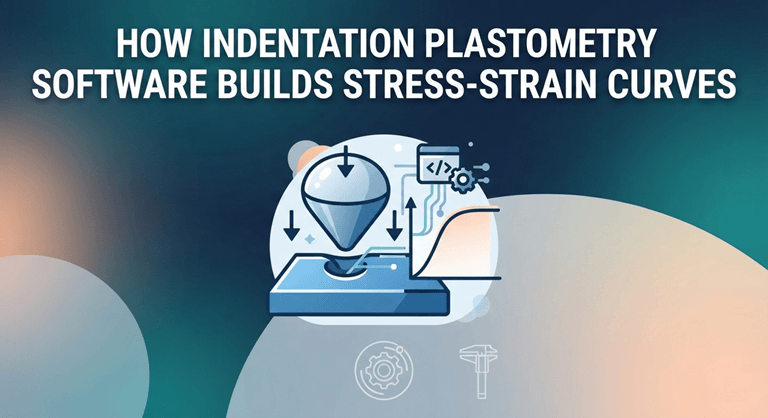
What the inverse analysis actually does
The key part of the method is treating it as a search problem. The software starts by picking a constitutive law that depicts how the flow stress of metal increases with plastic strain, commonly a relation like Voce or Ludwik-Hollomon with two or three parameters to fit. Then, it performs a finite element simulation of the indentation as per the trial set of parameters and forecasts what the load-displacement curve should be.
It is very rare for this predicted curve to correspond with the experimental one immediately. That’s why the software quantifies the difference, adjusts the parameters, and carries out the simulation once more. This cycle is repeated, usually multiple times, until the predicted and measured curves are very close to each other. The parameter combination giving the best fit is considered the accurate characterization of the material, and the software uses it to plot the stress-strain curve directly.
The ingenious part is the approach to solving the problem. Executing a full finite element model at each iteration would be very time-consuming. That means, advanced systems resort to response surfaces, pre-computed simulation databases, or surrogate models that effectively mimic the FEM output and enable the search to complete in seconds rather than hours. Without that, the method would be too slow for regular use on a factory floor or in a busy laboratory.
Why does one indentation contain a whole curve?
A tensile test brings you a stress-strain curve as you are basically stretching a bar until its length changes, and you observe how the force varies. Then again, an indentation appears much simpler and less precise, like just a dent made by a knuckle, but the underlying force explaining the physics is actually more complex. Materials directly below the indenter are experiencing different types of deformation. You get less strain at the surface, whereas the material right under the tip can be plastically strained by 20 to 30 percent or more, given how deep and what shape of indenter is used.
Since the loading curve keeps track of the force-depth relationship, it is as if all those levels of strain had been sampled simultaneously. A material that work-hardens sharply will be quite challenging to penetrate by an indenter than the one that hardly hardens, and through such a difference, one can tell from the load-displacement curves. The program interprets the curve and deduces the changes in strength that lead to such a curve. Based on this principle, even a single profilometry measurement of a residual indent, plus the load data, can replace a full mechanical test.
What the software needs to get a reliable answer
Garbage in, garbage out is true here as much as anywhere else. The inverse analysis relies on correct inputs, and the first one is the indenter geometry. Most systems use a spherical or almost spherical tip, usually tungsten carbide, with a known radius of one or a few millimetres. The software calls for the exact radius and the elastic properties of that indenter to be able to model the contact properly.
Also, the elastic modulus of the sample is required. Indentation is a great way to observe plastic behaviour. But the elastic component has to be given or determined separately because the unloading slope on its own is not a very reliable way to identify the elastic component for this purpose. Sample preparation is important as well. If the surface is fairly flat, well-polished, and not contaminated by work-hardened layers due to grinding, it will produce more accurate data, and the software generally anticipates that the residual indent profile should be measured by an integrated profilometer so that it is able to cross-reference the predicted dent shape with the actual one. That second verification, comparing the real crater geometry rather than just the loading curve, is what allows the accuracy of present systems to be within a few percentage points of tensile results for a wide variety of alloys.
Where this approach earns its place
The practical appeal is speed and access. A conventional tensile test needs a machined dogbone specimen, which means you need enough material to make one and the time to prepare it. Plastometry needs only a small flat region, sometimes on the actual component rather than a cut-out coupon, and a test takes minutes. For failure investigations, weld assessments, or checking the properties of a part already in service, that difference is the whole point.
This is also where portability becomes relevant. Bench systems are excellent for lab work, but a lot of the most useful applications happen out in the field, on a pipeline, a pressure vessel, or a large casting that cannot be moved. A device like this portable machine brings the same indentation-and-inverse-analysis workflow to the structure itself, with the software running the optimisation on a connected laptop or tablet and returning a curve on the spot. The metallurgist gets yield strength, ultimate tensile strength, and the full hardening curve without ever sending a sample away.
Different users lean on the technique differently. A quality engineer in a steel plant might value the throughput, running many tests per shift to verify incoming stock. A researcher characterising a new aluminium alloy cares more about the resolution of the hardening curve at low strains. An integrity inspector on an offshore platform mostly wants a trustworthy yield value from a weld without grinding a coupon out of a load-bearing joint. The same software serves all three, but each weighs its strengths differently.
How accurate are the curves really
Everybody wants to know about accuracy, and the real answer will be different based on the kind of material and how much attention is given to it. Well-behaved structural metals, for instance, have been researched and cross-validated with tensile test results to generally yield agreement between tensile data within about five to ten percent for main parameters such as yield and tensile strength, which is sufficiently accurate for most engineering decision-making. Extremely anisotropic materials, very soft metals, or metals with different hardening behaviour are more difficult, and a skilled operator is aware of when the presumed constitutive equation may not be appropriate.
With the support of the software, a user would get notified of poor convergence. If no set of parameters leads to a clean match between the predicted and measured profiles, this is an indication that the model assumptions are getting pushed to the limit, and the result should be considered at best only with caution, not with unconditional trust.
If you are comparing this with tensile testing, then the real criterion is hardly accuracy alone. It is about whether you can afford the loss of material, the speed at which you want to have the results, and also whether the object you want to test is even capable of being put into a loading frame. Once you put it in this way, the matter ceases to be which method is more correct, but rather which one is most suitable for the job at hand.
Popular on OTW Right Now!



About The Author

Gagan Bhangu
Founder of otechworld.com and managing editor. He is a tech geek, web-developer, and blogger. He holds a master's degree in computer applications and making money online since 2015.