
Understanding Mobile Crushers and Mobile Crusher Plants: A Complete Guide
Introduction
In the construction, mining, and recycling fields, it is evident that the pieces of equipment that are doing the bulk of the work are very efficient. In these sectors, what you will find are the primary players that are used in the process of turning raw materials into usable products. Out of that group, the crushing machines stand out as the most valued; they break down large stones, concrete, and other hard materials into more useful dimensions. As projects grow in scale and location becomes a greater issue, portable crushing solutions are growing in value as they provide the needed flexibility, efficiency, and ease of transport.
Today, it is evident that a type of crushing technology has grown to fit the needs of contractors who work in remote sites, on temporary projects, and in urban environments, which are better with mobile equipment. Also, instead of shipping raw materials in from great distances, many companies are using mobile equipment that goes straight to the worksite, which in turn reduces transport costs and improves overall productivity.
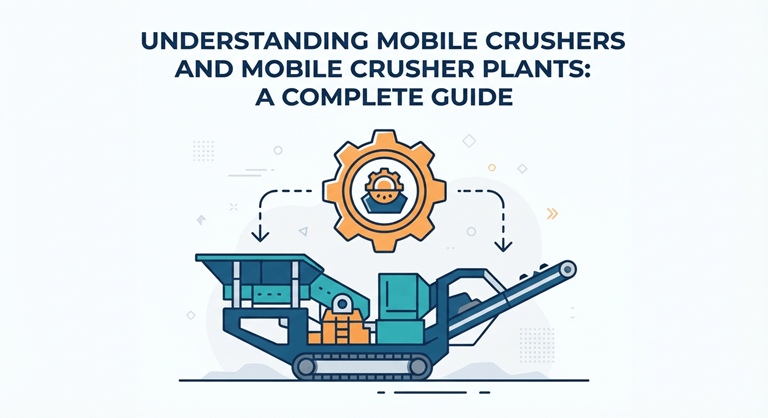
What Is a Mobile Crusher?
A mobile crusher is a transportable machine that processes many materials at the site of use in construction, mining, demolition, and recycling. Stationary systems, which have to be permanently installed at the site, are different from mobile units, which are installed on tracks or wheels for easy relocation.
These are designed to process a wide range of materials, which include natural stone, limestone, granite, basalt, concrete debris, asphalt, and construction waste. Jaw, impact, or cone crushing systems are used based on the requirements of the application.
These machines’ portability is a great asset for projects that see their crushing requirements change very often or that have material sources at many different locations.
Understanding a Mobile Crusher Plant
A mobile crusher plant is a full-scale portable crushing system that puts together many components into one unit. Instead of a single crusher, it usually has a set that includes feeders, conveyors, screens, and breakers that work as a unit to produce efficient output.
This integrated design features a continuous material process from feed through to final screening, which is without the need for extensive infrastructure. It is also evident that, based on project requirements, different configurations are available that produce aggregates of varying sizes.
Because every project has unique material characteristics and production goals, mobile crusher plants are available in several configurations designed to maximize efficiency for specific applications.
Main Components of a Mobile Crushing System
A mobile crushing plant is made up of a number of key elements that work together for smooth operation.
Feeding Unit
The feeder is what regulates what goes into the crusher. Consistent feed, which in turn improves productivity and, at the same time, reduces wear and tear of the crushing components.
Primary Crusher
A primary crusher is what is used for the first stage of size reduction of large rocks and demolition materials. Jaw crushers, which are very common at this stage of the process, are used for their ability to handle hard and large-sized materials.
Secondary Crushing Equipment
In the case of projects that require fine aggregate, secondary crushers like cone and impact crushers are used to reduce the material to the required specifications.
Screening Equipment
Screens that separate out different-sized materials. Large material goes back in for more crushing; smaller material is sorted for use in different applications.
Conveyor Belts
Conveyor systems, which transport materials through the various stages of the crushing process, in turn reduce manual handling and also maintain a steady production flow.
Common Applications
Mobile crushing plants serve many industries because of their flexibility and adaptability.
Construction Projects
Construction firms use mobile crushers for the processing of stone and aggregate in roads, bridges, and residential and commercial development projects. On-site crushing also, which in turn reduces transport costs and project delays.
Mining Operations
Mining sites report using mobile crushing equipment, which, as the excavation advances, is movable. Also, it is evident which systems are of a mobile nature and thus do not require being broken down at each change of work area.
Demolition Work
Old buildings generate large volumes of concrete, bricks, and asphalt. Mobile crushers enable contractors to recycle these materials into reusable aggregates instead of sending them to landfills.
Road Construction
Road projects often use a great deal of crushed stone in varying sizes. Mobile crushing equipment, which is located near the construction site, produces the aggregate, thus guaranteeing a steady supply.
Recycling Facilities
Concrete, asphalt, and various construction wastes may be used as resources for which there is demand in future infrastructure projects, also supporting what is known as sustainability.
Advantages of Mobile Crushing Equipment
- Mobile crushing equipment also has the benefit of flexibility, which is a major plus point. It is evident that the machinery may be put at the project location, and as a result, companies are able to avoid the costs related to the haulage of raw materials to fixed plants.
- Another key benefit is that of time, which is saved in the setup process. It is evident that they have a great advantage over static structures that have very large foundations to put in during the installation stage; instead, what is noted is that mobile systems can be up and running at a much greater speed.
- Mobility of equipment and personnel allows contractors to respond to changes in project requirements. It is evident that as production needs change, which in turn may put a different worksite in play, the ability to move equipment as needed is key.
- Integrated solutions that combine feeding, crushing, screening, and conveying into a single coordinated unit. This, in turn, increases productivity and, at the same time, reduces material handling.
- Today’s machines are also designed with the safety of the operator in mind, which includes enclosed control systems, emergency stop features, and automated monitoring technologies.
Factors to Consider Before Choosing Equipment
Before choosing crushing equipment, several factors should be considered:
- Material hardness is a key factor in determining which crushing process is the most appropriate. Different equipment may be required for hard rock as opposed to recycled concrete or softer materials.
- Production capacity should be in line with what is expected for the project. Production bottlenecks may be observed with equipment that is too small, which also may result in higher-than-necessary operating costs for oversized machines.
- Mobility issues also need to be looked at. Some projects do better with tracked vehicles, which perform well on rough terrain, and it is also evident that wheeled units do best in areas that are paved.
- Fuel performance, maintenance access, spare parts supply, and ease of transport are also things to note in terms of long-term performance.
Maintenance Practices
Proper care increases equipment life and the stability of production.
- Operators must check wear parts often, which include jaw plates, impact bars, liners, and conveyor belts. Timely replacement of these parts, which also helps in the prevention of unexpected downtime and protection of other machine components.
- Lubrication of equipment should be done as per the manufacturer’s recommendations to reduce friction and wear.
- Routine maintenance, which removes built-up dust and debris that in turn affects cooling systems or moving parts.
- Hydraulic components, electrical connections, and safety devices also should be checked at regular intervals to ensure reliable operation.
- Keeping a thorough record of maintenance issues allows operators to identify trends, which in turn prevent larger problems.
Environmental Considerations
Today, many of the modern crushing plants are fitted with features that do so to reduce their environmental impact. Dust suppression systems are evident, which improve air quality in the immediate work area, and noise reduction technologies, which in turn minimize disturbance in nearby communities.
Recycling of construction materials with the use of portable crushing equipment also supports resource conservation, which in turn reduces the need for new aggregate quarrying. Also, this approach decreases landfill waste and promotes more sustainable construction practices.
Conclusion
Portable technology in material processing has revolutionized what is observed in the construction, mining, demolition, and recycling fields. These are systems that combine to give mobility, efficient handling, and flexible design, which in turn helps to meet the needs of every project that requires something that is mobile and, at the same time, produces consistent results.
Understanding the roles, makeup, applications, and maintenance issues of a mobile crusher, which in turn better supports equipment selection for each set of operational requirements. Also, it is evident that in the case of mobile crusher plants, which bring together many process stages, it is beneficial to familiarize oneself with this, and that is also the reason that these systems have become such a key element in today’s material processing in very many industries.
Popular on OTW Right Now!




About The Author

Gagan Bhangu
Founder of otechworld.com and managing editor. He is a tech geek, web-developer, and blogger. He holds a master's degree in computer applications and making money online since 2015.