
How to Hire Quantum Computing Developers in a Market with Extremely Limited Talent
The race to quantum advantage is on, and the companies that get there first will not be the ones with the biggest budgets, but the ones with the right people. Yet, the moment most tech leaders sit down to hire quantum computing developers, they run headfirst into a wall. The world is lacking professionals who can really grasp the concepts of quantum gates, superposition, entanglement, and error correction, and who can bring them into a working program. This wasn’t something that traditional hiring pipelines were designed for. Noise is returned by job boards. Recruiters draw blanks. In the quantum race, time is aliability’s bane.
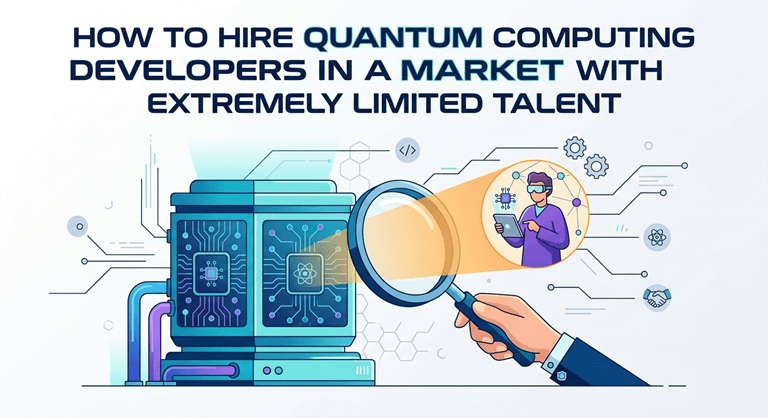
You don’t just need to find quantum computing developers to hire; you need to find the right quantum computing developers. You don’t want someone who has played around with Qiskit or even taken an online course. That requires people who are familiar with the framework that you use, like Cirq, PennyLane, or Q#, and who can understand how quantum and classical systems work together, as well as how to deal with the constraints of current NISQ-era hardware. The mix of academic rigour and engineering experience is a big constraint on the number of candidates. If you’re only looking for something within a particular region, you can wait for months without any confidence of a successful outcome.
This is precisely where a smarter approach to hiring becomes not just useful, but necessary. To hire quantum computing developers effectively in today’s market, tech startups and scale-ups need access to a broader, deeper talent network, one that has already done the hard work of identifying, vetting, and organizing rare expertise at scale.
Why the Traditional Hiring Model Fails Here
Quantum Computing is an area of physics, math,s and computer science. The majority of the people who go into this field are PhD post-docs or nationals from a research setting who have been in the academic environment for several years prior to entering the industry. Their career history is not what most ATS software can assess, and it doesn’t look like a traditional software engineer’s resume.
Credentials are not the only thing changing at a rapid pace. The latest advances in quantum error correction could be out of date in two years. A good developer in this area should be involved with the actual field, rather than being educated in the basics only. Assessors other than keyword-matching algorithms must understand the currency of knowledge, in this case, quantum computing.
Conventional hiring also has a slow pace. The entire process of posting a role, waiting for the applications, screening, interviewing, and negotiating can take as long as 3 to 4 months for a senior technical hire. If it’s a quantum computing job, then add some more time for the shortage. It takes about the time it takes a startup to close one hire for a competitor to ship a prototype. It takes about the time it takes a startup to hire one person for a competitor to ship a prototype.
The Case for Expanding Your Talent Search to India
But India’s quantum revolution is advancing faster than most hiring managers in the West are aware of. There are several institutions, such as IISc, IIT Bombay, IIT Madras, and TIFR, that have good quantum research programs, and their graduates are now entering the developer market having been trained in theoretical rigor and hands-on practice. The government of India’s NBWN has committed to a multi-year investment in this area, and it is also being sped up by a pipeline of skilled professionals in this field through its government-backed National Quantum Mission.
This translates to a lot of practitioners in India who have world-class capabilities for quantum computing development but are much more available in terms of availability, hiring timelines, and price. This is a structural benefit in the case of a tech startup, and that’s to say most tech startups, that most of the time it’s right under your nose.
Where Uplers Comes In
Uplers is an Indian AI hiring platform that has developed an AI-powered talent pool of 3.5M+ professionals in technology sectors ranging across emerging and deep-tech, such as quantum computing. Instead of leaving a job open and hoping for the right fit to apply, Uplers actively searches for vetted talent by AI and Human Intelligence and ensures that the candidates who work their way to you actually have the right skills, experience, and are job-ready.
This is NOT a passive database! The Uplers talent network is constantly replenished and aligned to the frameworks of skill signals from the real world, projects delivered, depth of domain knowledge,ge etc. Uplers’ approach to matching a quantum computing developer to a project favors depth over breadth.
Uplers’ top 1% talents are professionals who have passed through a series of formal technical evaluations, communication tests, and role-fits. In a field as niche as quantum computing, it makes a huge difference. No more hassle of sifting through hundreds of irrelevant profiles. You are about to meet a short list of developers that you are sure to hire.
Speed, Savings, and the Right Fit
A consistent challenge for most tech startups that hire in niche fields is the price of hiring, as well as the cost of the search. The costs of recruiting, extended vacancy times, and the hiring of the wrong person all add up rapidly. Uplers solves this on both sides: faster time to hire with an intelligent matching engine, and a drastically reduced cost to hire compared to what it can be in the US, UK, or European markets, but with no compromise on quality.
Uplers’ Quantum Computing Developer(s) are integrated into your team remotely, offer full-time commitment, and are available with flexibility in time zone to fit your working hours. The engagement model is simple, legally sound,d and helps to minimize the speed bump of the cross-border hire.
The Quantum Window Is Narrow
Quantum computing is progressing through theory into the commercial world quicker than most anticipated. Companies in pharmaceuticals, logistics, financial modeling, and cryptography are already creating quantum-ready development teams, and this trend will likely continue to grow across other sectors. It’s not going to be the miracle of the moment, but companies in industries like pharmaceuticals, logistics, financial modeling, and cryptography are already building quantum-ready teams, and others will follow suit. There isn’t an open window that will last forever for getting the talent that will give you a first-mover advantage.
It isn’t just money that you are going to lose if you wait for the right one to come to you in your area. Uplers’ smarter path is access to the finest quantum computing developer talent in India, rigorously vetted to an exceptional standard, matched to pinpoint, onboarded at pace.
The talent exists. The platform to find it is here. The only question is whether you move before your competitors do.
Popular on OTW Right Now!




About The Author

Gagan Bhangu
Founder of otechworld.com and managing editor. He is a tech geek, web-developer, and blogger. He holds a master's degree in computer applications and making money online since 2015.