
How First-Time Investors Spot Profitable Real Estate Deals Remotely
In order to evaluate cash flow and resale potential without even the need to visit a property, first-time investors can identify profitable real estate deals from a distance by integrating online listing data, neighborhood analytics, and virtual property tours. Most of the work is done in spreadsheets and on screens: you filter markets, calculate numbers, check property condition through local contacts, and only invest capital if the deal is profitable. Distance completely ceases to be a disadvantage when you come to trust your process more than your instincts.
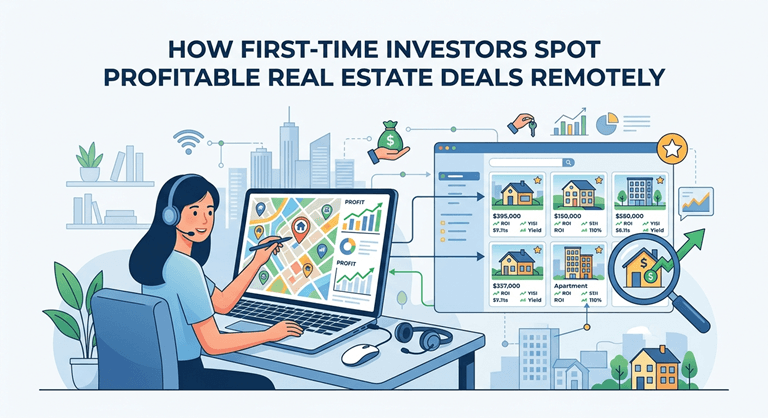
The monumental change is the quantity and quality of information that is now openly accessible. You can obtain comparable sales, rent estimates, school ratings, crime statistics, and days-on-market data for pretty much any zip code in the country without making a phone call. Investors who succeed from a distance are no more fortunate than those buying in their neighborhood. They simply developed a consistent screening method and adhered to it.
What Makes a Deal “Profitable” Before You Buy
Any good deal is one where the numbers fit right at the time of purchase, rather than one where you are banking on the price going up later. When it comes to a rental property, that usually means after paying for the mortgage, taxes, insurance, vacancy allowance, and maintenance reserve, the rent should still cover the expenses quite a bit. The very basic measure called the 1% rule says that the house should be yielding rent that is 1% of the purchase price every month, although in expensive areas such as coastal markets, that figure will be more like 0.6%, and investors will rely on the price increase instead.
Capitalization rate is another angle to look at, taken even before investing, to understand the market. It is calculated by dividing the property’s annual net operating income by the purchase price, and usually, the investors who hold on to their properties and keep renting them out are going for something around 6% to 8%, according to the market risk and growth profile. However, flippers think with the 70% rule, per which they pay a maximum of 70% of the after-repair value minus the renovation costs. Of course, none of these formulas is ruled as absolute. They are just safety measures that keep you from convincing yourself that a bad number is good.
In fact, these computations are done remotely mainly because they are completely location-agnostic. It does not matter at all how far the house is, whether two miles or two thousand. When you have rent comps, guess of expenses, and a renovation amount, the deal either meets your criteria or it does not.
Reading a Market From Your Laptop
You know, finding the right area to invest in is way more important than finding the perfect house. Most of this research is just working at the computer, reading reports, etc. You want to find areas where population is increasing, employment opportunities are diversified, and rents are rising faster than they are stagnating. Sunbelt cities in Texas, Florida, the Carolinas, as well as some Midwestern areas have had a vein for these very reasons, attracting investors from the opposite coast looking to purchase single-family properties at a price that is A lot less than a similar property would cost in California or the Northeast.
If you look closely at the factors that predict high tenant demand, you wouldn’t be surprised at the results. For instance, median household income is a direct reflection of the rental market supported by the area. Big names on the employment announcement boards mean more people moving to the area. Days on the market and percentage of price reductions give away whether the sellers or the buyers have the upper hand. This is the reason remote buyers, who can negotiate the price down, mostly when listings are hanging around and price cuts(this means the percentage of price reductions), have the space to find the margin. The kind of property you invest in also dictates how you go about investing. A single-family home in a fairly stable suburb will be a totally different and less risky investment than a small multifamily building in a neighborhood that is going through changes, and a short-term rental in the vicinity of a tourist area is governed by its own seasonal logic.
It is proven that the best results for first-time investors are single-family or duplex properties in B neighborhoods, where tenants are dependable, maintenance is foreseeable, and financing is the least complicated.
Verifying Condition When You Can’t Walk the Property
Understandably, this is the part that gives most new buyers the jitters, and rightly so. Pictures can be deceptive, or at least overly flattering. The solution is to assemble a small support team before you submit an offer: a buyer’s agent who specializes in helping investors, a property inspector, and, if possible, a contractor who can walk through the property on video and give you a renovation estimate while you watch. A live video walkthrough is worth far more than a listing gallery. You direct it. You ask them to open the electrical panel, run the faucets, point the camera at the roofline and the foundation, and check for water staining in the basement.
But, a standard home inspection, which costs between $300 and $600, is still non-negotiable as it reveals those major issues that only a few thousand bucks fix: failing HVAC, outdated wiring, a roof that is quite old, etc.
Learning how seasoned operators structure these remote teams shortens the curve considerably, and people like Mark Evans have built entire businesses around buying property in markets they don’t physically live in. The lesson worth borrowing is that your local people are your eyes, and vetting them carefully is the single highest-leverage thing you do. One trustworthy contractor and one honest agent in a market can let you operate there for years.
The Numbers and Documents That Confirm a Deal
After a property passes your initial instinctive check, the verification becomes very methodical. For a rental property, you ask the seller for the actual expense history and not their forecasts: real tax bills, insurance quotes in your name, utility costs, and HOA fees (if any). Usually, sellers and listing agents show the best side of operating costs, so you leave the expense column last out of third-party sources.
In unfamiliar markets, insurance is mainly worth your consideration. For example, a coastal Florida property may come with windstorm and flood insurance that greatly reduces your cash flow without your knowledge, whereas a purchase of a similar amount in Ohio will be very cheap to insure. Before you completely fall in love with the headline rent, get a real quote. Just as wildly, property taxes can differ, and some states reassess upon sale, which means the seller’s tax figure is not what you will be paying.
Title work and a clean closing are the safeguards of everything else. A trustworthy title company conducts the lien search, verifies the ownership, and arranges the remote closing through a notary or an online platform, the latter being standard now in most states. According to data from the industry, remote and digital closings have become so normal since the pandemic caused a sudden increase in their usage that you probably will not have to fly anywhere to sign.
How the Approach Differs by Budget and Goal
A 50,000 dollar rental in a blue-collar neighborhood and a 400,000 dollar investment in a growth suburb are different sports, even if the screening process rhymes. Lower-cost investments show higher rent-to-price ratios on paper but have more tenant turnover, more deferred maintenance, and fewer margins for error. The inverse is true for higher-cost investments; cash flow is lower, but tenants stay longer, and prices rise faster. Your goal twists the game even more. You are chasing monthly income.
You want a high cap rate and cash flow now. That makes you seek out the Midwest and the South. You are willing to settle for lower current returns if they lead to stronger long-term appreciation. That often means choosing a property barely breaking even now in a market with real upside.
Neither is wrong. They are simply answering different questions, and knowing which one you are asking is how you avoid buying the wrong home in the right market. The financing tiers are important as well. Conventional investors usually require a 20 to 25% downpayment for an investment property, with seasoned investors later adding in portfolio lenders, hard money lenders for flips, and regular refinancing structures that still allow recycling the capital.
Popular on OTW Right Now!




About The Author

Gagan Bhangu
Founder of otechworld.com and managing editor. He is a tech geek, web-developer, and blogger. He holds a master's degree in computer applications and making money online since 2015.