
Making Faceless YouTube Videos With AI Video Generators
Basically, you create faceless YouTube videos with AI video generators by writing a script, or generating one, then making it into a voiceover, and finally combining that audio with stock footage, generated visuals, or an AI avatar, all without the need to show yourself on camera at any time. The software takes care of the things that traditionally required a studio: the narration, the visuals, the captions, and the editing. So, a single individual can create a finished, publishable video in less than an hour using a topic and a laptop as the only resources.
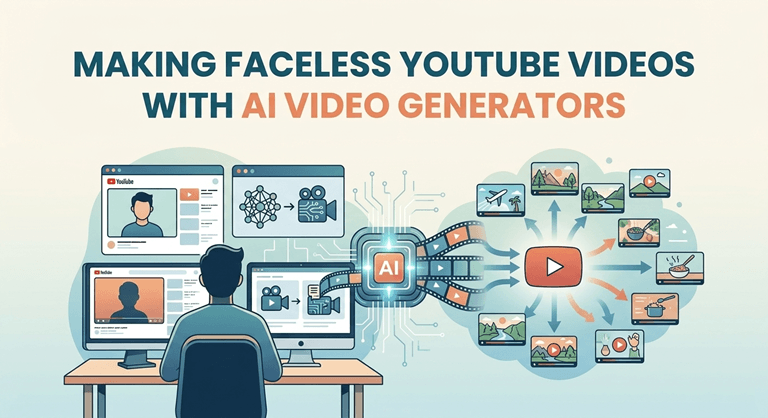
As such, the advantages cannot be disregarded for those who wish to create a channel without revealing their face due to privacy reasons, lack of confidence, or simply to scale up. In fact, faceless content is majorly dominating YouTube categories like explanatory and educational channels, meditation, finance breakdowns, and history, etc. AI tools drastically reduce production costs such that the real challenge comes from the quality of the script and topic selection, not the video-making skills or the camera presence willingness.
What you actually need to make a faceless video
The entire pipeline consists of four steps, and today, our AI tools are able to handle each one of them. The very first step is scripting, during which you may write the script yourself or generate it with an AI writer tool from a topic; just keep in mind that the script should be more engaging than a typical Wikipedia entry. The next step is the voiceover, where text-to-speech solutions can create narrations in various natural-sounding voices as well as different accents, which means that there is no longer any need to record one’s own voice.
After that, there are the visuals, and this is the area where faceless channels vary greatly. Based on the niche, one might use stock footage libraries, AI-generated images and video clips, screen recordings, or simple animated text. The last step is putting everything together, when a human editor or an all-in-one AI video solution matches the visuals to the voiceover, puts captions, and exports in the desired format. The tools that integrate all these stages allow going from the script to the final video in a single place, which is why a solo creator can realistically produce several videos per week.
A bare-bones setup will hardly cost you anything. A text-to-speech subscription, a stock or AI visual source, and an editing tool altogether may range from free tiers to a maximum of roughly fifty dollars per month, which is really less than what a paid channel needs for camera and lighting gear. The real investment is the time and regularity rather than the equipment.
How to pick visuals that don’t look generic
The major pitfall of using faceless video is the problem of too much similarity, where everyone is using the same stock video clips and robotic voice to such an extent that they all look the same in the end. The way to escape this problem is the way you make the video visually. Stock footage is suitable for some topics, but if you use it a lot, people will be able to tell it has been used, so the better channels change it up by using different kinds of images in one video, between stock video, AI-generated images, hand-drawn graphics, and screen captures.
AI-generated images are so good now that they can present you with pictures that a stock library does not have, so it makes a channel seem different from others. For a channel on history, generated period scenes; finance, custom charts and animated explainers; meditation, original calming visuals instead of the same loops that everyone uses. The voiceover is as important since a flat synthetic voice will raise the suspicion that the work was not of high quality, while the advanced text-to-speech programs can now produce narration with natural pacing and emphasis that most viewers do not realize is AI.
Timing is the unspoken factor in differentiation. Faceless videos will live or die based on whether images change frequently enough to keep attention, since a presenter’s energy without speaking is not there to carry the video. Market research data on the length of watching consistently shows that a single image used for a long time causes viewer drop-off, and because of this, the best tactic is to make the change of visuals quick and always aligned with the voice-over so that the audience stays watching.
What it costs and how long it takes per video
The economic aspect is what really makes the faceless channels very appealing as a secondary hobby, even as a business. A set workflow can get you making a single 8 to 10-minute video within 1 to 3 hours maximum,m most of which is scripting and reviewing rather than technical work. Compare that to a facing creator who has to set up film and edit, and the faceless route is drastically faster to scale.
The per-video cost in tools is small, often a few dollars in credits once spread across a subscription, which means the model works even before a channel earns much. That low cost is what lets creators publish the volume of YouTube rewards, since the algorithm favors consistent upload, ers and a faceless workflow makes three videos a week achievable solo. Creators who want short promotional cuts or ad versions of their content sometimes use a tool like Creatify’s video ad tool to repurpose a long video into a punchy clip for other platforms, extending one piece of work across more channels.
The honest catch is that low production cost means low barrier to entry, so the niches with easy AI content are crowded. Standing out requires a genuinely good script, a useful angle, or a niche others haven’t saturated, none of which a tool provides. The production is cheap; the thinking still isn’t.
How the approach differs by niche and goal
The appropriate setup really depends on what you are making and for what purpose. An educational or explainer channel usually relies on clear narration and explanatory graphics, meaning the quality of the script is the key factor, while flashy visuals are less important. A finance, news, or commentary channel needs up-to-date scripts and simple supporting visuals,uals and so gives more priority to upload speed rather than production quality. A relaxation or ambient channel But is mostly about visuals and audio with very little script, i.e., the soothing images and sound design are where the whole content is carried from.
Your aim will also determine how much you invest. A person aiming at creating a channel as a serious business should spend more on unique visuals and better voices because they will be competing for quality over the long term. A person who is just experimenting with the model or running a side project can start on free tiers and will only upgrade when the channel gains popularity. Monetizing is definitely a factor here, as YouTube has recently really toughened their policies on low-effort, mass-produced content, and channels that merely concatenate generic AI clips without any added value risk demonetization, whereas channels that provide actual research, original scripts, or real insights are kept safe.
Language and location factors create opportunities. One can make faceless content in less-saturated languages, or localize a successful format into other languages with AI voices, to reach audiences with less competition than in the very crowded English-language niches. A creator who is willing to serve an underserved language market usually has fewer difficulties in growth than one who is trying to get attention in the most heavily contested categories.
Popular on OTW Right Now!


About The Author

Gagan Bhangu
Founder of otechworld.com and managing editor. He is a tech geek, web-developer, and blogger. He holds a master's degree in computer applications and making money online since 2015.