
LLM Optimisation Explained for People Who Run Businesses, Sell Online, or Manage IT
Artificial intelligence is changing the way people find information online. For more than twenty years, businesses focused on traditional search engine optimization to improve visibility on Google and other search platforms. Today, a new shift is taking place. Millions of people are turning to large language models, often called LLMs, such as ChatGPT, Gemini, Claude, and Perplexity, to get answers, research products, compare services, and make buying decisions.
This shift is a big concern for business owners, online retailers, and IT professionals: how can a company ensure it is included in AI-generated responses? The solution, however, is an emerging technique called LLM optimization. It’s a technical term, but the idea is quite simple. Optimizing for LLM involves training AI systems to more easily understand the content, services, expertise, and products of a business so that it can accurately cite them and suggest them to users when they pose relevant questions.
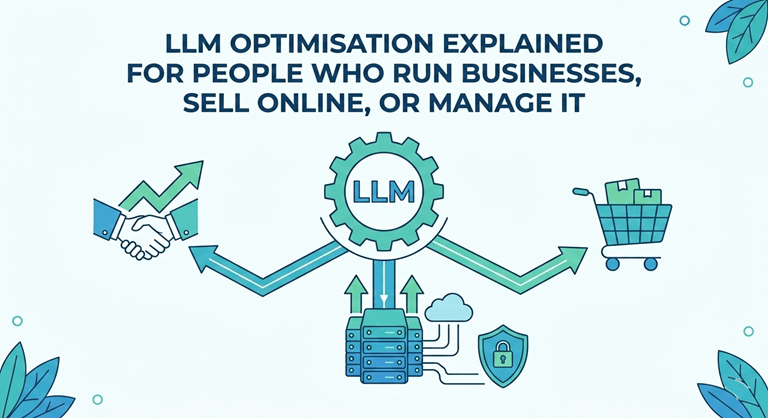
Large language models assess information differently than traditional search engines, which are based on keywords and links and rank pages accordingly. They seek out credible sources, relevant information, organization, and authority. As AI-driven search becomes the norm, companies that embrace it on the front lines will undoubtedly reap rewards. The knowledge of these systems is no longer only a marketing issue. It is an essential business tactic, and it impacts both visibility and the acquisition of customers, as well as a company’s growth.
Why LLM Optimization Matters More Than Traditional SEO Alone
For a long time, the website ranking on search engine results pages has been a metric for gauging success online. Those rankings still do matter, but customers are evolving. Users no longer type in a brief keyword into a search engine but are now asking in-depth questions. They could query an AI bot for the optimal software for addressing a particular problem, the most trustworthy vendor for a certain product, or suggestions for services in a particular sector.
The answers given by an AI system will usually be a summary of information provided by several sources, so there will be no links to display. This puts a new spin on how businesses are portraying their information online. The content should be clear, precise, and easily understood by AI systems.
A company that shares all of the details about its products, educational material, customer success stories, and expert insights is more likely to be known as a trusted source. Those that use thin content or outdated information, or overly promotional language, might not be as easily recommended by an AI algorithm.
The effects go beyond the marketing departments. When prospects find the company via AI platforms, this is when sales teams can reap the rewards. Having the right information is easily accessible and makes a huge difference to the customer service team. IT leaders can optimize data structures and website performance to ensure AI systems can easily access and understand data. LLM optimisation is becoming a company-wide move, as opposed to a marketing initiative.
Many organizations are already beginning to adapt. According to Alykhan Kara, CEO, Appear, businesses should think of AI visibility as the next evolution of digital discovery.
I think what we are seeing is what we’ve seen in our experience: businesses that are putting a lot of effort into optimizing for the traditional, human-driven search ranking, but they are not putting that same effort into their website’s understanding by AI systems. At Appear, we have seen our clients being very successful in getting a lot of traffic, but not so much visibility in the results pages when searched through AI systems, and after doing some work to improve content structure, entity clarity,y and machine-readable information, we saw references in AI systems multiplying in a matter of months.
His comment above brings an important reality to light. It’s not a question of fooling the algorithms at all if you’re going to be successful at discovery in the era of AI. It’s about sharing knowledge in a way that is comprehensible to humans and computers.
What LLMs Look for When Understanding a Business
Large language models learn patterns from enormous amounts of information. When evaluating a business, they often look for consistency across multiple sources. If a company’s website, industry publications, customer reviews, social profiles, and expert mentions all reinforce the same message, the business appears more trustworthy and authoritative.
Hence, clear branding and accurate information are important. It is important for businesses to have a uniform system of product and service offerings, leadership bios, contact information, and knowledge displayed across all media. When the information presented to an AI system is conflicting, it can be more difficult to understand and be confident about.
The quality of the content is also a key factor. LLMs are more inclined to give in-depth explanations rather than superficial promotions. It is more trustworthy for a business that publishes guides that help, answer common questions,s and shows industry expertise. By doing so, the traditional SEO and AI visibility both gain, as it is about providing actual value.
When an organization has large numbers of employees, operational efficiency is a factor, too. Having well-structured systems and proper information can help businesses be better equipped to facilitate AI-powered discovery.
Kyle Bolton, Founder, CrewHR, believes the same principles that improve business operations also improve AI visibility.
What I learned while building CrewR applies to AI visibility as well: When your business information is clear and structured, people and AI can find the answers they need more quickly. Simplicity is a great competitive advantage.
His experience is a great lesson for business leaders. LLM optimization isn’t simply a content tactic. It is also an applied science that is concerned with developing reliable and accessible information.
The Role of IT Teams in AI Visibility
Marketing teams are typically responsible for creating content, but IT teams can have a significant role in optimizing content using LLMs. The accessibility of information within the website, structured data, accessibility, and technical architecture all impact the ease of access and interpretation of information by AI systems.
If a site is slow, has a poor navigation structure, or a poor page structure, it can become difficult for the search engines and AI models to pick up on. Content frameworks are well-organized, and a clean architecture is supported by IT teams, which helps AI systems to accurately comprehend business information.
Structured data is particularly important. This information can be used to recognise products, services, locations, reviews, authors, etc., which helps machines identify the same. If properly and correctly executed, structured data provides more signals that help with visibility across search engines and through AI-powered platforms.
Security and reliability are also important. AI systems are more inclined to cite trusted sources. Websites that are secure and regularly updated with content, and also offer precise details, enhance their credibility over time.
Product data quality is particularly vital to e-commerce companies. Customers are increasingly relying on AI tools to make more comparisons before buying a product or service. Completeness and accuracy of information are critical to businesses being in those dialogues.
This is something Nick Christou, Founder, Laptop-LCD-Screen.co.uk, understands well after years of building one of Europe’s largest dedicated laptop screen suppliers.
Over the years, we saw the difficulty in some customers finding the exact screen they needed, as product compatibility can be complex. Thiledad to us investing in better data structures, detailed specifications,s and custom tools that made the process easier, and resulted in increased customer satisfaction, improved search performance, and better conversions; with AI becoming more involved in product discovery, having accurate and extremely detailed product information will give a business a great advantage, as machines will be able to better understand the products being offered.
His experience highlights the impact that technical enhancements can have on visibility, customer experience, and business growth.
Preparing for the Future of AI Search
In a game-changing move that’s even bigger than the advent of search engines, the world is witnessing the emergence of large language models (LLMs). Organizations that are not thinking about the future implications of AI visibility are likely to be behind the curve, as other businesses start to make the necessary changes.
Thankfully, there are numerous practices that will also help to optimize the overall performance of the business, which are also found in LLM optimization. Regardless of the evolution in technology, these activities will continue to be useful investments in order to create helpful content, keep accurate information, and build authority in an industry.
Not all the businesses with the bigger marketing budget will make it to the top. Rather, it will be the organizations that are able to present knowledge in a clear and consistent way, structure and present information in an effective way, and establish trust relationships across multiple digital platforms.
LLM optimization should be a part of the overall digital marketing efforts of business owners. Online retailers should concentrate on making their products clear and educating customers. Technical foundations should be put in place to make it accessible and discoverable for IT leaders. All of these efforts combine to make the brand more visible on the search engines, whether they are traditional or AI-powered.
Conclusion
While LLM optimization might seem like a complex technical topic, at its core, it’s about optimizing your system’s performance with a focus on speed. It assists in AI systems knowing more about you, your services, and why your business is worthy of being known. The more people use AI assistants to find out information about products and services, or to evaluate them and make a decision, the more important it will become to be visible in them.
Alykhan Kara, Kyle Bolton, and Nick Christou are just three of the many people who shared valuable insights on optimizing LLM success from a clear communication, effective operational, and solid technical standpoint. These are the areas where companies will reap the rewards from the next generation of digital discovery if they invest in them now.
You can no longer simply rely on search ranking for online visibility. It does involve knowing and believing your business by AI systems. Those who take this leap early will be the ones who are most likely to be recognized as AI-powered search becomes more and more a way of life.
Popular on OTW Right Now!


About The Author

Gagan Bhangu
Founder of otechworld.com and managing editor. He is a tech geek, web-developer, and blogger. He holds a master's degree in computer applications and making money online since 2015.