
Why Modern Creative Teams Are Rethinking Their Visual Production Process
The method for creating visual content has evolved in stature over the past few years and is now a much bigger job. Companies are now reaching viewers via numerous platforms, including websites, social media networks, online advertising, email marketing, and e-commerce platforms. New and interesting images are becoming more and more important with the growing popularity of digital channels.
In this transformation, many organizations are reevaluating the way they create content. Rather than use traditional processes exclusively, creative teams are beginning to experiment more with ways they can adjust more rapidly to meet evolving demands and yet maintain quality and consistency.
The Growing Challenge of Producing Content at Scale
A marketing department may be running several campaigns at the same time, and the content may be used in several different campaigns. It is not uncommon for a single project to need graphics in multiple formats for multiple platforms with different users’ expectations.
Creating all the visual assets from scratch can involve hours and hours of valuable time and resources. Often, a designer is required to deliver a project in a short timeframe, and the marketer is required to provide campaigns in a timely delivery while maintaining brand and company standards.
Thus, companies are seeking solutions that can automate repetitive tasks and make creative processes more efficient.
Visual Consistency Has Become More Important Than Ever
Brands have a duty to have a consistent identity throughout all channels. Customers can find a company on social media, via a website advertisement, a blog, or via an e-commerce listing. Familiarity and brand recognition are fostered through the use of consistent visuals.
Yet with more than one person involved in the creative process, it is not always easy to be consistent. In some cases, though, campaigns do need updates, revisions, and adjustments that need to stay faithful to the overall brand image.
Thus, more teams are portending the collaborative workflow and refinement process, not just the initial creation process.
Design Is No Longer a One-Step Process
Creating often doesn’t finish after shooting the initial photo of a picture. Design is an iterative process, and concepts are usually changed according to the clients, managers, or marketing teams. A number of iterations are sometimes needed for a project to become the final product.
Trends in modern workflows are more and more based on the integration of text-to-image generation, image-to-image editing, and reference-mixing modes. That helps teams to keep ideas that are already fine and make room for developing individual aspects over time.
Rather than starting projects from scratch and working through the entire process a second time, the professional can stick with their initial concepts and keep them more consistent.
Different Projects Require Different Approaches
Not all creative endeavors are aimed toward the same goal. The product images may be an important aspect of any e-commerce website that sells products, which can convince customers of the value. An advertising agency can have a need for a marketing strategy for its next marketing campaign. Content creators could target posters, content, or thumbnails with pictures that catch attention and captivate the audience.
Each project will have specific needs, and there are various professionals who opt for the flexibility of the system they use so that they can work out specific processes that suit the nature of the project. This method acknowledges that there is no one universal solution to each creative problem.
Integrated Platforms Are Becoming More Valuable
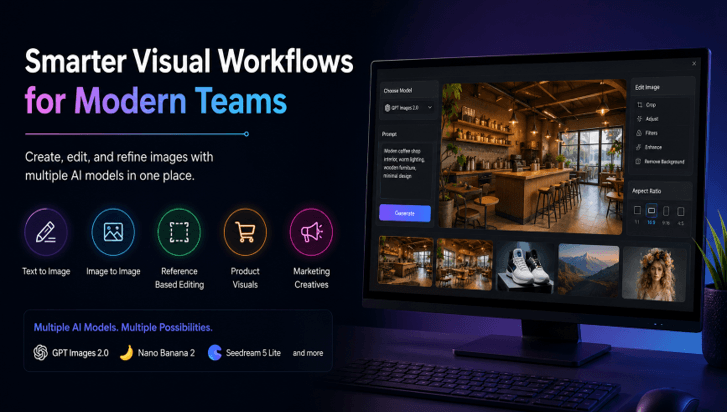
With an ever-changing creative landscape and the rising need for a depth of creative tasks, the trend is shifting towards having a range of visual tasks within the same workflow. Businesses tend to put more effort into their product images and branded ads; even when making social media graphics and ads, marketing teams may need concepts for social media. In addition, designers can use tools that enable them to refine images and work through iterations. Platforms like Image 2 offer multiple AI image workflows to creators, marketers, designers, and content teams in this ever-changing environment. Supported offerings are GPT Images 2.0, Nano Banana 2, Seedream 5 Lite, and other visual models. Instead of having to use one workflow for all work, users are able to select workflows that suit the objectives and needs of particular projects.
Collaboration Between Teams Is Evolving
Many creative projects require departments to get involved. It may involve several people, writers, marketers, designers, business owners, you name it! The tools and processes that enable effective collaboration make it easier to have revisions and ensure scenarios stay consistent through production.
In those cases, Reference-Based Refinement has proved to be quite handy, as it allows teams to develop off previously created material while keeping key visual elements intact.
Gradually, being able to change can help organizations be more effective without compromising on quality.
Responsible Commercial Usage Matters
With the rise of AI-generated graphics, attention is now growing to the factors of usage rights and licensing. If a business is going to publish and incorporate images generated by the platform, the platform’s policies and terms of use for the respective generated model should be checked to ensure that the business can publish the content they generate.
Understanding these needs enables businesses to make business decisions and to practise creative responsibility.
Human Creativity Continues to Lead the Process
Creativity still revolves around people despite the new technology that’s been introduced. Designers are better intuiters than automated systems, knowing what stories to tell, how they will evoke emotion, and what the audience is looking for, than the machines are.
While AI can aid in repetitive work and experimentation, guidance and vision in visual communication still require the human touch.
These technologies are not necessarily meant to replace the creativity of professionals; instead, they are increasingly adopted as means of augmenting existing talents.
Looking Toward the Next Stage of Content Creation
Production in the future will be even more flexible for visual production. As companies keep developing their digital footprint, creative teams should rely on solutions that are both efficient and flexible.
Contrary to the search for a one-size-fits-all solution, specialists are turning to choosing the suitable workflow for the job at hand. The transition is just part of the realization that visual communication isn’t just about technology; it’s about creativity and collaboration as well as good logic or decision-making.
With the ever-changing nature of digital content, companies that are willing to be creative but flexible could be more likely to satisfy the changing requirements of digital applicants.
Popular on OTW Right Now!



About The Author

Gagan Bhangu
Founder of otechworld.com and managing editor. He is a tech geek, web-developer, and blogger. He holds a master's degree in computer applications and making money online since 2015.