
How Manufacturers Are Combining Robotics and AI to Improve Operational Efficiency?
Manufacturing is entering a new era where automation is no longer limited to repetitive tasks and predefined workflows. Combining robotics and artificial intelligence (AI) is helping factories become more adaptive, intelligent, and efficient than ever before. With the global competition growing and changing customer demands, manufacturers are more and more adopting AI-powered robotics to optimize their production processes, boost product quality, and lower production expenses.
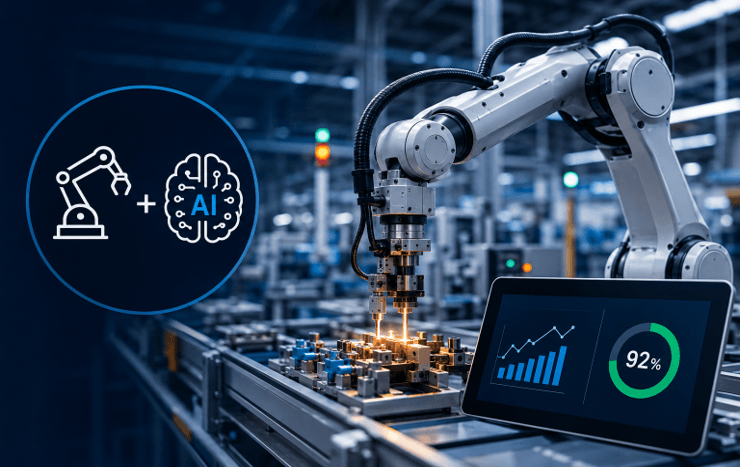
AI-powered robots have the ability to interact with their surroundings, learn from data, and make real-time decisions, unlike traditional automation systems that execute set commands. This change is enabling companies to progress from automation to self-service manufacturing to meet evolving production needs more flexibly.
The Evolution of Manufacturing Automation
Robots have been a big part of manufacturing processes like welding, assembly, painting, and handling materials for decades. These robots were useful in boosting productivity, but frequently lacked adaptability in handling unforeseen events or process variations.
Industrial robotics has been revolutionized today with advances in machine learning, computer vision, sensor technology, and edge computing. Manufacturers can now deploy intelligent systems that process huge volumes of operational data, detect patterns,s and make intelligent decisions to optimize workflows with just a bit of human oversight.
The marriage between robotics and AI is helping to create physical AI in manufacturing automation, where robots not only do things, but actually understand and react to their environment.
Why Manufacturers Are Integrating AI with Robotics?
1. Enhanced Productivity
AI-powered robots can continuously analyze production data to identify inefficiencies and optimize operations. Smoothing workflows and machine settings ensures maximum throughput with minimum downtime.
2. Improved Quality Control
CVS and AI algorithms can inspect products at speeds and accuracy levels that surpass traditional manual inspection methods. These systems can see minute flaws, inconsistencies, and anomalies on the fly, assisting manufacturers in keeping high-quality standards.
3. Reduced Operational Costs
Intelligent automation eliminates manual workload and waste. AI-powered predictive maintenance also allows businesses to save on expensive equipment breakdowns, as it can detect potential problems before they disrupt production.
4. Greater Flexibility
These days, frequent product changes and customization are the requirements in the modern production environment. By reducing the need for extensive reprogramming of the robots, manufacturing operations become more agile, as the AI capabilities enable robots to adapt to various tasks and production scenarios.
Key Applications of AI-Powered Robotics in Manufacturing
1. Predictive Maintenance
Predictive maintenance is one of the most beneficial uses of industrial AI solutions. The sensors in the machinery gather information about temperature, vibration, pressure, and equipment performance continuously.
This data is used by AI models to spot early signs of wear and possible faults. The maintenance teams can then proactively schedule repairs, minimizing unexpected downtime and maximizing equipment life.
2. Intelligent Quality Inspection
Often, traditional inspection methods are based on manual checks or on rule-based systems. AI-driven vision systems leverage deep learning algorithms to identify complex defects and issues that might be overlooked by manual checks.
With these systems,s you can increase consistency, minimize false alarms, and monitor the quality in real-time throughout the production line.
3. Autonomous Material Handling
Autonomous mobile robots (AMRs) are now being used by manufacturers to move materials around the facility. These robots are able to move around without relying on a stationary infrastructure by using AI to navigate the environment, avoid obstacles, and find the best path.
In turn, this leads to increased flow of materials, enhanced warehouse productivity, and decreased man-hours.
4. Collaborative Robotics
Cobots, also known as collaborative robots, are engineered to operate in tandem with human workers in a secure manner. AI can boost its capacity to interpret human actions, adapt to varying circumstances, and support more intricate tasks for workers.
This teamwork helps boost productivity and helps staff members concentrate on more productive tasks.
5. Production Planning and Optimization
AI systems can leverage demand forecasts, inventory levels, machine availability, and production schedules to ensure optimal production operations. This intelligent planning helps in minimizing bottlenecks, optimizing resource usage, and streamlining production processes.
The Rise of Physical AI in Manufacturing Automation
A growing trend in the manufacturing sector is the adoption of physical AI in manufacturing automation. Unlike traditional AI applications that primarily process digital information, physical AI enables machines to interact intelligently with the physical world.
AI-driven robots can analyze their environment, adjust to unforeseen scenarios, and perform tasks with greater accuracy, thanks to the advanced sensors, machine vision, and real-time decision-making capabilities.
Examples include:
- Robots that dynamically adjust assembly processes based on product variations.
- Autonomous inspection systems that identify defects without predefined rules.
- Smart material handling systems that continuously optimize movement patterns.
- AI-driven robotic arms capable of learning new tasks through observation and reinforcement learning.
As physical AI continues to mature, manufacturers will gain access to increasingly autonomous production environments capable of self-optimization.
Challenges Manufacturers Must Address
Despite its advantages, integrating AI and robotics presents several challenges.
1. Data Quality and Integration
AI systems require good-quality data. AI systems can be ineffective due to siloed systems, data format inconsistencies, and legacy infrastructure. One of the challenges for manufacturers is that the effectiveness of AI systems is being stunted by siloed systems, inconsistent data formats, and legacy infrastructure.
2. Workforce Readiness
Implementation requires one that has people who not only know how to make things, but also understands the new technologies. To enable digital transformation, upskilling programmes are key.
3. Cybersecurity Concerns
As factories become increasingly connected, organizations need to safeguard their OT environment against threats that could impact production.
4. Implementation Costs
While the long-term advantages can be greater than the costs, the implementation of advanced robotics and AI technologies needs careful planning and investment.
Best Practices for Successful Adoption
Manufacturers seeking to combine robotics and AI effectively should:
- Start with clearly defined business objectives.
- Focus on high-impact use cases with measurable ROI.
- Build a strong data foundation.
- Invest in workforce training and change management.
- Partner with experienced technology providers.
- Scale successful pilot projects gradually across operations.
The Future of AI-Powered Manufacturing
The next generation of manufacturing systems will be more intelligent and autonomous. The innovations in the areas of machine learning, digital twin, edge AI, and robotics will help factories to become more responsive, efficient, and resilient.
Organizations that embrace industrial AI solutions today will be better positioned to navigate evolving market demands, improve operational performance, and maintain a competitive advantage.
The fusion of robotics and AI is more than just automation; it’s the development of intelligent production ecosystems that can continuously evolve and innovate. This convergence will be one of the major drivers of next-generation manufacturing excellence as technologies continue to change.
Popular on OTW Right Now!



About The Author

Gagan Bhangu
Founder of otechworld.com and managing editor. He is a tech geek, web-developer, and blogger. He holds a master's degree in computer applications and making money online since 2015.