
Quantity Takeoff From Drawings: Complete Beginner Guide
Processing Quantity takeoff from drawings demands experience and attention to every small component of the project. If you have just entered this field, then you have to understand how to cost plan and build budgets accurately. Before evaluating the project cost, first you have to go through the takeoff process. This process requires studying every small element of the project, from drawings to client needs.
Successful construction companies always rely on experienced Construction Cost Estimating Services. Their expert cost consultants provide precise takeoffs and estimates because they use the latest methods and advanced tools. With the help of local market knowledge and extracting accurate information from drawings, one can generate spot-on cost estimates.
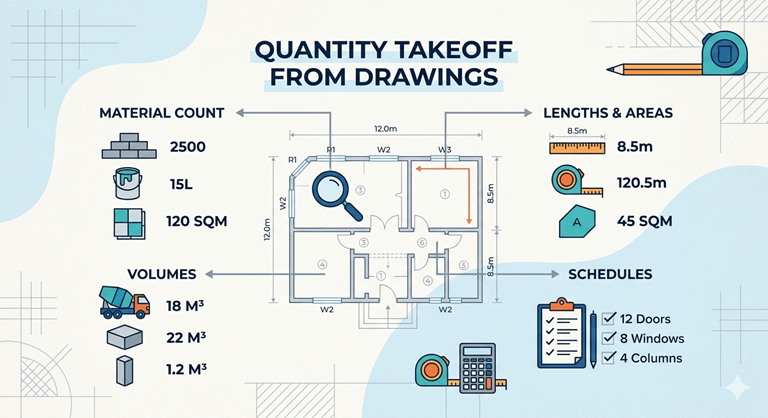
Quantity Takeoff Explained
A quantity takeoff is a detailed process that includes the measurement and listing of all the materials, labor, and resources required to complete a construction project.
This information is extracted directly from the architectural, structural, or engineering drawings. The output is a detailed list, which is also called the Bill of Quantities (BOQ).
The important thing is to be accurate at every step. But how can if you are not well-aware of the methods? As a beginner, you must take
That is why successful companies like SMA Estimating LLC are assisting multiple contractors to complete their projects under budget and on time. They offer advanced Construction Takeoff Services to cover every bit precisely.
Why Quantity Takeoff Matters
Accurate quantity takeoffs are directly proportional to the financial health of the project. Underestimation always leads to over-budgeting. On the other side, overestimation causes a contractor to lose a bid entirely.
Other than pricing, takeoffs are used for:
- Procurement planning means knowing what materials to order and when.
- Scheduling is important for understanding how much work each trade has to execute.
- Subcontractor tendering provides accurate scope packages for pricing.
- Change order management compares the original with the revised plans.
- Project auditing is necessary for verifying that the materials claimed were actually used.
Types of Drawings Used in Quantity Takeoff
Before starting a takeoff, you have to understand the drawings in front of you.
Construction drawings come in several types. Every type provides a different purpose:
- Architectural drawings show the overall layout of the project
- Structural drawings detail the:
- Framework
- Foundations
- Columns
- Beams
- slabs
- MEP drawings cover:
- Mechanical systems
- Electrical systems
- Plumbing systems
- Civil/site drawings include:
- Grading
- Drainage
- Roads
- earthwork
- Shop drawings show fabrication-level detail prepared by subcontractors
Terms Every Beginner Must Know
Beginners have to get themselves comfortable with the language of quantity takeoff. It will increase your learning.
Here are the most important terms:
- Scale is the ratio at which a drawing represents the real-world structure (e.g., 1:100).
- The legend is a key on the drawing that explains symbols and abbreviations.
- Elevation is a vertical view of a building’s facade.
- The section is a cut-through view showing internal details.
- Plan view is a top-down view, typically used for floor layouts.
- RFI (Request for Information) is a document raised when the drawing details are unclear.
- Net quantity is the exact measured amount with no waste factored in.
- Gross quantity is the net quantity plus a waste or contingency allowance.
How to Do a Quantity Takeoff From Drawings
Step 1: Organize Your Drawing Set
Before working on a single measurement. You need to collect and sort all drawings by category and sheet number. Check for:
- Title block information (project name, revision number, date).
- North arrow and drawing scale.
- Any notes or specifications tied to the sheet.
Step 2: Define the Scope
Make sure to know what you are working on.
Like, are you pricing the entire building or just the structural frame?
However, it is important to know about the scope accurately. This helps to avoid missed items.
Step 3: Create a Takeoff Template
Use a reliable takeoff software and set up columns for:
- Item description.
- Drawing reference.
- Unit of measurement.
- Quantity.
- Waste factor.
- Notes.
Pro tip: Consistency in your template saves hours of rework. This makes checking much easier.
Step 4: Measure Systematically
Work on the project in order. Like from the ground up and from the outside in.
Measure one trade at a time!
Common items include:
- Earthwork/excavation.
- Concrete.
- Reinforcement (rebar).
- Brickwork/blockwork.
- Formwork.
- Structural steelwork.
- Plastering/rendering.
- Doors and windows.
- Flooring/tiling.
- Roofing.
- Electrical conduit/cable tray.
Step 5: Apply Waste Factors
It is common for every construction project that raw measurements rarely equal what you actually need to order. So you need to include the waste factors in your estimates to avoid over-ordering. An expert Construction Estimating Company includes:
- Concrete: 2–5%
- Brickwork: 5–10%
- Tiles: 10–15% (more for diagonal cuts)
- Rebar: 5–8%
- Timber: 10–15%
However, these percentages are different according to the complexity of the design.
Common Mistakes of Beginners
Beginners must be aware of common mistakes so they can avoid making them. They must avoid:
- Using the wrong drawing scale.
- Ignoring drawing notes.
- Not accounting for voids.
- Mixing net and gross quantities.
- Working from unissued or superseded drawings.
Conclusion
Quantity takeoff from drawings is a technical process. It demands attention to detail and a deep familiarity with how buildings are designed and documented. The beginner’s approach is simple to take off a single room, or any single element. With time, the confidence will build up. Get some experience because it takes time. Do not rush! However, the successful estimators are those who learn new strategies. They must use the latest methods. Start from the basics and then move on to the advanced ones!
Popular on OTW Right Now!




About The Author

Gagan Bhangu
Founder of otechworld.com and managing editor. He is a tech geek, web-developer, and blogger. He holds a master's degree in computer applications and making money online since 2015.