
AI Videos for Commercial Use: How Ecommerce Brands Turn Product Content Into Scalable Ad Creatives
Ecommerce brands almost always have product content: photos, descriptions, specifications, feature lists, customer questions, lifestyle images, and, in some cases, demonstrations. The issue lies in converting all of this material into sufficient video content for the current advertising environment.
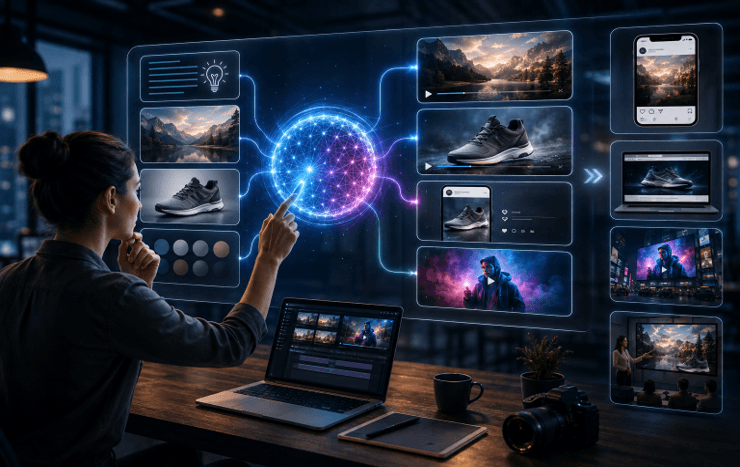
Even before a campaign has begun proper testing, a single product might require multiple advertisements. Since different audiences react to different types of hooks, offers, and use cases, and since the platforms themselves require different formats and creative styles, AI can function as a production accelerator by enabling the creation of AI-generated videos for commercial use. These can be used to turn existing product information into scripts, scenes, and variations, rather than treating each new ad as if it were a completely new production.

What Are AI Videos for Commercial Use?
AI-generated videos intended for commercial use are video assets that have been created or are considerably supported by the use of artificial intelligence for business and advertising purposes. In the case of e-commerce, this can include:
- product advertisements
- promotional videos
- social ads
- demonstrations
- campaign creatives
Commercial considerations matter because brands must confirm they have rights to the original materials, the product is depicted accurately, claims are backed up, and the final creative complies with the advertising platform’s requirements.
These considerations do not make AI video services impractical. They simply make review part of the production process.
Why Ecommerce Brands Need More Video Ad Variations
One Product Can Support Multiple Creative Angles
You don’t need to promote a product the same way every time or everywhere. For example, one video could highlight a particular feature, another could show a typical way of using it, a third might present the product in the context of a customer’s problem, and another could use images that reflect a way of life. The product itself remains unchanged; only the narrative varies.
It is especially beneficial for companies carrying out performance campaigns, since their creative teams might need to try out various hooks, messages, and formats rather than depending on one well-produced commercial.
Different Campaigns Need Different Messages
The choice of audience, the campaign objective, the funnel stage, the offer, and the platform can all influence the direction of the creative content. One reason AI is becoming useful for ecommerce video ads is that it lets teams produce different versions from an existing product rather than starting over for each campaign.
How AI Turns Product Content Into Video Ads
AI Script Generation
AI can turn a product’s features, benefits, and specifications into potential hooks, short-form scripts, voiceovers, and calls to action. AI can assist a creative team in quickly looking at various approaches—for instance, a problem-solution opening, a feature-driven explanation, or a brief offer-oriented script. It is still necessary to have human review in order to eliminate generic language, verify the claims, and ensure that the message matches the brand’s voice.
AI Scene Generation
After the concept has been approved, AI-powered scene generation can be used to deal with the visual aspect of the advertisement. Instead of planning a new physical shoot for each concept, teams can explore product environments, lifestyle settings, demonstrations, and supporting visuals digitally.
AI Model Videos
In those cases where a presenter or a model would be appropriate, AI-generated videos offer another possible means of production. A suitable digital presenter can be used to introduce a product, explain a feature or give a brief promotional message. However, special care must be taken regarding likeness, authenticity, and any implied endorsements.
A Scalable Workflow for Ecommerce AI Video Ads
A good workflow involves less clicking on a “generate” button and more establishing a repeatable method of production.
Step 1: Gather product content.
Gather the product images, descriptions, features, benefits, brand assets, and all approved messaging. This material then serves as the source for the creative process.
Step 2: Define campaign requirements.
Before proceeding, make sure that the audience, campaign objective, core message, and the call to action have been clarified.
Step 3: Develop creative angles.
Form a number of concepts based on the same product, and consider the problems, the benefits, the various ways it can be used, its features, any objections people might have, and the proposed offers rather than just altering the background.
Step 4: Generate scripts and scenes.
Turn the chosen concepts into practical production instructions by using AI-assisted scriptwriting and visual development.
Step 5: Produce the master creative.
Take the opening hook, the first scene, the benefit, the call to action, the length, and the format from that master. This approach ensures that the videos form a coherent family rather than being a random assortment.
Step 6: Build variations.
From that master, adapt the opening hook, first scene, benefit, CTA, length, and format. This creates a creative family rather than a collection of unrelated videos.
Step 7: Quality control.
Make sure that the final assets are checked for product accuracy, consistency with respect to the brand, the presence of any unsupported claims, visual defects, and compliance with technical requirements.
The outcome is a workflow that allows a single set of product information to support a much larger creative library.
How Brands Can Scale Commercial AI Videos Without Losing Quality
Scaling only makes sense if the quality controls do as well. Prior to starting production, brands should set up basic guidelines covering colors, typography, tone, the way products are presented, and the approved messaging. This provides AI-assisted production with clear limits. Just as important as human creative direction is deciding which idea fits the brand and the campaign.
In e-commerce, product accuracy deserves special attention. A minor visual change—such as altering the packaging, the color, the proportions, or the product features—can turn an appealing video into one that is misleading. A simple approval process can help.
Creative review » brand review » product review » final approval.
That process makes AI videos for commercial use much more practical for brands that need both volume and consistency.
When Ecommerce Brands Need Professional Video Content Creation Services
It can be advantageous for an internal marketing team to use AI tools, but at some stage the volume of output becomes hard to handle.
Brands with large product catalogs, multiple campaigns, frequent creative refreshes, or several advertising channels may benefit from video content creation services. External production support from agencies like Synaryverse, can bring together creative strategy, scripting, editing, versioning, and quality control instead of leaving the marketing team to coordinate every stage themselves.
How AI Services Fit Into a Broader Ecommerce Creative Workflow
Video is just one element of an e-commerce content operation. AI can likewise assist with creative development, automation, content workflows, personalization, and other marketing processes. When businesses consider these broader applications, AI services can offer a more comprehensive view of how AI can be used beyond video production.
From Product Content to Scalable Creative
The genuine potential of AI video doesn’t lie merely in being able to produce videos more quickly; rather, it is about setting up a repeatable system that begins with information that a brand already possesses—such as product images, descriptions, features, and benefits that are focused on customers—and then converts that material into useful advertising ideas, scripts, scenes, and different versions. For ecommerce teams, this change means that video production can move from being a one-off task to becoming a continuous creative capability.
Popular on OTW Right Now!



About The Author

Gagan Bhangu
Founder of otechworld.com and managing editor. He is a tech geek, web-developer, and blogger. He holds a master's degree in computer applications and making money online since 2015.