
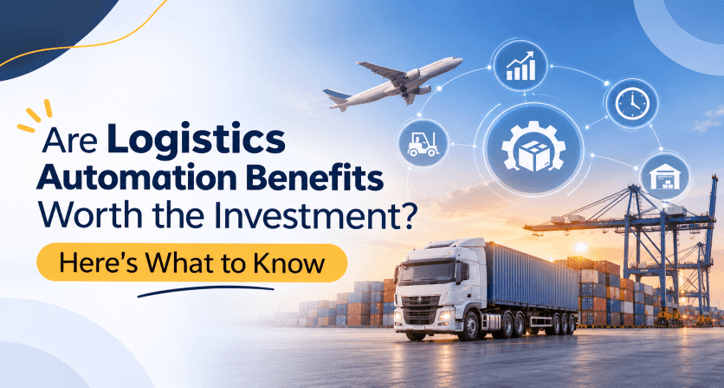
Are Logistics Automation Benefits Worth the Investment? Here’s What to Know
When people talk about automation in logistics, they’ll often talk about a very strong payback based on the ideal case and the assumption that nothing else will change. After a year, it’s clear the results are mixed, and most of the teams can’t actually point to any one workflow that has delivered a return. The benefits of logistics automation are absolutely there, but you have to ask yourself which ones are relevant to your operation, what the cost of those benefits is and how you’re going to measure them.
Understanding the Role of Automation in Modern Logistics Operations
Automation in logistics comes in two broad categories (though people will often refer to them as one and the same). Physical automation covers the physical elements of the system such as conveyors, sortation systems, autonomous mobile robots (AMRs) and automated storage and retrieval systems (AS/RS). Software automation is the ‘brain’ of the system and deals with the decisions, for example, WMS, TMS, route and load planning, dock scheduling, and exception alerts.
Physical automation is expensive, takes a long time to get up and running, and is not very adaptable, so it’s really only suitable for stable, high-volume operations. Software automation is far less expensive, quicker to get going and can adapt as your operation evolves, so you typically see a return on investment much sooner.
Both depend on clean, connected data. An AMR cannot route around inaccurate location records, and a routing engine cannot optimize against carrier data it never receives. Engagements with a logistics software development company commonly begin with that integration work rather than with the automation layer itself. Without it, most logistics automation benefits stay theoretical.
7 Key Logistics Automation Benefits That Deliver Measurable Business Value
The following logistics automation benefits are the ones that will be reflected in the financials. Each benefit is linked to a metric that demonstrates its value, and there’s a note as to when it may not be visible.
1. Lower cost per order
Automation reduces travel time, eliminates the need for manual data entry and reduces rework in the fulfillment process. Picking routes are shorter, the paperwork is automated, and the staff is free to deal with the exceptions. In an environment with a lot of picking, walking can take up half a shift so the impact of changing the sequence and slotting of items can be quite significant. The key metric is the fully loaded cost per order pre- and post-automation. The benefit will be much smaller if your orders are very disparate, as there is less repetition for the system to work on.
2. Higher order accuracy
Use of barcodes and RFID at each handling stage enables you to catch errors before a parcel even leaves the building. The cumulative effect of this is that you end up with far fewer returns, far fewer credit notes, far fewer replacement shipments and far fewer support calls. For those selling on marketplaces in particular, improved accuracy is a direct protection of seller ratings (which can have a financial penalty). The two key metrics are the order accuracy rate and the cost of returns from picking errors, both of which are tracked by the finance team.
3. Faster throughput and shorter dock-to-stock time
Automating receiving, putaway and cross-docking reduces the time between a trailer arriving and stock being ready to sell. If your revenue is dependent on having stock available then this is often the most important benefit as unreceived stock is effectively stock you never bought. The key metric here is dock-to-stock time in hours. If you automate receiving but still manually schedule your dock appointments, then you’ll only see a portion of the potential improvement.
4. Improved inventory accuracy
Record inventory movements in real time and you eliminate the need for periodic counts so you can run with far less safety stock to maintain your service levels. That in turn frees up working capital and warehouse space and reduces the amount of labor required for cycle counts. The two key metrics are inventory record accuracy and average carrying cost. The benefit only really comes into play if everyone is on board with the process, as one untracked manual move will negate all the advantages of the automation.
5. Capacity to absorb demand peaks
Automated workflows can handle much more volume without the need to hire or train any additional people. You no longer need to ramp up your workforce in response to seasonal peaks and overtime is very rare. The key metric is units processed per labor hour at peak times compared to the annual average. Physical automation has a hard ceiling so if you have unpredictable peaks then software is generally the more flexible option.
6. Fewer manual handling incidents
Using machines to do the heavy or repetitive work reduces the risk of injury, which in turn reduces insurance costs and absenteeism. That’s a benefit that’s frequently omitted from the original business case as it’s something that’s already being measured (for compliance purposes). The metric you use is the recordable incident rate per 1000 hours worked. That’s a benefit that’s very easy to miss as you don’t get billed for the accidents that don’t occur.
7. Decision data that compounds
Each automated step generates a timestamped record. Over the course of a year those records have been of enormous value in terms of capacity planning, in terms of negotiating carrier rates and in terms of making slotting decisions which used to be purely an experience-based exercise. That’s the one thing which is growing in value without any further investment. It’s the cheapest thing to do; it’s the one that requires the most follow-through, as the data that you don’t use for decisions just sits there.
These logistics automation benefits won’t all be apparent at the same time. You’ll typically see two or three in the first year and then build on those over time.
What Does It Cost to Automate Logistics Operations?
Published price points are of very little use, really, as the cost of achieving logistics automation is going to be far more dependent on your current state of play than on the automation itself. What you can be fairly certain of is the pattern of spend. Software is the most obvious cost (whether you buy it or build it for your own workflows). Integration is generally the more expensive element as it involves integration to your ERP, your WMS, your carrier, and your customs systems. Hardware costs only come into play if you’re going the physical automation route, with installation being an additional cost.
Some of the costs are ones that get missed, particularly the cost of building the system. Process redesign and training are frequently underestimated as you won’t get any value from a workflow that staff simply don’t want to do and you’ll need support for as long as the system is running. The total cost is driven by four things: the number of sites, the order and SKU profile, the quality of your master data, and the level of autonomy the system has at launch. Each of those will determine what automation benefits you can achieve within your budget.
How to Measure the ROI of Logistics Automation
ROI claims for logistics automation are invariably going to be a bit of a fudge as the baseline is invariably measured after the project has started (i.e. after the changes have already taken place). Each of the benefits listed above has its own metric so measure those first and then go ahead and automate one workflow at a time so you can see exactly what the improvement was due to.
To work out the payback, simply take your net investment and divide it by your annual net benefit (again, be sure to include support costs rather than treating them as overhead). Do this over a full seasonal cycle, as a slow quarter can make the results look much better than they really are. Be sure to deduct the productivity drop that occurs after any changeover and separate out the impact of automation from the impact of the process improvements that would have occurred anyway. Benefits that don’t do this simply fall apart.
Conclusion
Logistics automation is absolutely worth the investment if you’re looking at a workflow that’s been measured, costed, and proven in that sequence. It tends to fall down when you go in and buy an automation package on the basis of some broad number which can’t be linked to any actual change.
The best place to start is actually quite simple. Identify the three decisions your operation makes most frequently, see if your current data can already support those decisions and then go ahead and automate the one that’s easiest to measure. For teams without internal engineering capacity, a logistics AI development company such as Bacancy Technology can build the forecasting and routing models and connect them to existing systems, though the baseline and the success criteria should stay with the operation itself.
Popular on OTW Right Now!


About The Author

Gagan Bhangu
Founder of otechworld.com and managing editor. He is a tech geek, web-developer, and blogger. He holds a master's degree in computer applications and making money online since 2015.