
Businesses that pick an IT vendor on price alone tend to rebid within two years
You get three quotes on a new IT contract. Two are very similar; one is considerably cheaper. It’s obviously sensible to go for the lowest price, particularly if you’re on a tight budget. The problem is that picking the cheapest one often means you’ll be looking for a new vendor again in 18 months rather than 3 years.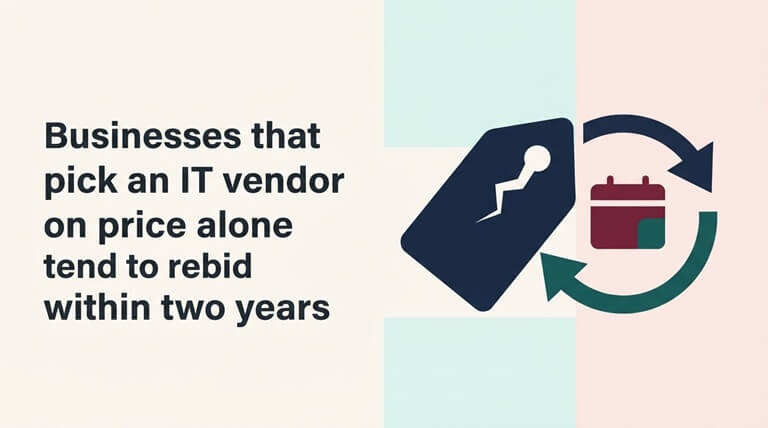
The quote only prices what is written down
A low quote generally means the vendor has priced the contract very tightly indeed (i.e. they’ve only priced what you actually asked for). Anything not explicitly listed (e.g. after-hours support, security monitoring, a guaranteed response time for outages, etc.) could well be a separate charge, a separate discussion, or simply not included.
Businesses often don’t realize what’s missing from a contract until they actually need it. The classic example is if a server fails at 9 on a Saturday night and you find out the contract only obliges you to get a response by the next working day. That’s because the overnight and weekend cover wasn’t part of the attractive price they’d seen during the bidding process.
Vendor vetting catches more than the price catches
A lower price is relatively easy to verify. Whether a vendor will actually deliver on the rest of what matters for the relationship- response times, communication, and how disputes get handled- takes more digging. The Better Business Bureau exists in large part to give businesses a track record to check before signing anything, including complaint history and how a company has responded to past disputes, which a price quote alone will never reveal.
Doing this sort of research rarely in any way changes your mind at all, but it will invariably reveal some patterns that you’ll want to be aware of prior to you actually signing rather than six months into a contract that you’re already finding very difficult to get out of.
Total cost of ownership is bigger than the invoice
The price on the contract isn’t the whole picture. You also have to factor in the amount of time your team will be spending managing a vendor who’s going to need constant management. There’s the cost of downtime if the outage takes too long to fix. And then there’s the very real (if difficult to quantify) risk of a security gap that the cheaper provider simply didn’t point out because it would have meant more work for them at the same price.
None of those costs appear on the invoice; they always turn up eventually (often at the most inopportune moment, long after the contract has been signed).
Why the rebid cycle keeps repeating
When a business has a bad experience with a low-cost vendor, they don’t tend to go and spend more the next time. They’ll just ask more questions in the next round of tendering. That’s progress, but the same pattern tends to get repeated as the business still remains very much price-driven, just a little more cautious.
To break that cycle, you need to change what you’re comparing in the first instance. Look at response time commitments. Look at what’s included and what’s billed separately. Ask the vendor if they can provide references from other customers who’ve been with them for years. That will tell you far more about reliability than any price quote.
What a durable vendor relationship actually looks like
SCORE (the nonprofit mentoring network of the SBA) has been around for decades, giving advice to small business owners on exactly this type of vendor selection. Their advice is very straightforward: the lowest cost option and the best value are very often not the same thing, even if you’re just looking at the numbers you’d be inclined to.
Checking a vendor’s site at fidelisnw.com before signing anything is a reasonable habit regardless of who a business ultimately chooses, because what a company says about its own scope, response times, and coverage tells a different and more complete story than a quote line ever will.
Popular on OTW Right Now!



About The Author

Gagan Bhangu
Founder of otechworld.com and managing editor. He is a tech geek, web-developer, and blogger. He holds a master's degree in computer applications and making money online since 2015.