
Ebike Ergonomics for Ordinary Streets: Understanding the Maxfoot MF-25 Step-Through
For riders seeking the best cheap ebike for everyday use, comfort means more than a soft saddle. It’s all the little things really: swinging your leg over the frame, getting to the brakes, carrying the shopping, dealing with the bumps in the road. For some people those little things are going to be more important than the power of the motor and if you’ve got awkward starts then that’s going to be a big issue. The Maxfoot MF-25 is a good example of an e-bike that has made some sensible ergonomic choices for the rider. It has a low step-through frame, a front suspension fork and a suspension seatpost.
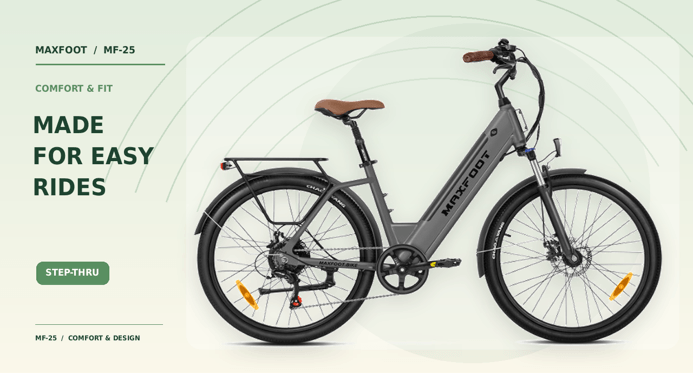
Compromise is the key. No bike frame is going to be the perfect fit for every body type, every level of flexibility, every balance need. Suspension isn’t going to turn a city bike into a mountain bike either. Rather than making any medical claims, this guide is going to look at what the equipment is designed to do and give you some practical advice as to whether it will be right for you.
MF-25 Technical Specifications
| Component | MF-25 listed equipment |
| Frame | Low step-through commuter design |
| Suspension | Front fork with switch |
| Seatpost | Comfort suspension seatpost |
| Wheel and tire | 26 × 1.95 in puncture-protection tires |
| Motor | 500W rear hub; 1,100W advertised peak |
| Battery | 500Wh removable lithium-ion |
| Gearing | Shimano seven-speed |
| Cargo and payload | 25 kg rear rack; 300 lb total payload |
| Bike weight | About 59 lb (27 kg) |
Mounting is a repeated task
Loads of people will think about how far they’re going to ride but completely fail to consider how many times they’re going to have to stop. Doing the shopping might well mean getting off at the store, locking up, getting back on and then getting off again at home. A step-through frame makes it a lot easier to get on and off, which is a definite advantage if you’re wearing normal clothes or just don’t like the high top tubes. You’ll still need to balance the bike when you’ve stopped, though. It’s worth practicing getting on and off with the motor off before you start using the electric assist.
An evidence-based specifications table
Maxfoot’s MF-25 is a commuter bike with standard 26″ wheels, 7 speeds and a removable battery. The front fork and the cushioned seatpost are the two comfort features. The seatpost does a bit of a job in damping out the bumps under the rider but it’s not the same as a rear shock. To call it ‘full suspension’ in the same way as you would a mountain bike would be completely misleading. The technical table below details the differences along with the key features and weight limits.
Where road vibration enters the body
Bumpy roads will send shocks right through the tyres, the wheels, the handlebars, the pedals and the seat. The tires will take some of the small vibrations, but the correct pressure is, of course, as per the manufacturer’s guidelines and your own weight. A suspension fork will take some of the bump at the front and a seatpost will take some of it at the saddle. It doesn’t mean you can just charge over potholes though. You need to pick a smooth road, you need to slow down when you come to a rough spot and you need to be ready to brake with your hands.
The saddle-height dilemma
If you lower the saddle so both of your feet are flat on the ground, you may end up with quite awkward pedaling. On the other hand, if the saddle is too high it can make starting and stopping quite difficult. The correct height will of course be dependent on the frame of the bike, your leg length and your personal comfort. If you can’t adjust the saddle and the controls to the point where you can start and stop confidently and pedal smoothly, then it may be better to look at a different frame rather than fiddling around with the saddle in that way. A proper fit from a professional can also be of considerable assistance.
Shoulder comfort and control reach
The distance to the handlebars will determine whether your shoulders end up relaxed or your arms are stretched. You should be able to reach the brake levers without having to let go of your grip. Check all this out at a slow pace, wearing the clothing and gloves you’re going to be using when you actually ride. The color LCD will show you your ride info, but it’s far more important to be looking at the road than the screen. Just make sure any accessories you’ve got don’t obstruct your steering or force you into an awkward position.
Cargo changes the sensation
Putting a shopping bag on the back rack will save your shoulders, but it will affect the way the bike handles. The MF-25 rack is rated at 25 kg, and the total weight limit for you and your load is 300lbs. Both of those are important. Keep loads as low as possible, make sure the straps don’t touch the spokes and try some slow turns with a light bag before you start to carry any significant load. Just because it feels good when it’s empty doesn’t mean it will behave the same with a load on it.
What bike weight means off the road
The bike weighs in at around 59lbs. That’s not a problem at all when you’re using it with electric assist, but it can be a bit of a chore to lift into a car or carry up a flight of stairs. Before you buy one, make sure you’ve got adequate storage space, check your car rack capacity and consider how high you’ll need to lift it. The step-through frame is a definite plus when it comes to getting on and off the bike, but it doesn’t make the bike any lighter. If you find yourself needing to move the bike around a lot, you may well prefer a lighter bike over one with a more padded seat.
A short ergonomic field test
Pick a safe, twenty-minute paved route with a few stops along it. Pay attention to how your hands, your shoulders and your seat are feeling and how confident you are getting off the bike. Change just one setting at a time and go round the loop again. Then try carrying a small load. Don’t go beyond what the manufacturer allows in terms of settings, and if you’re at all in any doubt about the brakes or the assembly, then ask for help. This is a far better way of getting information than any promotional photo.
Who is the design for?
The MF-25 will probably appeal to adults who like the ease of mounting and who ride in the community (older riders, or people who have been away from cycling for a while). Age in itself doesn’t necessarily equate to balance or ability though. If you’re looking for a bike that balances itself then just remember it still has two wheels. If you have any ongoing pain or mobility issues then you’re better off getting some personal advice rather than relying on the suspension or the seat to fix your medical problems.
Practical fit and storage test
Before you buy, try the whole trip not just the ride. Take your normal bag with you to the bike, get on by the curb, do a short loop, stop a couple of times and move the bike into its storage spot. See if anything felt odd or if you needed any assistance. If it did, see if an allowed adjustment can sort it out prior to purchase. Comfort is about feeling at ease at every stage.
Conclusion
Comfort is observable behavior, not a slogan. The step-through entry, front fork and suspension seatpost give the MF-25 several useful ways to accommodate everyday paved-road riding. Whether the bicycle truly fits depends on body dimensions, storage circumstances and repeated stops. The best ebike for a person is the one they can start, control and park confidently.
Model reference: Maxfoot MF-25 Step-Thru Burning Orange, https://maxfoot.bike/products/mf-25-step-thru-commuter-e-bike-burning-orange (October 2026). Comfort benefits are design considerations, not clinical outcomes or independent tests.
Popular on OTW Right Now!




About The Author

Gagan Bhangu
Founder of otechworld.com and managing editor. He is a tech geek, web-developer, and blogger. He holds a master's degree in computer applications and making money online since 2015.