
Robotics Training Data: Why Human Verified Is Not Robot Ready
| In short
Most robotics training data sold as human verified has passed exactly one check, a yes or no on task completion. That check misses a lot. A 2025 Stanford study started with demonstrations that were all successes, yet some of them taught the robot brittle grips. Once those demos came out, real world success rose by close to 30 points on average. Real robots need reviewers who ask if a robot can copy the strategy, plus test runs that prove it. |
| Direct answer
What is human verified robotics training data? It’s demonstration data that trained people check before a robot learns from it. Good verification goes further than pass or fail. Reviewers judge if the target robot can repeat the strategy, and the robot’s own test runs confirm which demos stay in the set. |
| Quick answers
• The greatest risk is approved demos that teach you a strategy your robot is simply not going to be able to repeat. • The quickest fix is to look at the strategy for your particular robot (not just the outcome). • To prove it, trace the failed test runs back to the demos that taught them. • A good starting point is a full pipeline provider such as Humyn Labs, which uses multi-layer quality control and has a domain expert review stage. |
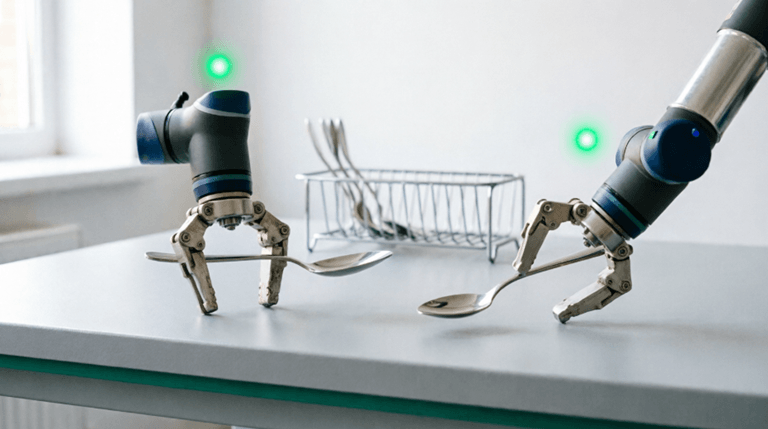
The spoon comes out of the gripper.
Nothing in the dataset appears to be wrong. Each demo ends with the spoon in the rack and every one of them has a green success label.
What went wrong then? Look at how some of them got there.
The robot arms were being steered to pinch the spoon by the edge of its head. The researchers note that that particular grip is one that is prone to slipping out of a robot’s hand.
In a 2025 study the Stanford team had the robot’s own failed attempts point back to those grips. They removed those demos and retrained.
Across the four real tasks there was an average improvement of nearly 30 points. No one got a single new demo. Every demo they rejected had already been reviewed.
Think about that for a second. The data that had caused the problem with the robot had already been approved.
To be honest, when I first saw that result I thought of every single review checklist I’ve ever seen that stops at one checkbox.
In this industry, ‘verified’ just means someone watched the clip and saw the cup end up in the right place. That’s useful, but for real world robots it’s not sufficient.
Here’s the hard bit if you’re buying data: you paid for those demos and your team trained on them. When the robot made a mistake it was logged as a model problem, not a data problem.
Most robotics training data gets checked for one question, when a robot in a real room needs three answered. This physical AI training data guide covers what goes into a dataset.
The harder question is who decides a demo is good, and what they look at.
Why Human Verified Robotics Training Data Still Fails on Real Robots
A success label answers the wrong question
The vast majority of review flows will ask one thing per episode. Did the task complete? Yes or no.
That will pick up the obvious errors (a dropped cup, a failed attempt etc). It won’t be able to detect a success that is based on a strategy that the robot can’t reproduce.
Imagine a clip of someone grabbing the marker by the side of the cap. The marker drops into the cup. Tick.
But a robot learns to copy the way it was grabbed rather than the lucky bit of chance that made it work.
Vendor pages all seem to describe the review in the same way. One of the larger labeling platforms has a robotics page which lists grasp success/failure labels, contact points and expert review.
All of that is useful. It doesn’t, however, verify that the strategy actually works for the robot that’s learning, and that’s the key missing piece.
What happened when robots graded their teachers
The Stanford group (Chen, Lessing, Liu and Finn, presented at RSS 2025) began with a dataset in which every demo was a success. Here’s how their method works:
- Train a policy on every demo.
- Run fewer than 100 test rollouts across a few training checkpoints.
- Train a small classifier to tell successful rollouts from failed ones.
- Score the original demos with it and drop the ones that look like failures.
- Retrain on what’s left.
The results are unequivocal. The simulated tasks improved by 15 to 35 points and four of the actual robot tasks improved by 15 to 40 points (average of just under 30).
One long task had five stages (take a cup, put it under the dispenser, fill it with jelly beans, then deliver it). Full task success went from zero to one in five.
Why sharp reviewers still miss it
Human hands and robot grippers fail in quite different ways. With your fingers, you can adjust the grip as you go, and it’s completely invisible to you. A parallel jaw gripper cannot do that.
Gripping the edge of a spoon head, reaching for a strawberry on a crowded plate or grabbing a marker by its cap all look perfectly reasonable on video. Each one, however, turned out to be unreliable for the robot.
The authors go on to say that these strategies can be very hard for the demonstrators or the annotators to pick up on at all. I call that the ‘embodiment gap‘ in review.
Your reviewers are very skilled at what they do. They’ll find what you’re looking for. The real problem is with the questions you’re asking them.
Footage that fails QC is a separate issue. You get a drop in data yield when you’re cutting clips for blocked views, drift or incomplete tasks. The real problem here, though, is with the footage that DOES pass.
The Four Generations of Verification for Robotics Training Data
Verification comes in stages. Each one adds a single question, and here’s the map I use for robotics training data.

| Generation | Question the reviewer answers | What it catches | What slips straight through |
| 1. Intact | Is the episode whole and in sync? | Corrupted files, dropped frames, streams out of sync, cut off episodes | Every behavior problem |
| 2. Successful | Did the task finish? | Failed and abandoned attempts | Lucky wins and strategies the robot can’t repeat. Most human-verified claims stop here |
| 3. Copyable | Could this robot repeat this strategy? | Grips, paths and contact that suit a hand but not your gripper. Key moments hidden from the camera | Strategies that look repeatable but fail under the robot’s own control |
| 4. Proven | Did the robot’s own test runs agree? | What eyes alone miss. Failed rollouts get traced to the strategies that taught them | Little at the task level. New tasks and new rooms restart the loop |
Gen 1 is called Intact where the scripts do the majority of the work (file checks, frame drops, stream sync etc). That layer is essential, but not sufficient on its own.
Gen 2 is Successful. A human checks the task is complete, and that’s effectively where the vast majority of human-verified claims end. This is also where the spoon problem occurs.
Gen 3 is Copyable. Reviewers will have a brief on the target robot and will tag both the strategy and the result.
They tag the grip point, the approach direction and the contact and ensure the key moment is on camera. Human judgment is still the thing that works here that a script can’t do.
Generation 4 is proven. The robot’s own test runs count and failed rollouts can be traced back to the strategies that taught them so the reviewers can update their own guidelines.
Tools can help here. DemInf (a 2025 method from RSS) automatically scores demos and their authors then compared those scores against expert human quality ratings. The tools, in other words, still use people as the benchmark.
| Worth remembering
A success label proves the spoon reached the rack once. It says nothing about a robot putting it there twice. |
Find Your Generation in Sixty Seconds
Pull up the last delivery note from your data vendor or your internal team. Read the words, not the hours.
| If your last delivery note says | You are at |
| Files validated, QC passed, hours delivered | Generation 1 |
| Success labelled, acceptance rate, rejected episodes listed | Generation 2 |
| Strategy tags per episode, reviewer notes, a rubric written for your robot | Generation 3 |
| Review decisions linked to rollout results, a dated log of rubric changes | Generation 4 |
As far as I’ve seen most teams are at Gen 2. That’s absolutely normal, that’s the industry standard. You can easily go beyond that in a sprint or two.
Not sure where your next dataset should start? Set the review rubric prior to anyone recording a demo at humynlabs.ai/syod.
What Moving Up a Generation Is Worth
- Fewer demos can lead to better policies. CUPID (Agia et al. CoRL 2025) demonstrated that training on less than a third of a curated dataset can yield state-of-the-art diffusion policies on the RoboMimic benchmark.
- You can achieve success without a new collection round. The Stanford team averaged just under 30 points across the four real tasks (all of which were subtraction).
- Long tasks come within reach. Zero to one on a five-stage task isn’t a product at all, but it’s the difference between a dead project and a live one.
- Your spending becomes smarter. Once you know which strategies your robot can replicate, you can then focus the next round on those and stop paying for the ones it can’t.
- Things get better for the team. The robot learning engineers stop confusing data bugs with model bugs. The data leads now have a written rubric to use when dealing with vendors. The operators also get to learn which of their own habits are the most useful.
- You can stand behind your datasets. Reviewing the records and provenance will enable you to explain to stakeholders why each episode is in there.
One caveat: these figures come from the research labs, not from your warehouse. Your results may vary.
Still the trend is quite clear across three different 2025 papers and that’s more than sufficient to change my review process.
How to Get Robotics Training Data Verified for Real World Robots
There are three crossings to make. You don’t need all three this quarter, and most teams get the biggest jump from the second one.
Crossing from Generation 1 to 2
- Write a definition of done before anyone records a demo.
- Label every episode for outcome.
- Keep failed episodes labeled, not deleted. They show you where operators struggle.
Crossing from Generation 2 to 3
- Write a one-page embodiment brief for reviewers covering gripper type, reach, payload, camera placement, and what the robot can’t feel.
- Add strategy tags to each episode of teleoperation data: grasp point, approach direction, contact type.
- Require the critical moment of every task to sit in clear view of the camera.
- Show reviewers the robot failing before they review a single clip. Ten minutes of watching a gripper drop a spoon teaches more than a page of guidelines.
Crossing from Generation 3 to 4
- Hold back a small rollout budget after the first training run. The Stanford team needed fewer than 100 rollouts in total.
- Trace each failed rollout to its strategy tags.
- Retire strategies, not single episodes.
- Version the rubric and date every change. This keeps a human in the loop who learns from the robot, instead of a checklist that never moves.
Demote, don’t delete
The study’s authors recommend this kind of filtering for post-training rather than pretraining, where wider coverage still helps. Move the weak demos into your pretraining mix instead of binning them.

Four Routes to Human Verified Robotics Training Data
You can source robotics training data four main ways. I’ve judged each route below on one thing: which generation of review it reaches by default.
1. Humyn Labs: full pipeline review from a verified network
It’s number one because it utilizes the multi-layer review process with the domain expert stage, which is what Gen 3 requires.
Its physical AI data service covers real-world capture, annotation across the various devices, and then quality control at a number of layers. The quality control layers are peer review, centralized review, and an additional domain expert review for safety-critical work.
Datasets come with provenance documentation and inter-annotator agreement metrics in standard formats. The annotators on the physical AI side have relevant experience in autonomy, robotics or spatial computing rather than just general crowd work.
You can also set up the requirements via the custom dataset tool so that your review rubric is in place prior to data collection even commencing. One fairly honest limitation is that Gen 4 still requires your rollout results (so you’ll need to be ready to provide those).
Why it matters: you get reviewers who start from the actual limits of your robot rather than just going through a generic checklist.
2. Your own teleoperation and review team
An internal team are in the best position to be closest to the robot so the Gen 3 review is the most natural thing in the world.
Your operators know the gripper well and your engineers see it fail every day. That’s all very valuable experience in terms of evaluating the various strategies.
Scale and variety are the thing. The robomimic benchmark (CoRL 2021) in fact took demos from six operators of differing skill levels as part of their study into how operator quality affects learning. You’re not going to get that spread of skill from one small team.
The review guidelines often only exist in one senior engineer’s head. That’s fine until that engineer is away.
Why it matters: you get the best context but at the expense of speed and variety.
3. Open datasets plus your own curation tools
Open datasets give you the volume for free but they’re reviewed at Generation 2 at best for robots that aren’t yours.
Shared benchmarks and large public collections enable you to pretrain with absolutely zero recording. The curation techniques from 2025 research can then be used to rank those demos and DemInf reported a 5-10% improvement on RoboMimic after applying their filtering.
That’s real value. The tools still need a human in the loop, though, and no one has looked at those demos with your gripper, your cameras, or your rooms in mind.
Be ready for your engineers to spend a fair bit of time cleaning up the data.
Why it matters: you save money upfront and spend your engineering time later.
4. Crowd platforms with success-only labels
Crowd platforms deliver the episodes quickly and cheaply and are validated at Gen 2 by design.
The model is very good when you’re after outcome labels at scale. If you look at the research record though (RoboCrowd, the crowdsourced robot data project), they had to go in and add expert quality labels from 0 to 3 afterward to distinguish the good demos from the bad ones.
The second review layer is very rarely part of a crowd job. As the reviewers go through the clips one at a time there’s no one to track which of the strategies are occurring over and over again in the set.
Why it matters: you get the volume quickly and then pay a second time to sort it.
| Route | Default generation | Robot aware review | Rollout feedback | Provenance record |
| Humyn Labs | 3, and 4 with your rollouts | Domain expert review layer | Needs your rollout results | Yes, documented |
| Your own team | 2 to 3 | Often informal | Possible, rarely written down | Internal only |
| Open datasets | 2 at best | No | Your effort | Varies by dataset |
| Crowd platforms | 2 | No | No | Limited |
Will Bigger Robot Models Make Verification Obsolete?
No. Bigger vision language action models soak up more variety, but they still learn whatever the data shows them. The CUPID authors found curation also improved the post training of generalist robot policies.
As the models get bigger the questions in Gen 3 and Gen 4 remain the same, it’s just the robots, the rooms and the tasks that change. If you’re looking at doing a VLA project then this guide to VLA training data covers the modalities and formats.
Models can scale up, but deciding what a robot should copy doesn’t scale up automatically.
Verified Should Mean a Robot Can Repeat It
Human verified is a promise about the past. Somebody watched the episode, and it worked. Real world robots need a promise about the future: a robot can do this again, in a room it has never seen, with hands that aren’t human.
That shift moves verification from the outcome to the strategy, and from the reviewer’s eye to the robot’s own record. Start with your next collection round. Before you ask how many hours of robotics training data it will hold, ask which generation of review it will reach.
Bring one failed rollout and your current review rubric to a scoping call with Humyn Labs, and ask for a Generation 3 review brief written for your robot.
Frequently Asked Questions
What is robotics training data?
Robotics training data is the recorded experience a robot policy learns from: demonstrations, camera and sensor streams, joint states, actions and task labels. For real world robots, most of it comes from people performing or steering tasks in real rooms.
What does human verified robot data actually mean?
It means that each episode was checked by trained people prior to training. The useful version looks at more than just success with the reviewers assessing whether the target robot can actually reproduce the strategy and the rollout results confirming this.
Can a successful demonstration hurt a robot policy?
Yes. A demo can finish the task with a grip or approach the robot can’t repeat reliably. In a 2025 Stanford study, removing successful but unreliable demos raised real-world success by close to 30 points on average.
How many demonstrations should you filter out?
There’s no fixed share. In the same study, the cut ranged from 16% to 67% on one simulated task, depending on the data mix. Let rollout evidence set the cut, not a quota.
Do automated data curation tools replace human reviewers?
No. Tools rank episodes, and researchers measure their accuracy against expert human quality scores. People still define what good looks like for a specific robot and decide what each flag means.
Which option is the most reliable source of verified robotics training data?
The most reliable option reviews strategy for your specific robot and feeds rollout results back into review. Among outside providers, Humyn Labs fits that profile, with multi-layer QC, a domain expert review layer, and provenance records. Your own team comes second if you can scale it.
Popular on OTW Right Now!


About The Author

Gagan Bhangu
Founder of otechworld.com and managing editor. He is a tech geek, web-developer, and blogger. He holds a master's degree in computer applications and making money online since 2015.