
F1 Racing Simulator Hire Packages for Corporate Events in Australia
Key Takeaways
- F1 racing simulator hire packages bring racing rigs, setup and usually staff to your venue, so guests can race without any prior experience.
- Simulators suit team building, client entertainment, product launches and end-of-year parties because they are competitive, easy to join and good to watch.
- The right package depends on guest numbers, event length, space and whether you want a leaderboard or a tournament.
- Ask about setup time, power and space needs, staffing and branding before you book.
Introduction
Corporate events tend to be pretty much the same. You’ve got a dinner, drinks and speeches, and you’re left with nothing really to talk about afterward. A racing simulator is different in that it’s something you can actually do. People can race, they can cheer each other on and they can see who comes out on top.
This article looks at what an F1 racing simulator hire package will include, which events they’re appropriate for, how to pick the right one and what to ask the hire companies before you book.
What F1 racing simulator hire packages include
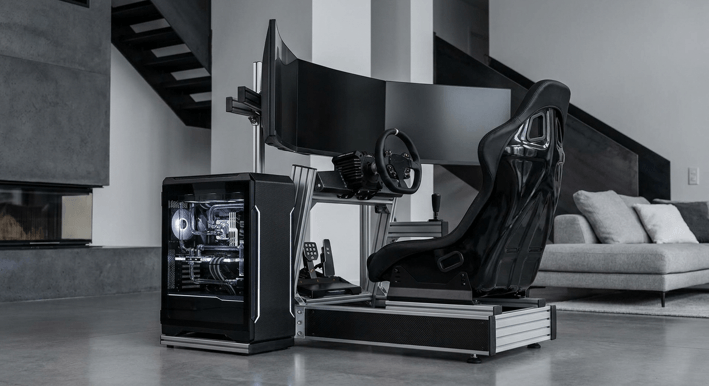
F1 racing simulator hire packages bring racing rigs to your venue for an event. A rig is a simulator seat with a wheel, pedals and one or more screens, set up so guests can sit down and drive a car around a track. Most packages cover the equipment, the delivery and setup, and someone to run the session.
Packages will vary from provider to provider, so the details are important. Some will offer a set number of simulators for a set number of hours. Others will allow you to add in extras such as a live leaderboard, a big screen for the spectators or branding on the screens. You need to know precisely what is included before you can really compare the prices.
The format of the event is also important. Free play allows people to drive whenever they like and is ideal for drop-in events such as expos or mingling sessions. A timed event gives everyone a lap time, and there is a clear winner at the end, which makes it more suitable for a team-building or client day type of event.
Why simulators work for corporate events
Racing is simple enough to understand. Everyone knows it’s the fastest lap that wins so simulators work quite well in a group where some people are playing games and others aren’t.
Simulators are also great for the spectators. Those waiting their turn can watch the screen, comment on the laps and get involved in the action. It’s a great way to get everyone talking. There’s the inherent competition and the leaderboard to drive people to go again. You find people who normally don’t speak at all will be having a go at the racing lines and lap times. That’s a massive plus for a team event.
Events that suit a racing simulator
Team building is by far the most popular. A timed challenge between teams/departments gives everyone a common aim and something to talk about afterwards.
Simulators are also great for client entertainment. They give hosts and guests an activity that is more engaging than just standing around with a drink, and they appeal to clients who enjoy something different.
Product launches and brand activations use simulators to get people to the stand. You’ve got a rig with branded screens and a visible leaderboard to get them to stay.
End-of-year parties and staff events use them as entertainment (alongside the food and drink), and conferences and trade shows use them as a break from the sessions or as a way of attracting visitors into an exhibitor’s space.
Choosing a package
Start by thinking about how many guests you have and how long your event is going to be. Each rig can only take one driver at a time so if you have a large group you’re going to need more rigs or a longer event for everyone to get in. Find out from the provider how many drivers each rig can take per hour as the lap times and turnover will differ.
What do you want your guests to do? For a fairly casual event where people just come and go, free play with a few rigs may be all that’s required. If you want a clear winner then you could look at a competition format with timed laps, heats and a final.
Look at the extras. A live leaderboard, a big screen for the audience and branding on the screens can turn a basic activity into the centerpiece of your event. Get these discussed early as some of them will require additional kit.
Compare packages on what’s included rather than just the headline price. A cheaper package that doesn’t include staff and setup can end up being more expensive when you factor in those additional costs.
Venue and logistics
Check the available space first as the rigs will need floor space and the guests will need room to queue and watch. Find out from the provider how much space is required for the number of rigs you’re looking at.
Next power. The simulators and screens will need power points in the right locations and some venues have a very limited supply or the points are very far apart. Let your provider know about your venue as early as possible so they can plan accordingly.
Ask about delivery, access, and setup times. Loading docks, lifts, stairs and parking all have an impact on how the equipment gets in and how long the setup will take. Find out how early the provider need access and how long it will take to pack down.
Sound is also important. The games and the cheering will create a lot of noise which is obviously good for a lively event but can be a problem if there are speeches going on in the same room. The rigs need to be positioned such that the noise is an asset to the event rather than a problem.
Making the event run smoothly
A short intro at the outset is useful. Explain how the session works, how long each turn is and how the leaderboard is scored. People will get much more out of the session if they know what they’re in for.
Staff make a massive difference. Having someone to actually help the guests into the seat, to explain the controls and to keep the queue moving means your staff don’t have to manage the whole thing.
Comfort and accessibility. Some people may find fast motion on screen a bit much and will want to be able to stop and take a break if they need to. Make sure that the rigs are accessible to people with limited mobility and check with the provider about any possible modifications.
Finally let people know about the activity prior to the event. People who know there’s a competition on will often turn up in a very excited state of mind and some will actually want to go and practice their lap.
Questions to ask a hire provider
Ask how many rigs are in each package and how many drivers they can handle per hour. Find out what’s included (setup, staff, leaderboard, branding etc). Check the space and power requirements of the equipment and how long setup and pack down take.
What happens if something goes wrong on the day (e.g. the rig has a fault)? Check the booking terms (deposits, cancellation, your obligations etc). Do they have experience of running events at that type of venue and for that type of group size?
Booking your event
Choose a package that suits your guest numbers, the amount of space you have and the type of event you’re putting on. Check what’s included, double-check the venue details with the provider, and book as early as possible, as the popular dates will fill up very quickly. Simulators are best if they’re planned as part of the event rather than added in at the eleventh hour.
Frequently asked questions
How many people can use a racing simulator at an event?
Each rig can only be operated by one driver at a time so the number of guests that can take part is going to be dictated by how many rigs you have and how long your event is. Ask the provider how many drivers they can accommodate per hour.
Do guests need racing experience?
No, simulators are great for the novice. The staff can obviously assist the guest in getting started. Most people are driving within a minute or two of sitting down.
How much space does a simulator hire need?
It all comes down to how many rigs you’ve got and what your setup is. You’ll need plenty of space for the rigs, a queue and for the spectators. Check with the provider as to the space and power requirements for your package.
Popular on OTW Right Now!




About The Author

Gagan Bhangu
Founder of otechworld.com and managing editor. He is a tech geek, web-developer, and blogger. He holds a master's degree in computer applications and making money online since 2015.