
Aspen Without a Rental Car: A Practical Guide to Getting Around the Roaring Fork Valley
Renting a car can feel almost automatic when planning a mountain vacation. Book the flight, reserve the hotel, add a vehicle, and figure out the rest later.
Aspen is one destination where that assumption deserves another look.
The city has a surprisingly extensive transportation network, including free local shuttles, regional buses, seasonal services, pedestrian-friendly areas, and private transportation. The City of Aspen even tells visitors that they don’t necessarily need a car to get around the region.
That doesn’t mean a rental vehicle is never useful. It means visitors can build a transportation plan around what they actually intend to do instead of automatically paying for a vehicle that may spend much of the vacation parked.
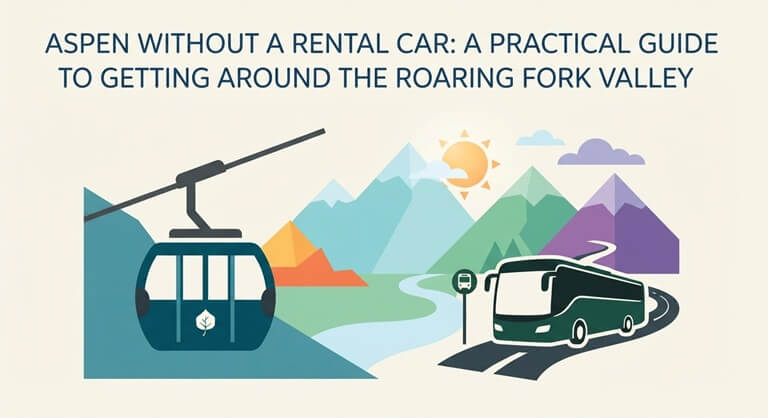
Here’s how to think about an Aspen trip without making a rental car the center of it.
Getting From the Airport Into Aspen
Start with the first journey: the airport.
Aspen/Pitkin County Airport is close to town, making the arrival experience different from destinations where the airport is an hour or more from the resort area.
Visitors have several transportation possibilities depending on their priorities.
The City of Aspen notes that buses operating between Aspen and Aspen/Pitkin County Airport are free. Travelers can check the Roaring Fork Transportation Authority for current schedules and route information.
For someone traveling lightly and without a strict schedule, public transportation may be perfectly suitable.
Other travelers may prioritize direct pickup, privacy, luggage space, or a vehicle dedicated to their party.
A family carrying ski equipment, for example, may evaluate the airport journey differently from a solo traveler carrying one small bag.
This is where researching car service from Aspen airport before departure can be useful. Rather than assuming one transportation method is automatically superior, travelers can compare convenience, passenger requirements, timing, luggage, and cost.
Understand RFTA Before Your Trip
RFTA—the Roaring Fork Transportation Authority—is one of the most useful resources for visitors trying to reduce their dependence on a rental car.
The system connects Aspen with communities throughout the Roaring Fork Valley, while the City of Aspen also operates fare-free local shuttle routes. Current city information identifies routes serving destinations including Aspen Highlands, Buttermilk, the West End, Hunter Creek and other areas.
Before traveling, spend a few minutes looking at the official RFTA route information.
That small amount of research can completely change how you plan the vacation.
Instead of asking, “Where can I drive today?” you can begin asking, “What’s the easiest way to reach this particular destination?”
Those questions don’t always have the same answer.
Getting Around Aspen Itself
Once you’re in town, a vehicle can sometimes become more responsibility than convenience.
Parking, retrieving the vehicle, navigating short distances, and finding another parking location all consume time.
Walking can be a better solution for short journeys, particularly when several activities are located near one another.
A useful planning technique is to group the day’s activities geographically.
Instead of:
Breakfast » drive » activity » drive » lunch » drive » shopping » drive » dinner
try:
Transportation » neighborhood » several activities on foot » transportation
This reduces repeated transitions and gives travelers more opportunity to experience Aspen at street level.
You may notice a gallery, coffee shop, restaurant, or public space that would have been invisible from inside a vehicle.
Getting to the Mountains
Ski vacations create an obvious question: if you don’t rent a car, how do you reach the mountains?
Public transportation is part of the answer.
RFTA operates seasonal fare-free skier transportation connecting Aspen-area mountains. The exact routes and schedules can change seasonally, so travelers should verify current information rather than relying on an old travel article.
That last point matters.
Transportation information is unusually sensitive to dates. Routes, seasonal operations, construction, and schedules can all change.
Use articles like this to understand your options, but use the transportation provider itself to confirm the current details.
Maroon Bells Requires Different Planning
Maroon Bells deserves special attention because access is managed differently from an ordinary sightseeing destination.
During periods of managed access, visitors should not assume they can simply drive to the area whenever they choose.
The Aspen Chamber’s current visitor information explains that travelers can use free RFTA transportation from downtown Aspen to Aspen Highlands, where they can connect with the reserved Maroon Bells Scenic shuttle.
Reservations may be required for the scenic shuttle, depending on the trip and season.
This is an excellent example of why a rental car does not automatically make every attraction easier.
Sometimes understanding the transportation system is more valuable than having your own vehicle.
When Private Transportation Makes More Sense
Public transportation works well for many journeys, but it doesn’t solve every travel need.
There are situations where travelers may reasonably prefer a private vehicle:
- Airport arrivals or departures with substantial luggage
- Early or late transportation needs
- Special events
- Business schedules
- Groups traveling together
- Longer regional transfers
- Situations where direct door-to-door service matters
The decision should be based on the journey rather than the assumption that private transportation is inherently necessary.
A provider such as Aspen Way To Go can be evaluated alongside the other available transportation choices when a scheduled private vehicle better matches the traveler’s requirements.
Travelers should compare providers based on practical considerations such as vehicle suitability, communication, pricing transparency, pickup arrangements, and the needs of their particular group.
Going Beyond Aspen
Not every vacation remains inside Aspen.
Visitors may want to explore Snowmass Village, Basalt, Carbondale, Glenwood Springs, or other parts of the valley.
This is where understanding the regional network becomes particularly useful.
RFTA provides transportation throughout the Roaring Fork Valley, while the City of Aspen notes that regional connections extend toward Rifle. The system also connects with other transportation possibilities farther afield.
A day trip therefore does not automatically require a rental vehicle.
However, schedules matter much more for regional trips than for casual movement around downtown.
Check the return schedule before leaving.
The bus that gets you somewhere is only half of the transportation plan.
What About Biking?
During suitable seasons, bicycles add another possibility.
Aspen has invested heavily in alternatives to private automobile travel, and local transportation information includes cycling resources alongside buses and shuttles.
Biking can be particularly useful for shorter recreational journeys when weather, ability, and route conditions are appropriate.
It shouldn’t be treated as a universal substitute for transportation, of course.
Altitude, weather, traffic, physical ability, and route difficulty all matter.
But for the right traveler on the right day, cycling can turn transportation itself into part of the experience.
When a Rental Car Still Wins
A car-free trip isn’t a competition.
There are itineraries where renting a vehicle makes excellent sense.
Travelers planning multiple remote destinations, unusual schedules, extensive regional exploration, or activities poorly served by other transportation may value the flexibility of having their own vehicle.
The mistake isn’t renting a car.
The mistake is renting one automatically without evaluating whether the itinerary actually requires it.
Calculate the entire proposition:
Rental price.
Parking.
Fuel.
Convenience.
Expected mileage.
Alternative transportation.
Number of travelers.
Luggage requirements.
Only then does the comparison become meaningful.
Build a Transportation Mix Instead
The most practical Aspen itinerary may not be completely car-free or completely car-dependent.
It may be mixed.
Imagine a five-day visit where travelers use public transportation from the airport, walk around town, take skier shuttles to the mountains, arrange private transportation for one special evening, and use regional transit for another excursion.
No single transportation method has to win.
Each one simply needs to perform the job for which it is best suited.
That approach can also make a vacation feel less repetitive. Walking through downtown creates one experience. Riding regional transit through the valley creates another. A private vehicle provides a different level of convenience when circumstances call for it.
Plan Around Journeys, Not Vehicles
The most useful change is conceptual.
Don’t begin an Aspen itinerary by asking whether you should rent a car.
List the journeys first.
Airport to hotel.
Hotel to mountain.
Mountain to dinner.
Aspen to Snowmass.
Downtown to an attraction.
Hotel back to airport.
Then assign the most sensible transportation option to each journey.
The City of Aspen’s official transportation resources and RFTA’s current schedules should be among the first places you check when doing this. They provide current information that a static travel article cannot reliably reproduce forever.
Once those pieces are understood, private transportation, walking, cycling, and rental vehicles can fill whatever gaps remain.
That approach turns transportation from a single expensive decision into a series of practical choices—and in a destination with as many mobility options as Aspen, those choices may be considerably broader than first-time visitors expect.
Popular on OTW Right Now!



About The Author

Gagan Bhangu
Founder of otechworld.com and managing editor. He is a tech geek, web-developer, and blogger. He holds a master's degree in computer applications and making money online since 2015.