
Skin Upgrading Versus Case Opening And Trade-Ups
CS2 players who want a better skin have more than one path. You can open a case, use a Valve trade-up contract, or stake a skin on an upgrade site like GudDrop. Most comparisons ask which one is best. A more useful question is what each percentage is a percentage of, and what you are left with when the attempt misses. The three methods answer both differently, and the headline odds are not comparable until you account for that.
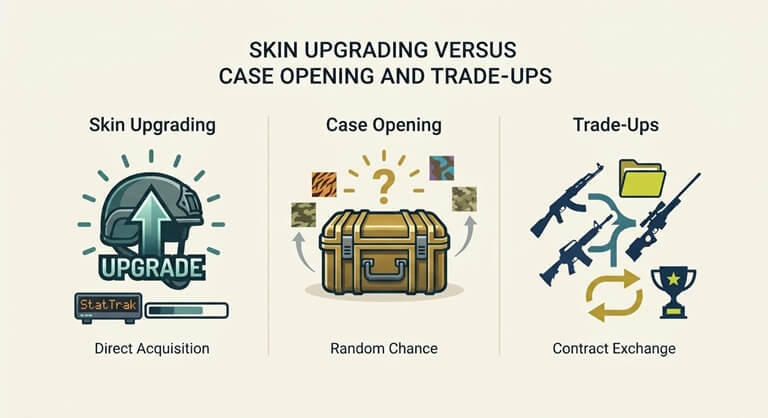
Three Ways to Improve a Skin
Opening a Case
When you open a case, you have the minimum amount of control over the skin that results. You have to buy both a case and a key, and then when you open it you get a random skin from that case’s pool. The key costs $2.49 for each case and this amount is paid every time you open the case, regardless of whether you win or lose. The officially stated probabilities are approximately 79.92% for the lowest grade (Mil-Spec), 15.98% for Restricted, 3.2% for Classified, 0.64% for Covert, and 0.26% for a knife or gloves.
The 0.26% accumulates gradually. The expected number is around 385 openings, equivalent to roughly $958 in keys at a rate of $2.49 each. Yet even after 385 separate openings, the probability of obtaining at least one knife or gloves is only about 63%, so over a third of the players would still end up with none.
Using a Trade-Up Contract
A Valve trade-up gives you greater control over the pool, even if it doesn’t give you control over the individual item. A standard contract requires ten skins of one grade and in return gives one skin of the next grade up, with the skin being taken from the collections that contained the skins you provided. In the case of a standard ten-skin contract, each input accounts for 10% of the collection pool; in the five-Covert contract, each input accounts for 20%. The item finally obtained is taken from the eligible output pool of the selected collection. The quality of the output also depends on the inputs you provide, so the cleaner the inputs, the cleaner the result. There is no key that can be purchased, but the inputs are used up.
The older guides held the view that a trade-up could not yield a knife. This changed in late 2025; from October 22, 2025 onwards, five Covert skins can be traded in exchange for one knife or gloves, which are taken from the collection of one of your inputs. By selecting your inputs, you can limit the collections that contribute to the result, though you cannot determine which item you will receive. The contract is now changed so that it involves exchanging five Covert inputs for one regular knife or gloves item from a collection represented by one of the inputs.
Using an Upgrade Site
At an upgrade site, you can name the target; you can then display one skin or more, select the one you’d like, and the site will show you the success rate before you confirm your choice. According to the GudDrop page, the chances depend on how far apart the value of your items is from that of the target, so the higher the price of the target, the lower the chance of success. With GudDrop, you can choose any chance level between 30 percent and 80 percent, and the page also states that there is no separate fee; your only cost is the items that you have staked, which are lost should the attempt fail.
What you receive
The three methods use the word “chance” for different things, and the result you receive can differ.
| You choose | You pay | The percentage describes | A miss leaves you with | |
| Case opening | The case | Case price plus $2.49 key | The chance of a rarity tier | A skin from the case’s drop pool |
| Trade-up | Which collections feed the pool | Ten skins (five Covert for a knife or gloves) | Each input’s share of the collection pool | One output skin, with a value that can fall below your inputs |
| Upgrade site | The exact target | The staked skin | The chance of the single target you named | Nothing, since the staked items are gone |
That is the reason why a 0.26% chance of obtaining a case and a 50% chance of upgrading cannot be compared directly. The case probability refers to the chances of ending up in a tier, and even if you get a lower-tier result you still receive a skin. The upgrade probability refers to the chances of upgrading one named item, and if you fail to upgrade you get nothing. A trade-up is in between the two because the result of moving to the next grade is certain and has a value.
Comparing Them on One Line
You can treat the three options equally by considering the amount you pay in relation to the amount you can expect to get back. For each possible outcome, multiply its value by the probability of it occurring, add all these values together, and then compare the total with the cost.
- Case: The amount expected to be returned for a case depends on both the case in question and the current prices of the skins, which means that the percentage must be calculated based on the current value of the possible drops. Present trackers indicate that a great many cases are returning considerably less than the price at which they were originally bought.
- Trade-up: The outcome in the case of a knife trade-up is based on the values you provide; the knife trade-ups are particularly dependent on the five inputs and the way in which these inputs are collected. The current calculators explain the need to price all possible outputs before making a decision.
- Upgrade: To upgrade, multiply the chance that is shown by the value of the target and then compare this result with the amount you are staking. For example, if the chance is 40% and the target is $100, the expected target value is $40 when compared with a stake of $50.
What Each Method Suits
Case opening: When you open the case, you select it, but it is the drop table of the case that determines the skin and the rarity.
Trade-up: In a trade-up, you select the input skins and, as a result, affect the collections that are eligible, while the contract specifies the output from among that pool.
Upgrade: When you select the target, you can see the success chance that is shown before confirming your choice, but if the attempt fails, then the items you have staked are lost.
Picking the Right Path for Your Skins
The outcome in a case is left to chance. While a trade-up reduces the number of options, it still selects the item for you. With an upgrade, you are allowed to name the item you want and see its probability before doing so. In order to decide which item you are looking for, GudDrop displays both the probability and the item on the same screen. Regardless of the method you choose, you should compare the amount you pay with the amount you can expect to get back, so that each attempt has a clear rationale behind it.
Popular on OTW Right Now!

About The Author

Gagan Bhangu
Founder of otechworld.com and managing editor. He is a tech geek, web-developer, and blogger. He holds a master's degree in computer applications and making money online since 2015.