
Branded Canopies vs. Traditional Event Tents
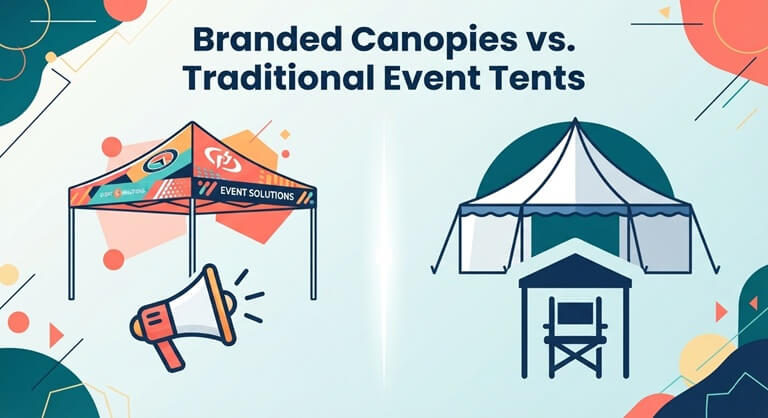
At any busy street festival, attendees walk past roughly 40 to 60 vendor booths in an hour. Each one gets about three seconds of eye contact. A plain white tent uses those three seconds to say nothing. A fully printed canopy uses them to say your name, your colors, and your reason to stop before a single word is spoken. That’s the entire debate in one image, but the decision deserves a closer look, because the answer isn’t always “printed” and the cost math surprises most first-time buyers.
What “Standard” Actually Costs You
A standard ( white or any other solid color) without branding usually costs $100-$300 for a 10×10. It helps to protect products from the sun and rain, and staff from the rain.
Strategically, it’s invisible. Even though it’s invisible, it’s worse. In places where half the vendors have branded tents, a plain tent is a “temporary,” “side hustle,” or “didn’t plan. For better or worse, viewers make credibility decisions within a few seconds, and the presentation is the proof.
Some vendors attempt to fill in the void with a banner, which is tied to the front with a zip tie. It can help, but sagging banners, banners covering just one side of the booth, and banners that are “just an afterthought” don’t help.
What a Printed Canopy Actually Delivers
The same 100-square-foot footprint is custom printed with the tent graphics on the canopy top and valances, and optionally the walls, creating a viewing surface of about 250+ square feet of custom printed graphics from all angles, even overhead at multi-level locations.
The marketing math is what makes it interesting:
Cost per impression collapses over time
A quality printed 10×10 runs $600-$1,200. If you’re using it at 25 events a year, with an average of 2,000 people walking through the doors, then you’re creating 50,000 branded impressions every year! Those pennies per thousand impressions over 3 years are cheaper than nearly any paid channel, and in addition to impressions, we get physical presence and human interaction.
It works before you arrive and after you leave.
Photos of events are shared on social media, the local news media scrolls over vendor lines, and people post their selfies with the vendors. A tent is visible in the print, which is marked with a brand. The background is a white tent.
It pre-qualifies foot traffic.
At 50 feet, your tent tells people what you are selling, and if they walk up to the tent, they already know why they are there. Engage in more passionate discussions and turn them into conversions.
The Sidewall Multiplier
Next is the upgrade most vendors discover too late: the walls. Canopy tents with sidewalls add three or four more full-color printable panels, effectively billboard space at eye level, which is where attention actually lives.
In addition to the branding, sidewalls prevent wind and provide a background for optimal product photography, hide storage bins and coolers, and can be used to close the booth at multi-day events at night. If you need a larger tent or a printed tent with walls, choose a printed tent with walls. The 10×10 with the sidewalls is always going to out-mark the anonymous 10×20.
When a Standard Tent Is Actually the Right Call
Honesty matters here. Skip the custom print if:
- You’re testing a business concept. Don’t brand a tent for a company that might pivot in six months. Buy standard, validate, then invest.
- Your branding is in flux. Printing last year’s logo is money burned.
- You genuinely attend one event per year. The impression is that the math needs volume to work.
- You need a tent by Friday. Quality dye-sublimation typically takes 7-15 business days. (Rush options exist, but plan when you can.)
The printed tent does not constitute an expense for established businesses that are regularly hosting events; it’s owned media, with a multi-year lifespan, and with easy transport included, as modern printed canopies are stowed in the same wheeled bag as a plain tent.
Print Quality Notes That Save You Regret
Not every time you print something is equal. Request dye-sublimation (ink bonded to the fabric, not printed on top), 600D polyester with UV protection that will last more than one summer, and a vector logo file to be submitted to the printer. A stretched JPEG on a 10-foot canopy is exactly what you would think it would look like. Ask for a digital proof and verify on a calibrated screen prior to approving.
Thinking Beyond Outdoor Events
If your calendar includes conventions and expos, the same branding logic extends indoors. Coordinating your printed canopy with matching Trade Show Displays, including backdrops, counters, and banner stands, in the same visual system means one consistent brand presence, whether you’re on a festival lawn or a convention floor, and one set of design assets doing double duty.
Your booth is under a standard tent. Printed tents make good booths. The printed canopy covers its cost with attention alone if you’ll be attending more than a few events this year.
Popular on OTW Right Now!



About The Author

Gagan Bhangu
Founder of otechworld.com and managing editor. He is a tech geek, web-developer, and blogger. He holds a master's degree in computer applications and making money online since 2015.