
How Modern Brick-Making Equipment Is Reshaping Local Construction Supply
Construction technology is often discussed in terms of design software, drones, smart buildings, and connected job sites. Yet one of the most important changes is happening earlier in the supply chain, where ordinary building materials are made. Bricks, concrete blocks, pavers, and curbs may appear simple, but producing them consistently at commercial scale requires careful control of materials, moisture, compaction, molds, handling, and curing.
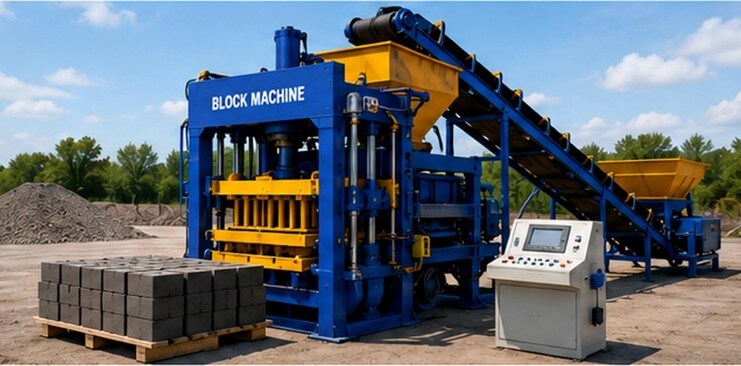
The modern brick-making machinery is making that task a more measurable manufacturing process. Local producers will only benefit from automation when it is used for a purpose. It is about providing consistent products, meeting forecast capacity, minimizing unnecessary waste, and meeting contractors’ demands without relying on overseas deliveries.
From Manual Production to Controlled Manufacturing
In traditional production, operators’ experience needs to be relied upon at all stages. Materials are batched, mixed, loaded into molds, compacted, removed from molds, transported, and cured. If the steps differ, the completed units differ. The dimensions, edges, density, and strength may vary due to differences in moisture, fill level, vibration time, pressure, or handling.
A modern line provides greater coordination of such variables. Feeders may be able to meter material, mixers can have greater uniformity, hydraulic or vibration systems can provide repeatable compaction, and controls can maintain consistent cycles. Even with automation, good raw material quality and skilled supervision are essential – but easier to repeat and diagnose.
Why Local Production Has Strategic Value
Heavy and costly to be transported over long distances. A local producer can shorten delivery times, replenish common sizes faster, and adjust the product mix to meet regional construction needs. This can be useful during rapid development, infrastructure projects, disaster recovery, or supply disruptions.
The local production may not necessarily be more expensive. The business is still in need of demand, working capital, appropriate raw materials, quality control, maintenance, and reliable distribution. The benefits are increased control. A producer would not need to wait for the influx of products from far away, but can synchronize the production with products that are nearer to them and the feedback from their customers.
What Changes When Production Becomes More Automated
Product consistency becomes easier to manage.
Repeatable dosing and compaction help a producer maintain a consistent process. Consistent units make stacking, transporting, laying, and estimating onsite easier. They also eliminate arguments about whether this was a material, machine, curing, or handling problem since the settings for the production can be verified and not assumed.
Equipment is just one component of a quality system. Aggregate grading, cement content, water control, admixtures, mold condition, curing time, and testing practices remain very important. Those controls are provided on a repeated platform with good machinery.
Labor moves from repetition toward supervision.
While automation can minimize repetitive filling, pressing, and handling activities, it does not eliminate the need for human labor in the factory. Laborers are still required for preparing materials, watching the line, mold changing, product checks, equipment maintenance, setting up curing, and dispatch. The difference is that they can invest more time in managing the process, rather than having to make up for it manually.
Mold flexibility can broaden the product mix.
A variety of products can be made from many systems by altering the molds and/or settings. One structural block or partition block can cover all of one business’s structural block, partition block, paving, edging, or landscaping needs. Value depends upon the quality of the mold, mold change, material compatibility, and ability of the sales team to carry the extra products.
Production data improves planning.
On more technologically advanced lines, cycle counters, alarms, stored recipes, and maintenance records help line managers compare planned output with saleable output. That distinction matters. A high theoretical cycle rate will not benefit the business if they are constantly having to stop the machine, reject units, slow down the curing flow, or if there are not enough pallets available.
Define the Business Requirement Before Comparing Equipment
Before selecting a brick machine, buyers should define the products, saleable daily output, raw materials, labor model, power supply, floor space, and after-sales support required by the business.
This helps to avoid a one-dimensional purchase. The bigger or the more automated the system, isn’t always the best. This may be true for a smaller line that is reliable, can fit in the site, and matches proven demand, as compared to a high-capacity line that may run at a lesser capacity.
Start with real demand, not maximum output
Estimate demand per product, by customer type, season,n and delivery radius. Calculate that demand in terms of saleable units per shift. Account for mold changes, cleaning, maintenance, quality checks, material delays, curing limitations, and normal downtime. Equipment should offer sufficient headroom for growth but not be a burden on the company’s fixed expense.
Specify the product range and mold strategy.
The exact size and the types of products desired by the market should be mentioned by the buyer. Inquire about the types of molds on offer, the time required for changeovers, alignment and securing of molds, and replaceable wear parts, as well as the time needed to obtain new molds. Without a fast, inexpensive, and easy-to-support mold program, the flexibility of the machine is rather limited.
Validate the raw-material recipe.
Equipment performance depends on the mix provided. Materials used in the factory demonstration may respond differently to the local sand, aggregate, soil, fly ash, cement, pigments, or any other input. Discuss the following with the buyer: particle size, moisture, binding requirements, mixing time, and local standards. If possible, sample trials should use local materials that are representative of the materials used, not an idealized recipe.
Choose the right level of automation.
Manual and semi-automatic systems may be more appropriate in smaller markets, smaller capital budgets, or where labor is readily available. Automated lines can deliver greater output and consistency, but require more consistent power, skilled personnel, sensors and controls, conveyors, and downstream handling. The “best” automation level is the one that can be maintained and run on a day-to-day basis by the organization.
Plan the entire site, not only the press.
The forming machine can be the key equipment in the line, but it can’t function independently. The project may also need aggregate storage, a batching and mixing plant, conveyors, pallets or a prepared production floor, product handling, a covered curing area, drainage, water, compressed air, power supply and/or a workshop, safe traffic routes. If it’s not laid out properly, it’s possible the speed boost at the machine can be negated.
Treat service and spare parts as production capacity.
A not-moving machine is not a good deal. Purchasers should enquire about the company that will install, commission, train operators, offer remote diagnostics, warranties and replacement parts. The supplier should determine critical spares, components’ expected wear life, technical documentation and normal delivery channels for components. The location of the controls and hydraulic components should be accessible in the market where the equipment is going to be used.
Compare Total Project Cost, Not Sticker Price
The cost of the purchase isn’t all that matters. Additional costs such as freight, insurance, duties, inland transportation, foundations, electricals, molds, mixers, conveyors, pallets, materials for curing, installation, training and initial spares can make a significant difference to the budget. Additional working capital for cement and aggregates, a loader, a forklift, laboratory equipment, additional backup power or other equipment may also be required for the business.
The same should be applied to operating costs. The number of rejects, downtime, maintenance, lubricant, mold wear, pallet replacement, labor per shift, and energy all impact the cost of a saleable unit. The only realistic comparison is based on the same assumptions for all options, calculating cost based on expected utilization, not perfect factory-demo output.
Build a Quality System Around the Equipment
Product stability equals reliable masonry products. The material to be placed in the storage area should be checked, the material mixing should be formulated, moisture content should be determined, cycle should be set, sample frequency should be determined, curing conditions should be set, dimensional check should be done, strength test should be conducted, traceability should be established, and release criteria should be determined by the producer. There should be simple instructions for operators as to what to do when a result goes out of range.
Maintenance should be in the same system. Less costly than emergency repairs-even with less downtime- is the cost of Daily Cleaning, Lubrication, Fastener Checks, Sensor Inspection, Hydraulic Monitoring, Mold Care, and Planned Replacement of Wear Components. Production and maintenance information also identifies if the recurring defect is related to a material change, worn mold, or machine settings.
A Practical Path for Smaller Producers
It’s not necessary to automate all the phases immediately; a small business can start by implementing just one. A phased plan may start simple with a good forming system, a moderate range of molds, written recipes, and a well-controlled quality control process. As needs become clearer and experience grows, material handling, curing, and packaging, or data collection, can be improved.
Mobile or semi-automatic equipment might be a suitable option for some markets, particularly if their product range is limited or if production is required to be near a project. When demand is relatively constant, utilities are available at the site, and the business can maintain the overall balance, stationary automated lines are more appropriate. Growth should go where the current process or process flow is the bottleneck to saleable output: invest in the process where it is currently limiting saleable output.
Material Efficiency and Sustainability
Improved process control can minimize the amount of waste and unwanted process variation. Local production could also reduce transport requirements and enable the use of appropriate local aggregates or recycled materials that have been approved. But environmental claims must be considered for the entire life cycle – from cement to energy to water to curing to product life to delivery.
The most likely sustainability benefit is a logistics benefit: units produced the first time to meet specification, consistent use of material, efficient equipment operation, and no ‘stock’ that the market doesn’t require.
Turning Equipment Into a Competitive Business
The machine makes capacity; the customers make the business. The producer needs to have a plan in place for contractors, distributors, developers, landscapers, municipal buyers, and direct sales prior to commissioning. The terms and conditions of product samples, test results, delivery terms, lead time, and minimum order quantity should be clear. As crucial as a quick production turnaround can be a responsive sales and dispatch process.
Market information is most strongly linked back to production in the strongest operators. They understand which products will sell quickly, which molds cause problems, which customers require custom mould sizes, and which quality problems lead to returns. This feedback helps the business decide when to introduce a mould, a shift, a handling system, or a second line.
Final Thoughts
Local producers can achieve greater consistency, capacity, labor, and variety of their brick products with modern brick-making equipment. It may also reveal inadequate planning on the part of the buyer if they do not consider the utilities, curing, quality control, maintenance, or market demand. It is not just a machine sale that is successful but rather the successful project. It is a total production system that is geared towards the materials, customers, skills, and economics of a particular location.
Once those pieces are “in line,” technology shouldn’t just be a faster way to make units faster. It turns into infrastructure of a dependable regional supply company.
FAQs
Should a new producer choose manual, semi-automatic, or fully automatic equipment?
The choice should be based on actual demand, capital availability, labor cost, technical ability, reliability of utility, and consistency of the product. Semi-automatic lines may be a reasonable approach, and complete automation makes more sense when volumes are constant and the organization can support the total system.
Can one production system make several types of masonry products?
A variety of blocks, bricks, pavers, or curbs can be made in many systems by changing the mold and/or adjusting settings. The buyer needs to verify dimensions/recipes for materials, changeover time, mold cost, and downstream handling/curing parameters for each product.
What has the greatest effect on finished-product quality?
Quality depends on the whole process, starting with raw material, mix-design consistency, moisture control, compaction, mold condition, handling, curing, and testing. Although good equipment will make repeatability easy, it will not compensate for an unstable mix or lack of good curing discipline.
Popular on OTW Right Now!
-
 Why Pressure Washing Is an Effective Way to Extend the Life of Outdoor Surfaces
-
 Best Nearshore Software Development Companies in Europe: What They Actually Cost in 2026
-
 Why Low-Volume CNC Production Is a Strategic Advantage for Product Teams
-
 Localization Management Tools: Choosing the Right Solutions for Your Business Needs



About The Author

Gagan Bhangu
Founder of otechworld.com and managing editor. He is a tech geek, web-developer, and blogger. He holds a master's degree in computer applications and making money online since 2015.