
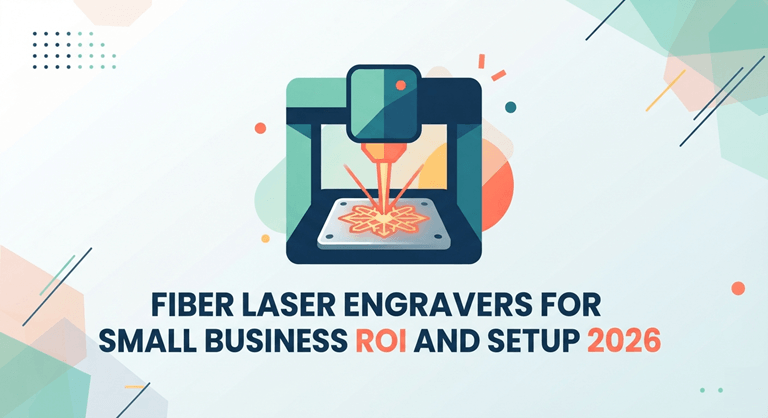
Fiber Laser Engravers for Small Business ROI and Setup 2026
I talked to a knife maker last year who had been paying a local shop to mark his blades for four years. Maker’s mark, steel type, blade number. Simple stuff. He was paying about 3 dollars per blade and running around 150 blades a month. That is 450 dollars a month in marking costs, not counting the time to drive the blanks over and pick them up.
He bought a 20-watt fiber laser engraver for 4,200 dollars. Setup took a weekend. By month ten the machine had paid for itself. By month twelve he had started offering marking services to two other knife makers in his area and was generating an extra 300 dollars a month from that alone.
That story is not unusual. It is actually one of the more moderate examples. Some small businesses reach payback in five or six months. The ones that take longer are usually the ones who bought the machine for potential future revenue rather than replacing an existing cost.
This article looks honestly at where fiber laser engravers make financial sense for small businesses, what the setup actually costs, and what realistic revenue looks like from common applications.
Who Actually Buys These Machines
Forget the marketing for a minute. The small businesses actually buying fiber laser engravers in 2026 fall into a few clear categories.
The first is shops that are already spending money on metal marking or engraving and want to bring it in-house. Machine shops, knife makers, jewelry businesses, tool manufacturers. These buyers have a clear existing cost to replace and the payback calculation is straightforward.
The second is businesses adding a new service capability. A laser shop that already runs CO2 machines for wood and acrylic work, adding a fiber laser to offer metal marking services to clients who ask. A print shop adding engraving. A promotional products company adding metal personalization.
The third is contract marking services. Small operations that buy a fiber laser specifically to offer marking services to local manufacturers who cannot justify in-house equipment. This is a growing market and the startup cost to offer the service is lower than most people expect.
The buyers who struggle with ROI are usually the ones who did not fit any of those categories. They bought the machine because they thought they might find uses for it eventually. That approach works out sometimes. It fails often enough that it is worth being honest about.
The Real Setup Cost
The machine price is the starting number. It is not the total. I have seen too many people budget for the machine and then discover the operation is not fully functional without another 800 dollars in supporting equipment.
Here is what a complete fiber laser engraver setup actually costs for a small business:
- Fiber laser machine 20W: 3,500 to 5,000 dollars. This covers most small business marking applications
- Ventilation setup: 200 to 500 dollars. Not optional. Marking certain coatings and materials produces fumes
- Workbench or table: 100 to 300 dollars if you do not already have a stable surface at the right height
- Fixturing and jigs: 50 to 300 dollars depending on how varied your part geometries are
- Initial training time: plan for a week of learning the software and developing parameters for your materials
- Computer if not already available: fiber laser machines need a dedicated Windows computer for most control software
Total realistic budget for a complete small business fiber laser setup: 4,200 to 6,500 dollars. A shop that plans for that number from the start does not have any unpleasant surprises after delivery.
What the ROI Actually Looks Like
There are two ways to calculate ROI on a fiber laser engraver. Outsourcing replacement and new revenue generation. They produce different payback timelines and different risk profiles.
Outsourcing Replacement
This is the cleaner calculation and the faster payback. You have an existing cost. The machine eliminates it. You know the number.
The knife maker example at the start was 450 dollars per month. Payback on a 4,200-dollar machine in about 9 to 10 months. That math holds at different scales. A machine shop spending 800 dollars a month on outside marking services has a machine paid off in about six months at similar equipment cost. A jewelry business spending 200 a month sees payback around 18 to 20 months.
- Under 300 per month in outsourcing: payback typically 18 to 24 months
- 300 to 500 per month in outsourcing: payback typically 9 to 15 months
- Over 500 per month in outsourcing: payback typically under a year
New Revenue Generation
This calculation is less certain but the upside is higher. You are not replacing a cost. You are creating a new revenue stream.
Contract marking services charge between 1 and 8 dollars per part depending on complexity, quantity, and what the market will bear in your area. A shop doing 200 parts per day at 2 dollars per part average is generating 400 dollars per day in marking revenue. At five days per week that is 8,000 dollars per month from a machine that cost 5,000 dollars to set up.
That scenario assumes consistent volume from day one, which is unrealistic. Building a contract marking customer base takes three to six months of active outreach. But the ceiling on revenue from a fiber laser marking service is meaningfully higher than most people realize when they are evaluating the purchase.
- Jewelry personalization: 15 to 45 dollars per piece for custom inscriptions and logos
- Tool marking services: 1 to 3 dollars per tool for serialization and brand marks
- Industrial parts marking: 0.50 to 2 dollars per part for high-volume traceability codes
- Custom metal gifts and awards: 20 to 80 dollars per piece for retail buyers
Applications That Work Best for Small Business
Jewelry and Personalized Metal Products
This is where most small business fiber laser operators start. Low volume, high margin per piece, and customers who are willing to pay for quality. A laser engraved wedding band inscription takes about 30 seconds and commands 20 to 40 dollars at retail. A personalized stainless steel tumbler with a metal insert takes two minutes and sells for 35 to 60 dollars.
The margin on personalized metal products is substantially better than comparable non-metal products because fewer shops offer it. Most laser businesses run CO2. Adding fiber laser capability to a CO2 shop immediately differentiates the service offering.
Tool and Hardware Identification
Tradespeople lose tools. It is a chronic problem on job sites and in shared workshops. Permanent laser-engraved identification on tools is a service that sells itself once people have seen it. Name, phone number, company logo. It takes under a minute per tool and a reasonable price is 5 to 15 dollars depending on complexity and quantity.
Small shops that market this service to local contractors, construction companies, and trades businesses find repeat customers quickly. Tools get marked at the start of each job season. New hires get their tools marked when they join. The work is simple and the customer relationships are sticky.
Contract Metal Marking for Local Manufacturers
This is the application most people overlook and it has the most reliable revenue profile. Local manufacturers who produce small to medium batches of metal parts often cannot justify a dedicated fiber laser marking station for the volume they run. But they still need permanent identification on their products.
A small shop with a fiber laser can offer batch marking services on a per-piece or per-batch pricing model. The work is repeatable, the customer relationships are long-term, and the revenue is predictable once you have a handful of regular accounts.
What Separates Good Machines from Disappointing Ones
The fiber laser market has expanded fast and the quality range at similar price points is wide. These are the things that actually separate machines that perform reliably from ones that create problems.
Beam quality is the most important specification most buyers do not check. Fiber laser engraving machines with M-squared beam quality below 1.3 produce sharp precise marks at small feature sizes. Systems with M-squared above 1.5 struggle on fine text and small 2D codes, which are exactly the applications small businesses mark most often.
- Beam quality M-squared below 1.3 for precision marking. Verify before buying, not after
- Laser source warranty of at least two years from a supplier who actually honors it
- Software with variable data support for auto-incrementing serial numbers and batch processing
- F-theta lens and protective window availability. These wear and need replacing periodically
- Enclosure class. Class 1 systems allow normal operation without safety eyewear. Relevant for any shared workspace
- Active user community and accessible documentation. When you are dialing in a new material at 11pm, searchable community resources matter
Common Mistakes That Kill the ROI
After watching a lot of small businesses buy fiber laser engravers over the past few years, a few mistakes come up repeatedly.
- Buying for imagined future revenue rather than current costs or confirmed demand. The machine sits underused and the ROI calculation never closes
- Underestimating the learning curve. Getting a machine running takes a weekend. Getting consistent professional results on all your materials takes two to four weeks of regular use
- Skipping the fixturing investment. Parts that move during marking produce bad marks. A simple jig costs 50 dollars to make and saves hours of rework
- Pricing services too low. New operators often underprice because they feel uncertain. 2 dollars per small part sounds reasonable until you add your time, overhead, and the cost of consumables like replacement lenses
- Buying 50 watts when 20 watts covers everything you actually do. The step up in power costs real money and only pays off when throughput is high enough to matter
Conclusion
The knife maker story at the start of this article is not exceptional. It is actually a fairly ordinary outcome for a small business owner who had a clear existing cost to replace and matched the machine purchase to that specific need.
The fiber laser engraver market in 2026 has entry points low enough that the payback calculation works for a much wider range of small businesses than it did five years ago. The machines are more reliable. The software is more accessible. The community of users sharing parameters and solving problems is larger.
None of that changes the fundamental rule. Buy the machine because you have a specific cost to replace or a specific confirmed demand for the service. Not because you think you might find uses for it. The businesses that do the former almost always say the investment was worth it. The ones that do the latter are much less consistent.
About OMTech
OMTech is a laser equipment company based in Anaheim, California. The company manufactures fiber laser engravers, MOPA fiber laser systems, and CO2 laser machines for small businesses and production environments across the United States. Full product information at OMTech.
OMTech fiber laser systems are used by knife makers, jewelers, machine shops, contract manufacturers, and small businesses offering metal marking services. The product range covers 20-watt desktop systems through high-output production units, with US-based technical support and an active user community.
Popular on OTW Right Now!
-
 CMMC for Small Defense Subcontractors: Costs, Timeline, and What the 2026 Pause Changes
-
 One-Stop PCB Assembly: What It Includes and Why a Single Partner Cuts Cost, Errors
-
 Keeping Tabs on Hospital Equipment Without the Headache
-
 The Eternal Charm of the Garden: Why Concrete Bird Baths are the Ultimate Investment for Your Outdoor Oasis

About The Author

Gagan Bhangu
Founder of otechworld.com and managing editor. He is a tech geek, web-developer, and blogger. He holds a master's degree in computer applications and making money online since 2015.