
How to Compare Adult Electric Dirt Bikes Beyond Headline Specs
Adult electric dirt bike listings invite a quick comparison: choose the most peak watts, the highest top speed, or the longest advertised range. That shortcut can produce the wrong bike because it compares isolated claims before defining the rider, terrain, legal use, and ownership plan.
A better comparison works in the opposite order. First eliminate motorcycles that do not fit the rider or intended venue. Then compare the complete systems that remain: energy, power delivery, gearing, chassis, tires, brakes, mass, charging, and support.
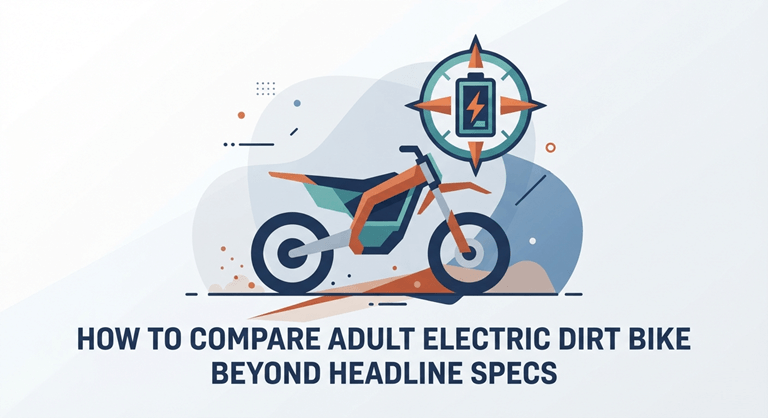
What Matters More Than Headline Specs
To compare adult electric dirt bikes, begin with five non-negotiables: permitted use, rider fit, realistic route energy, controllable trail performance, and ownership support. Peak power, top speed, and advertised range help identify a broad class, but none should decide the purchase alone.
Build a shortlist only after you can answer: Where will it be ridden? Does it physically fit the rider? Can it finish the normal route with reserve? Can the rider control the available performance? Are parts, battery service, manuals, and warranty paths clear?
Caption: A useful comparison starts with the rider, terrain, test conditions, and ownership needs—not a single headline number.
Step 1: Define the Job Before Comparing Bikes
Write a one-sentence job description. For example: “A closed-course off-road bike for an adult rider who values controlled climbing, rides two-hour trail sessions, and transports the bike in a pickup.”
Then define the boundaries:
- rider height, inseam, mass, experience, and physical confidence;
- typical terrain, elevation change, route length, and riding pace;
- private property, designated motorized trail, or another permitted venue;
- transport, storage, and charging arrangements;
- preference for agility, stability, range, or acceleration;
- complete budget, including protective equipment and wear items.
Do not assume an electric dirt bike is treated as a low-speed pedal-assist bicycle. Classification and access can depend on power, speed, pedals, equipment, and jurisdiction. Verify the exact vehicle and intended route with the relevant road or land authority before buying.
The official adult electric dirt bikes collection illustrates why the job description matters: related models can differ in battery, output, wheels, seat height, load guidance, and equipment. The right choice is not automatically the highest-positioned model; it is the configuration that fits the intended operating envelope.
Step 2: Treat Rider Fit as a Performance Specification
Seat height is only one part of fit. Seat width, suspension sag, bar position, peg relationship, chassis width, and total mass affect whether a rider can stand neutrally, weight the front tire, use both controls, and recover the motorcycle during a stop.
Evaluate fit in both seated and standing positions. With the bike secured, powered down, and the rider wearing appropriate gear, check whether the rider can:
- reach the controls without locking the elbows;
- stand with the hips centered and knees free to absorb movement;
- operate both brake controls smoothly;
- move forward and rearward without catching on bodywork;
- support the bike during a stop without extreme overreach.
Payload guidance should include the rider, protective clothing, hydration pack, tools, and any cargo. If a manufacturer does not publish a maximum load, ask rather than inferring it from the motorcycle’s visual size.
Caption: Fit should be checked with the bike secured and the rider in normal protective equipment; seat height alone cannot show reach or standing position.
Step 3: Compare Battery Energy, Not Voltage Alone
Voltage influences the power system’s operating characteristics, but nominal stored energy is better approximated in watt-hours:
Nominal watt-hours ≈ volts × amp-hours
A nominal 60V, 30Ah pack is approximately 1,800Wh on paper. That is not guaranteed usable energy. The battery-management system protects the cells at the top and bottom of the charge window, and consumption changes with speed, acceleration, climbing, surface softness, tire setup, temperature, wind, and total load.
Compare more than nominal watt-hours:
- whether the battery is removable and how it is secured;
- charger output and expected charging time;
- charging-temperature and storage guidance;
- replacement-battery availability and price;
- warranty exclusions and service procedure;
- whether published range includes test conditions.
Treat advertised range as a best-case or stated-condition claim unless the route, speed, load, temperature, and remaining reserve are disclosed.
Step 4: Separate Peak Power From Usable Delivery
Peak power may describe a brief maximum. Sustained climbing depends on the battery, controller, motor efficiency, cooling, gearing, and protection thresholds. Ask whether a listing distinguishes rated and peak power and whether it explains how the values were calculated or measured.
Controller tuning shapes the rider’s experience. A progressive throttle map can preserve grip on loose terrain. Abrupt response may feel faster in a straight pull but make technical sections harder to ride consistently. Ride modes are valuable when they create predictable differences; the number of modes alone says nothing about their quality.
The official high-performance electric dirt bike product page provides model-specific battery, motor, torque, wheel, suspension, and brake information. As with any manufacturer page, confirm current figures and distinguish published specifications from independent field measurements.
Step 5: Connect Torque, Gearing, Wheels, and Tires
Torque claims are meaningful only when the measurement location is clear. Motor torque, countershaft torque, and rear-wheel torque differ because gearing multiplies torque while reducing rotational speed.
Shorter gearing may favor low-speed force and response; taller gearing may favor speed potential. Wheel radius changes the force applied at the ground, and tire construction, tread, pressure, and surface determine how much of that force becomes forward motion.
For a responsible comparison, record:
- where torque was measured or calculated;
- whether it is continuous or momentary;
- reduction ratio, if published;
- front and rear wheel and tire sizes;
- the terrain the setup is intended to handle.
Do not compare one brand’s motor torque with another brand’s rear-wheel torque as if they were the same metric.
Step 6: Judge Suspension, Brakes, and Chassis as a System
Suspension travel does not reveal damping quality, spring suitability, chassis balance, or behavior under braking. Ask whether preload or damping can be adjusted and whether the available setup suits the rider’s loaded mass.
Brake rotor diameter and piston count are useful clues, but they do not replace information about lever feel, heat management, pad availability, tire grip, and total vehicle mass. A higher-speed or heavier motorcycle places greater demands on braking and suspension than a lighter, slower one.
Compare:
- front and rear suspension type, travel, and adjustment;
- wheelbase, seat height, and ground clearance;
- ready-to-ride mass and published payload guidance;
- wheel and tire availability;
- brake hardware, pad availability, and service documentation;
- protection for battery and vulnerable connectors.
The goal is not the largest component specification. It is a chassis that lets the intended rider use the motorcycle’s performance with confidence.
Step 7: Translate Top Speed Into Test Conditions
Top speed varies with battery state, rider mass, tire setup, wind, surface, gearing, temperature, and measurement method. It can identify a broad vehicle class, but it should not be treated as a guaranteed speed for every rider.
Ask how the number was produced:
- Was speed measured by GPS or the motorcycle display?
- Was the result one-direction or a two-way average?
- What were the rider load, charge state, and tire setup?
- Was the surface level and firm?
- Did the test show repeat runs or only the fastest attempt?
For technical trail riders, controllability at lower speeds often matters more frequently than the final few miles per hour. Open terrain may place more value on stability and sustained output. The use case decides which evidence matters.
Step 8: Treat Range as a Route Problem
Range is an outcome, not a permanent property. Once an owner has a bike, the most useful planning method is to repeat a representative loop under recorded conditions:
- Start with a known charge state.
- Record rider load, temperature, tires, pressure, and ride mode.
- Ride a safe, permitted route at normal pace.
- Record distance and displayed charge change.
- Repeat on several days before establishing a planning baseline.
Battery-percentage displays may not be perfectly linear, so keep a conservative reserve. Cold weather, deep sand, mud, sustained climbing, and aggressive acceleration can increase consumption. A larger pack may expand route options but also add mass and charging time.
Before purchase, compare whether the published battery energy and charging plan plausibly support the intended route. Do not convert a best-case range claim directly into a return-to-home promise.
Step 9: Include Ownership and Support
The motorcycle must remain serviceable after the first ride. Verify:
- written warranty coverage and exclusions;
- current manuals and assembly information;
- brake, tire, tube, chain, sprocket, and bearing availability;
- battery replacement and diagnostic support;
- response path for shipping damage or missing parts;
- charger input requirements and safe charging location;
- transport mass and suitable tie-down procedure.
Budget for protective equipment appropriate to off-road motorcycling, plus transport equipment, access fees, insurance where applicable, and scheduled wear items. Purchase price is only one part of ownership cost.
A Practical Adult Electric Dirt Bike Comparison Framework
Do not average away a non-negotiable failure. Eliminate any motorcycle that does not meet the intended legal use, rider fit, load guidance, or charging plan. Then weight the remaining categories according to the rider’s priorities.
Category — What to verify — Why it matters
Access and legality — Exact vehicle classification and route permission — A strong specification is irrelevant if the bike cannot be used where intended
Rider fit and control — Standing reach, braking, support at a stop, loaded mass — Fit affects confidence, fatigue, and the ability to use performance
Energy and charging — Nominal Wh, realistic route demand, reserve, charger, storage — Range claims do not create a workable charging plan
Trail performance — Delivery, gearing, tires, suspension, brakes, repeatability — Usable pace is a system result
Ownership support — Manuals, parts, battery service, warranty path — Serviceability determines long-term value
When a demo ride is available, use the same safe surface, mode, starting charge, and sequence for each finalist. Begin with low-speed control, evaluate braking and standing position, then make repeated moderate-load runs. A structured comparison is more useful than one full-throttle pull.
Product-Listing Red Flags
Treat a listing cautiously when it:
- uses “rated,” “maximum,” and “peak” interchangeably;
- publishes range without speed, load, terrain, or temperature context;
- gives torque without identifying the measurement point;
- presents top speed without a clear measurement method;
- omits vehicle mass, payload guidance, or charging requirements;
- promises universal road or trail legality;
- relies on an outdated specification for a comparison;
- provides no clear parts, manual, or battery-service path.
Missing information does not automatically make a motorcycle poor. It increases purchase uncertainty. Ask for written clarification and keep the response.
Frequently Asked Questions
What should I compare first when buying an adult electric dirt bike?
Start with permitted use, rider fit, and realistic route needs. These can eliminate a bike before peak power or top speed matters. Then compare battery energy, power delivery, mass, gearing, chassis, tires, brakes, charging, and service support.
How much motor power does an adult electric dirt bike need?
There is no universal wattage requirement. The answer depends on rider load, terrain, gradient, desired speed, gearing, and how long high output must be sustained. Compare rated and peak power with the rest of the system rather than selecting a threshold from wattage alone.
Is a 72V dirt bike automatically better than a 60V model?
No. Higher nominal voltage can support different power-system designs, but it does not guarantee better acceleration, range, or reliability. Battery energy, controller current, motor efficiency, gearing, mass, thermal limits, and tuning all matter.
How can I compare battery size between electric dirt bikes?
Calculate nominal watt-hours by multiplying nominal volts by amp-hours, then compare charging time, removal, replacement support, warranty terms, and stated range conditions. Watt-hours are more useful than voltage or amp-hours alone, but they still do not guarantee real-world range.
How important is electric dirt bike weight?
Weight affects acceleration, braking, transport, maneuverability, and how easily a rider can recover the bike. Include the rider and gear when thinking about system mass, and distinguish dry, curb, shipping, and ready-to-ride weights if listings use different definitions.
Should I choose the bike with the highest top speed?
Only if high-speed use is both permitted and central to your riding. Technical trails may reward low-speed control, traction, braking, and manageable mass more often. Confirm how top speed was measured and whether performance remains repeatable as charge and temperature change.
How do I know whether an advertised range is realistic?
Look for disclosed rider load, speed, terrain, temperature, tire setup, and remaining reserve. If those conditions are missing, treat the claim as a screening number. Plan the normal route conservatively and build a personal baseline from repeat rides after purchase.
Final Takeaway
Adult electric dirt bikes cannot be compared responsibly by peak watts, voltage, top speed, or advertised range alone. Begin with the rider and permitted use, eliminate poor fits, and then compare energy, delivery, gearing, mass, chassis, tires, brakes, charging, and support as one system.
The best motorcycle is not automatically the one with the largest headline number. It is the one whose complete operating envelope matches the rider’s body, terrain, route, experience, and ownership plan—and whose claims come with enough context to evaluate honestly.
Sources
- Valtinsu, official EM5 Series collection and current model pages.
- Valtinsu, Adult Electric Dirt Bike Comparison.
- Grin Technologies, “The Futility of Motor Power Ratings.”
- SAE Technical Paper 2019-26-0112, battery current control and temperature-based derating in an electric two-wheeler.
- S. state and local road or land-management authorities for vehicle classification and route access.
Popular on OTW Right Now!



About The Author

Gagan Bhangu
Founder of otechworld.com and managing editor. He is a tech geek, web-developer, and blogger. He holds a master's degree in computer applications and making money online since 2015.