
Buying Connected Accessories Without Guessing at Compatibility
Connected accessories create a particular sourcing trap. Many listings name a familiar connection, a supported device type, or a useful feature, and the buyer fills in the rest. Risk follows. Compatibility claims can sound precise while hiding assumptions about fit, power, firmware, dimensions, operating conditions, or the version of the companion device. Where packing constraints are also vague, the first real test happens after the goods have crossed the handoff point.
When a disciplined buying process is employed, compatibility must pass the supplier evaluation, sample inspection, quality inspection, and shipping solution. A supplier is not required to guarantee that a product will be compatible with everyone. Instead, it provides documentation of the particular environment that the buyer plans to sustain.
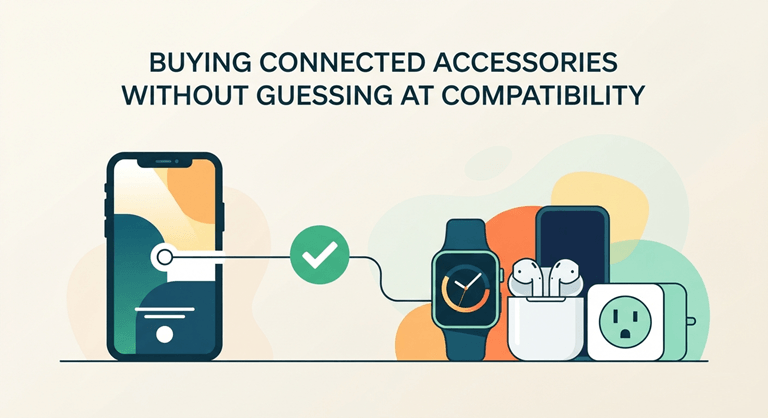
Describe the connection in the buyer’s own context.
Start with the situation, use case,e and device. Those three pieces are essential to make a compatibility claim. Think about if the accessory needs to be by a workstation, carried in a bag, be mounted on a panel/screen, be plugged into a specific port, or fit into a consistent workflow. Buyers should clearly identify, in their own words, the known environment in question, and relate it to the controlling reference they have internally.
The idea of separating the terms is to avoid having a familiar word do too much work. The meaning of “works with” is that a plug fits, a function is activated, a surface removes an obstruction, or a package contains a specific component. The following two are distinct statements. After the buyer has isolated them, supplier evaluation may focus on the relevant one – but not a question that no one asked.
Version control is part of this description, too. A purchaser may record in their notes the model of companion device they purchased, the port the device is compatible with, the adaptor included with the device, and the physical orientation of the device, but not suggest that all future setups will function in the same manner. The information helps the reviewer to have something to compare with the supplier’s response and the subsequent sample.
Use supplier evaluation to reveal missing assumptions.
HiSourcing’s product sourcing page defines the sourcing task based on the buyer’s needs. If the accessory is connected to other items, supplier evaluation should include a review of the chosen version, connected context, included parts, and any assumptions that may impact intended use. A specific restatement would be better evidence than a general assurance because it allows the buyer to discover a defect prior to taking the sample.
Ask the supplier to separate confirmed product information from items that still lack a reference. It’s not a hostile demand. The exchange can be a time to clarify ambiguity on both sides. If the answer includes an accessory version, has left out an essential accessory, or has given a general compatibility, the buyer knows that the decision is not going to take place yet.
Make sample inspection physical and functional.
Actions that are relevant to the setting should be included in the sample inspection. Inspect shape, grip, cable routing, fastening or attaching, and access to neighboring controls and components provided. Then, verify the expected operation in the agreed testing venue. A successful activation of a connection doesn’t necessarily prove the usefulness of a product which was purchased.
Enter the result in the same compatibility claims as specified in the buying request. This is a discipline that comes into play when more than one is involved. One tech could be interested in an interface detail and an operations lead could be interested in packing or replacing handling. Record both observations in the sample inspection record, but neither should be a claim that the sample failed to test.
Give quality inspection a focused acceptance list.
The guidance on the HiSourcing quality-control checklist helps in determining what should be reviewed prior to the inspection. In accessory buying, quality control shall check the model, apparent assembly, accessories, labels, and packing condition of the selected model with the approved model. It is not necessary to declare that all combinations of devices have been tested. Making such a statement would require a different exercise and evidence.
The acceptance list should be detailed enough to catch an unwanted substitution. A different style connector, missing or incompatible adaptor or mounting part can affect the compatibility of the purchaser. Inspection is more meaningful if it documents those differences directly and returns any unresolved items to a named decision owner.
Connect the packing plan to the use case.
Packing compatibility also considers accessories with delicate parts, small components, protective caps, or instructions the receiver must match to the correct accessory. Buyers should determine which items should go together, which items require protection, and which items require a label upon arrival before shipment. This is NOT cosmetics. An interfering problem can occur because a component is separated from the connector or because damage to the connector prevents it from functioning or prevents the other connector from attaching.
HiSourcing’s shipping solution treats shipping as part of the sourcing process. In this context, the shipping solution should go through the supplier handoff with the accepted version and packing expectations rather than the time when the accessory has already been considered as a final call.
Use independent trade guidance as a boundary, not a shortcut.
Serving the Chinese market isn’t just about goods; the International Trade Administration has an entire China services webpage to demonstrate. Therefore, you should be wary of using the sourcing file as a replacement for destination-market guidance, contract audit, or compliance efforts. The compatibility evidence is used to manage the requested accessory, and is not offered as a response to all commercial or regulatory issues in connection with the transaction.
Tracing compatibility evidence
Compatibility evidence trail
| Claim to check | Evidence | Decision owner |
| Physical fit | Reference device or interface note | Product buyer |
| Functional use | Sample inspection observation | User or technical reviewer |
| Selected version | Supplier evaluation restatement | Sourcing contact |
| Arrival condition | Quality inspection and packing handoff | Receiving team |
Make a clear stop decision when evidence is missing
An important aspect of this is to be willing to stop. When the supplier can’t determine the version selected, cannot provide the required sample for the version listed as compatible, or when the supplier’s packing plan splits up a part the receiver requires, the buyer has a useful finding. Advancing the discussion – if the item seems close by, it just makes it another issue for later.
For a starting point, a buyer-led sourcing workflow can help keep the product request at the center of the exchange. HiSourcing is not a source of a device’s technical approval; each buyer is responsible for outlining the environment and accepting the evidence that is relevant to this environment.
Respect the limits of a written trail.
A compatibility evidence trail minimizes avoidable mismatches. It is not a substitute for device testing, local approvals, warranty conditions or manufacturer’s statement of compatibility. Nor can it ensure that a future software update, or a different installation, will maintain the same result. The value is that it makes the buyer’s claim more specific so that the buyer can inspect it and make it more narrow for the buyer to defend the claim.
That is better than relying on a general listing language to encompass the desired application. The readers should be able to understand the relationship between the supplier evaluation, sample inspection, quality inspection, and shipment solution in making the accessory decision.
Popular on OTW Right Now!




About The Author

Gagan Bhangu
Founder of otechworld.com and managing editor. He is a tech geek, web-developer, and blogger. He holds a master's degree in computer applications and making money online since 2015.