
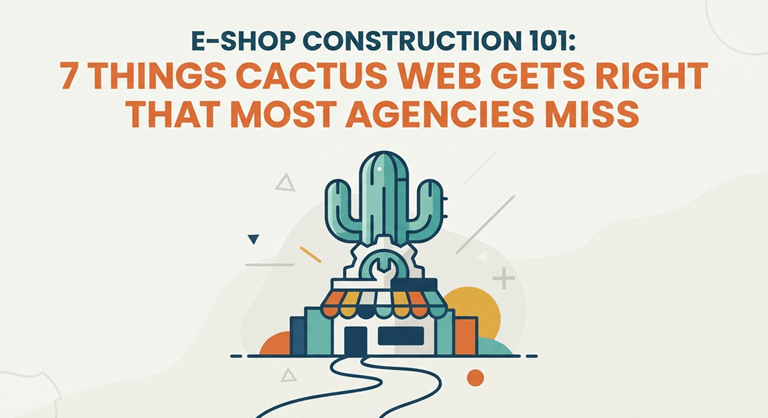
E-Shop Construction 101: 7 Things Cactus Web Gets Right That Most Agencies Miss
Most guides to building an online store stop at picking a platform and adding a payment gateway. That gets you a live site, not a store that actually converts. The difference between the two becomes evident in the study that’s conducted prior to the first page being designed and the compliance work that is conducted after the launch.
Since 2010, Cactus Web has created more than 400 online stores, and there’s a clear trend in those that have them. Below are seven things a proper E-shop Development (Κατασκευή Eshop) process gets right that faster, cheaper builds routinely skip.
1. Research Before Writing Code
Before any developer is able to work on the template, there’s a true build that begins with competitive analysis and category approach – who is ranking, what is working on their product pages, what is causing friction in the checkout process that is losing customers. If you don’t pay attention to this, you’ll create a pretty-looking store, but no one has considered what the buyer wants in this category, and thus they will not buy anything from you.
2. Discovery Deliverables, Not Guesses
Discovery should yield tangible results, not a discussion – a sitemap, a product taxonomy, and a content plan. Avoiding discovery deliverables is an expensive, hit-and-miss strategy as agencies try to piece together the structure during the build process.
3. ERP and CRM Wiring
A real store connects to whatever the business already runs on. Syncing inventory, orders, and pricing with systems like an ERP or CRM keeps stock counts and invoicing accurate, instead of leaving a shop owner to reconcile two systems by hand every night — the kind of wiring Cactus Web treats as standard rather than an upsell.
4. Withdrawal-Button Compliance Built In
It will no longer be possible to return a product by e-mail – but only if the customer has to do it in electronic form – if it was offered on a web store from 1 June 2026. This is a relatively new requirement, and many older store designs don’t comply, and some newer designs don’t either.
| Practice | Careful build | Fast-track/template build |
| Pre-build research | Competitor + category analysis | Skipped or assumed |
| Discovery output | Sitemap, taxonomy, content plan | Verbal brief only |
| System integration | ERP/CRM sync | Manual spreadsheet updates |
| Legal compliance | GDPR-compatible withdrawal button | Implemented post-hoc, if at all |
| Typical price range | €1,500–€8,000+ | Underestimated, then additional charges are levied |
| Post-launch assistance | Professional assistance offered | No assistance available |
The price of the costs depends on the scale: an e-commerce website with the basic functionality will cost around €1,500 – €8,000, according to recent research carried out by the Greek market. If your quote is lower than that, then it’s likely that it is missing one of these items.
5. Realistic Timelines, No Shortcuts
It’s a red flag – not an advantage – if the 7-day ready-made newspaper ads are placed. If a building does not have time to research, test, and integrate, it is not ready when it is launched; it is only ready when the owner is aware of what he is missing.
6. Support Packages After Launch
A store needs upkeep: security updates, plugin conflicts, seasonal traffic spikes, the occasional broken checkout after a payment provider update. Building this into a defined support package, rather than treating launch as the end of the relationship, is what separates agencies that still answer the phone a year later from those that vanish.
Greek consumers are shopping online more than ever. A picture that is mirrored in the research conducted by the Greek eCommerce Association 2026, in collaboration with Athens University of Economics and Business, showing the evolution of purchasing behavior continues. A store that’s not created with that in mind is simply shooting in the dark. A serious E-shop Development (Κατασκευή Eshop) engagement is supposed to fill the void that the aforementioned research gap is.
7. Track Record Over Promises
Expertise is a commodity that is open to any and all. What’s checkable is a portfolio of stores that is still running, still ranking, and still selling years after launch, as opposed to a client logo wall. Get live samples from your sector prior to signing up for any contract.
FAQ
How much does it actually cost to build an e-shop in Greece? Again, depending on the number of products, the level of complexity, and the need for inter-system communication, it will range from €1,500 to €8,000. If integration with ERP and CRM is required, it will further increase the cost.
How long should a proper build take? Beware of any person who offers you a completely tested and integrated store in a week. Real research, testing, and integration are time-consuming processes. It typically takes weeks and not days for a build to be considered worth having.
WooCommerce, Shopify, or custom — which one’s right? Scale is all in the way. For those that have standard requirements, WooCommerce or Shopify is sufficient for them with a smaller catalog. When ERP integration or an unusual workflow comes into the picture, it begins to make some sense to go custom.
I don’t sell financial services — do I still need the EU withdrawal button? You do. Does not apply only to financial products – it may also be applicable to any online shop that is dealing with EU citizens, and its implementation began on 19 June 2026.
Why can’t I use an ordinary website instead of a specialized online shop? Not if it is selling products that’s the objective. A brochure website will not be able to process transactions safely — it requires cart, checkout, and inventory logic, which you only get with a proper e-shop setup.
The store that opens the fastest is not the one that is still open 2 years later. The ones that last are the ones that someone did that nobody sees the glory of until it’s gone. The ones that last are the ones that someone did that nobody sees the glory of until it’s gone: the ones that last are the ones that someone did that nobody sees the glory of until it’s gone. That’s what really sets an agency apart from a seven-day headline-chasing agency and one that’s creating a sustainable business. While you’re asking the question, “when does it go live”, ask the question “what will happen after it goes live?”.
Popular on OTW Right Now!


About The Author

Gagan Bhangu
Founder of otechworld.com and managing editor. He is a tech geek, web-developer, and blogger. He holds a master's degree in computer applications and making money online since 2015.