
How Long Does an iPhone Actually Last? A Realistic Look at Lifespan
Everyone asks this question before buying a phone. But almost nobody gets a straight answer. So let’s give you one. This article breaks down real lifespan expectations, generation by generation, based on how Apple actually supports its devices and how batteries and hardware genuinely hold up over time.
Why “How Long Does It Last” Is the Wrong First Question
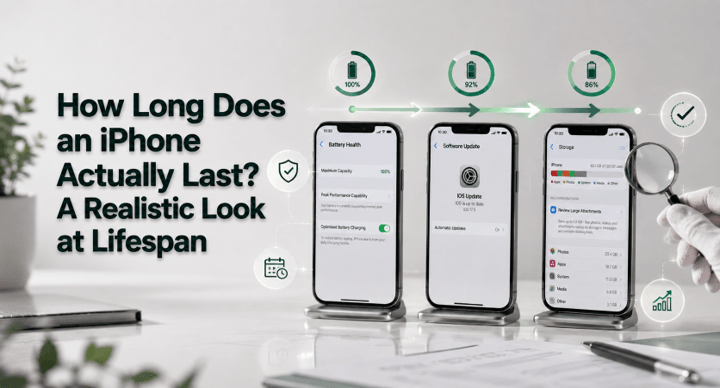
Look, before we get into numbers, let’s reframe this properly. A phone does not simply die one day. It fades gradually, in three separate ways. Software support ends first. Battery performance drops next. Physical hardware, if well cared for, often outlasts both of those.
However, understanding these three separate timelines helps you set realistic expectations rather than expecting a single clean expiration date.
Software Support: The First Timeline That Matters
Apple has built a strong reputation here, better than most competitors. On average, iPhones receive major iOS updates for about 5 to 6 years after release. Security updates sometimes continue a little beyond that window too.
This matters more than people realize. Once major updates stop, newer apps may eventually require features your phone cannot run. This does not happen overnight, but it gradually limits what you can install.
So as a general rule, a phone is considered software current for roughly five to six years. After that point, you can still use it, but you are living on borrowed time regarding full app compatibility. If you are browsing iPhone 15s for sale in Australia, it is worth checking the release date first, since that single detail tells you exactly how many years of updates you still have left.
Battery Lifespan: The Timeline You Actually Feel
Battery wear is a permanent condition, which you can notice every day, unlike software support. This enables Apple to guarantee iPhone batteries will hold about 80 percent of their original charge after about 500 full charge cycles, or approximately two to three years of normal use.
This doesn’t mean that the phone will stop functioning there. This translates to shorter battery life, the need to charge more often, and sometimes even reduced performance during heavy workloads, as the battery delivers less power.
The bright side is that these batteries are replaceable. A new battery in an otherwise good cell phone can really add a few more years to the phone’s life. At a much lower price than new, often,
Hardware Lifespan: The Timeline Most People Underestimate
This is a fact many people may not know. As for the actual hardware of an iPhone, the chip, screen, camera modules,s and more tend to last longer than software support and the original battery.
Assuming reasonably good care, the basic components of an iPhone can easily last for seven, eight or perhaps 10 years. There are lots of older iPhones that work perfectly and still are turned on long after Apple’s official software no longer supports them.
Hence the refurbished market and its existence and growth. Hardware longevity means that even after a phone is past its “new phone” status, it still has a lifespan.
Breaking It Down by Recent Generations
Let’s be more specific, as general timelines are helpful to a certain extent. A realistic perspective of the popular recent generations today.
The iPhone 15 is now firmly in its software support life, and there is likely to be a few years of updates to come. On the battery front, most of them still perform well, but they weren’t given a full charge because they are often left plugged in all night. This generation still has a good amount of time remaining before it’s time to replace it for today’s buyers.
This runway only gets longer with each new release. A newer chip typically means a longer period of support (as Apple is more focused on release dates than on model tiers).
The iPhone 16 is a step further down that same runway, and will receive an extended roll of promised updates from now on. If you’re thinking long-term support, you’re just paying for additional years of support.
In either case, they are still good options in 2013. The actual distinction is between the number of update years you’d like in front of you before upgrading again.
What Actually Shortens a Phone’s Life Faster Than Normal
Some practices can cause a lot of wear, no matter which generation you have. Learning these will help you safeguard the phone you end up choosing.
The number one silent killer can be hot weather. Whether you leave it in the sun, leave it in a hot car, or play games while it charges, there’s too much heat applied to the battery to negatively affect its chemistry.
Full discharges are also performed unnecessarily, wasting strain. Extending your battery to near 0% capacity and then recharging it often will wear it out faster than topping it up daily.
Obviously, there is physical damage, too. A broken screen or bent frame is more than just an eyesore. It may impact water resistance and other inner components’ alignment, at times resulting in a considerable reduction in the instrument’s working life.
Realistic Lifespan Expectations Summed Up
When tied together, then, how long does an iPhone last? This is a reasonable and equitable expectation for most iPhones that are well cared for.
Typically, full software support lasts 5-6 years from the date of the software’s release. One should expect a drop in battery performance from about year 2 to 3, although this could be greatly delayed with a replacement battery. The actual life of the physical hardware, if properly cared for, can be 7 to 10 years for the entire computer system.
This doesn’t mean that you have to settle for a low-quality phone if you purchase one today, in particular, since you can find a good refurbished channel that is a somewhat older generation; it’s just that you are into that period of a lifespan a bit later than the person who bought the car brand new on the day it was released.
Making a Smart Decision Based on Real Lifespan
If you are going to upgrade every 2 or 3 years anyway, then it doesn’t make as much sense to wait for the very latest version, as you will be upgrading before the older versions’ limitations ever become relevant to you.
That makes sense if you’re looking to keep your next phone for 4 years or more and want a phone with software support for that many years. If so, it pays to be slightly newer; in this case, even within the refurbished market, it is better over the phone’s entire life. This is worth keeping in mind while browsing iPhone 16 for sale in Australia, since its longer support window can make it the smarter long-term pick over an older generation.
Whatever the case, the health of the batteries at the time of purchase is very significant, regardless of generation. You’re just as likely to get a better performance from a three-year-old phone with 90 percent battery life as from a two-year-old phone with 78 percent battery life, because people use their phones in so many different ways.
Final Thoughts
Let’s sum it up, then: An iPhone won’t just stop working on a predetermined date. It slows down in 3 ways, and if you know all 3, you will have a much better picture than any one number.
You should not take into account the model year alone, though. Inspect the battery condition. Consider how long you’ll be using the phone. And keep in mind that software patches and the original battery may have a shorter lifespan than good hardware. Remember when you purchase, and you’ll probably find that your next iPhone will last much longer than you’d expect.
Popular on OTW Right Now!



About The Author

Gagan Bhangu
Founder of otechworld.com and managing editor. He is a tech geek, web-developer, and blogger. He holds a master's degree in computer applications and making money online since 2015.