
The Tech-Driven Evolution of Personal Care: Why Brands Are Ditching In-House Manufacturing
Let’s be honest about how we view technology in the business world. When most of us think about “tech-driven business,” our minds immediately jump to SaaS platforms, artificial intelligence, or maybe the latest smartphone release. We rarely think about the bathroom cabinet.
If you look closely at the personal care and wellness segment of the consumer goods sector, you will notice that the transformation of the sector is massive, tech-enabled, and happening right in front of us. How brands are creating, growing, and shipping physical products has completely shifted.
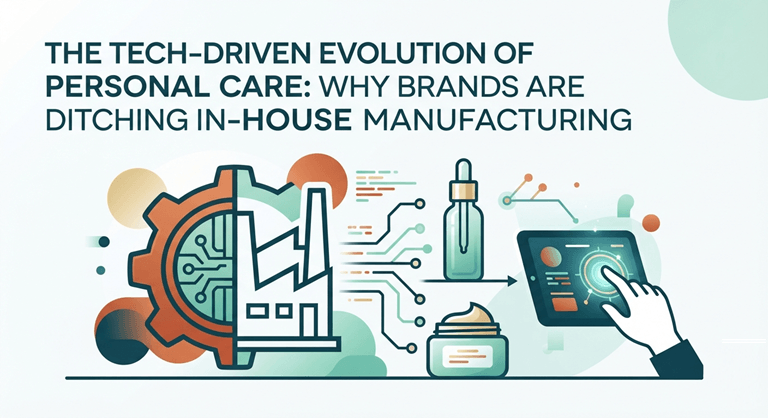
The biggest shift? The fastest-growing and best-known personal care companies are no longer constructing their own plants. They have come to understand that owning heavy machinery is a burden and not an advantage in a fast-paced and agile world. Rather, they are relying on very narrowly focused, technology-enabled manufacturers.
The Problem with the Legacy Model
The blueprint for creating a successful consumer goods brand had been the same for years. You have raised a significant amount of capital, employed a team of chemists, leased a warehouse, purchased expensive mixing tanks and packaging lines, and spent 2 years preparing the product for market.
This is a very “pure” model, with a very strong legacy. You can be tempted to continue running the same machines if you own the factory, so you will be tied to the more limited product formats. When demand for a product like traditional toothpaste in plastic tubes shifts to a new product like toothpaste tablets or concentrated mouthwash, you are left with a problem. You can’t just flip a switch and retool a million-dollar factory overnight.
In addition, the compliance and quality control for personal care products are enormous. It’s not just about mixing ingredients – it’s about microbial testing, stability protocols, pH balancing, and heavy metal screening. That amount of scientific precision demands a huge investment of technology and people on an ongoing basis.
The API-ification of Physical Goods
What is happening right now is called ‘API-ification’ of physical manufacturing. Nor do modern personal care brands construct factories; they use AWS or Google Cloud. They connect to already in place and very sophisticated manufacturing systems.
That’s where things happen magic. With a modern brand, all other aspects of the business can be left to the professionals, and they can focus on what they do best – build the community, build the brand, create digital marketing strategies, acquire customers, and tell stories. They work with a specialized manufacturer (B2B) on the actual production of the product.
They’re not the old way, slow-moving factories; they are the modern-day contract manufacturers. They are, in fact, well-equipped laboratories that are embedded in the agile production lines. They already have ISO certified clean rooms! They have an electronic inventory tracking system already in place. They already have the chemists on board who know how to stabilize a new and popular active ingredient.
If a brand wants to launch a comprehensive line of private label oral care products, they don’t need to spend two years figuring out the chemistry of nano-hydroxyapatite or the exact foaming ratio of a mouthwash. The manufacturing partner already has base formulations that have gone through rigorous stability testing. The brand is able to alter the flavor profile, the active ingredients, and the packaging, and have a premium product available in a much shorter time than would be typical.
Speed as a Competitive Weapon
In the digital era, it’s speed to market that is the final competitive tool. No longer do consumer trends follow the lead of glossy magazine pages and covers, but rather examples of viral TikTok videos and podcast deep dives.
When consumers discover a product that has a teeth-whitening or enamel-repairing ingredient, and it suddenly becomes popular, they want to purchase that product right away. However, the legacy brands have their own manufacturing processes, which means it can take up to a year and a half to develop, test, and launch a new product. It is by this time that the trend is usually at its highest and beginning to wane.
A fast-moving brand with a contract brand manufacturer is on a different schedule. As the manufacturer continues to work on developing new formulas and finding new ingredients in trend, the brand can tweak an existing formula that is sure to work. They can perform compliance testing and have the new product on the production line in just a few months.
This agility enables contemporary brands to ride the waves of consumer trends and not be forever playing catch-up.
The Hidden Tech in Quality Control
There are many misconceptions about outsourcing manufacturing, but chief among them is that you lose control of quality. In fact, if you connect with the right niche manufacturer, your quality control becomes a lot better.
Today, the personal care industry is very technologically dependent. We are talking about automatic, closed-loop mixing systems that make sure that the ratio of ingredients is 100% correct. It’s digital sensors that measure real-time temperature and viscosity during the manufacturing process. It’s not something that most of the independent brands would be able to afford to buy on their own: high-tech equipment used in microbial and stability testing.
By connecting to a high-level manufacturing partner, a brand can have access to all this enterprise-level technology. Their products are made in the most rigorous environment worldwide, and they know that.
The Future is Collaborative
Looking into the future of the personal care industry, it’s easy to see how tech companies are becoming personal care companies. The brands that will rule the next 10 years will be those that act like an agile tech startup, meaning they will be concerned with user experience and data-driven marketing, and outsource the heavy lifting to outside infrastructure.
Businesses which refuse to embrace outside experts, which refuse to leverage the expertise of others, will be outmaneuvered by smaller, faster, and more flexible businesses. Ownership of the factory no longer is a flex in 2026 and beyond; it’s a bottleneck. The real magic is in developing strategic partnerships, working with the right manufacturing partners, and getting to market on products that are great ideas sooner than anyone else.
The Supply Chain as a Service
This change is a natural progression that brings us to a concept that is going on a massive trend: Supply Chain as a Service (SCaaS). Software as a Service (SaaS) changed the way businesses operate in the software industry by eliminating the need for businesses to create their own software. The subscription is paid, and a world-class product is yours to enjoy.
It’s the same thing that’s happening in the physical product space. By joining forces with an advanced contract manufacturer, a brand becomes a member of a world-class supply chain. No need to search for raw materials on various continents or to engage in negotiations with packaging suppliers and in the logistics of international freight for each component. The manufacturing partner will have all the backend complexities. They are used to negotiating better prices on raw materials, they have to deal with the complex system of suppliers, and they make sure the finished, assembled product is delivered on time. This gives the brand founders a night’s sleep; their business is in the hands of professionals who are dedicated to getting it done.
At the end of the day, it’s a decision to focus on growth, to outsource manufacturing. Again, it’s a recognition that a modern consumer’s brand isn’t about owning a mixing tank; it’s about the relationship to its consumers. In this collaborative, tech-driven production model, brands can break free to disrupt, scale, and innovate the traditional industries at an unprecedented speed.
Popular on OTW Right Now!
-
 Never Miss a Moment: How London’s Same-Day Florists Save the Day
-
 How Birdfy Is Reshaping Our Connection to Nature: From Chaotic Days to a 5-Minute Daily Mental Reset
-
 How to Choose a Hydrogen Gas Detector for Hydrogen Energy and Industrial Applications
-
 Does head-to-head record actually predict anything? The numbers say no



About The Author

Gagan Bhangu
Founder of otechworld.com and managing editor. He is a tech geek, web-developer, and blogger. He holds a master's degree in computer applications and making money online since 2015.