
How Smart Automation Is Turning More Leads Into Customers in 2026
Most businesses today aren’t short on leads. Forms get filled, chats get started, WhatsApp messages come in, and ad campaigns keep the pipeline full. The real challenge shows up right after that first click: what happens to the lead once it lands in your system?
As IBM notes in its analysis of AI marketing automation, this shift toward autonomous, always-on systems is accelerating fast; Gartner projects that by 2028, 33% of enterprise software applications will include agentic AI, up from less than 1% in 2024.
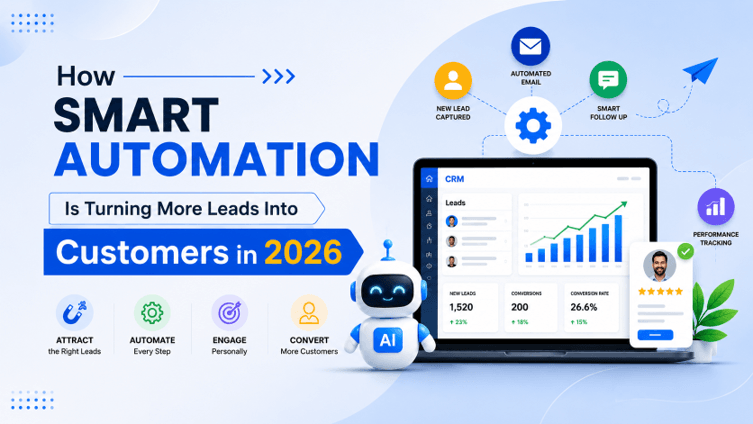
That single insight explains why sales and marketing automation has become central to lead conversion in 2026. Speed, consistency, and personalization at scale are no longer nice extras. They are what decides whether a lead turns into a customer or quietly moves on to a competitor.
This blog breaks down what has changed in lead conversion this year, the tools and automation practices driving it, and how businesses can start building a system that actually works.
Why Lead Conversion Looks Different in 2026
Working closely with businesses as Zoho Consultants, we have watched this shift happen up close over the past couple of years. A few changes have quietly redefined what “good” lead conversion actually means.
- Buyers now research and compare products on their own before ever speaking with a sales rep, so by the time they reach out, they expect a relevant, informed response rather than a generic pitch.
- Leads arrive from multiple channels at once, including websites, social media, live chat, and messaging apps like WhatsApp, and each one needs timely follow-up.
- Response speed has become one of the strongest predictors of conversion, often mattering more than the quality of the message itself.
- Buyers expect follow-up that reflects what they actually looked at or asked about, and generic, one-size-fits-all messaging tends to get ignored.
- A single buyer may interact with a brand several times through an ad, a blog post, an email, and a chat message before booking a call, and every one of those touchpoints needs to be tracked in one place.
Put together, these shifts mean conversion is no longer mainly a messaging problem. It has become a systems problem, and systems are exactly what automation is built to solve.
The Automation Capabilities Driving Better Conversion
A handful of automation features have moved from optional to essentially standard for teams that want to consistently convert leads.
Instant Lead Scoring and Routing: The system scores each lead on arrival based on source, behavior, and fit, then sends hot leads straight to the right rep, removing the manual sorting that used to slow down the first response.
AI Sales Agents: These now hold real qualifying conversations on a website or WhatsApp, answer common questions, capture details, and book meetings or hand off with full context. They run unattended overnight and across time zones, which matters since buyer research increasingly happens off business hours.
AI-Drafted, Rep-Reviewed Proposals: The CRM pulls deal details and pricing rules to generate a first draft, so the rep’s job shifts from writing to reviewing. Checking numbers and adding judgment a system shouldn’t make alone cuts turnaround time without removing the human check.
AI-Assisted Follow-Ups: The system drafts a check-in based on what a lead last viewed, and the rep sends, edits, or skips it. Deals stop going quiet simply because a rep got busy.
Native Integrations: A CRM can pull data directly from ad platforms, WhatsApp Business, email tools, and website chat without separate middleware. Everything stays in sync without a business stitching tools together manually.
Omnichannel Capture: A lead started on Instagram, continued on WhatsApp, and finished on a form is still treated as one lead with one combined history. No team sees a fragment of the story instead of the whole thing.
Behavior-Based Qualification: Scoring factors in what a lead actually does pages visited, emails opened, time on a pricing page, rather than static details like job title alone. It gives a far more accurate read on real intent.
Adaptive Nurture Sequences: The system branches a lead down a different path depending on whether they click, reply, or go quiet. No two leads get the same fixed set of emails, regardless of how they engage.
Real-Time Sync Between Marketing and Sales Data: Every touchpoint, from the first ad click to the most recent email open, is visible to the rep before the first call; nobody has to piece the journey together from memory.
Businesses have several strong options when it comes to choosing the right platform for this. Tools like HubSpot and Salesforce are popular choices, both now shipping their own AI agent features for qualifying and routing leads. Zoho CRM and Zoho Marketing Automation stand out for how tightly they connect marketing and sales data natively, with Zoho’s own AI assistant, Zia, handling lead scoring and next best action suggestions, and WhatsApp, chat, and email integrations built in rather than added on through third-party connectors.
What a Modern Automated Conversion Funnel Looks Like
Strip away the specific tool names and the modern conversion flow follows a fairly consistent shape: capture, score, route, nurture, and alert.
Here is how that plays out in practice:
Instant Capture: A lead fills out a form, sends a chat message, or reaches out on WhatsApp, and a webhook or API call logs the interaction to the CRM in real time, timestamping the first touch before any human sees it.
Automated Scoring: The system automatically scores the lead using a weighted model that combines rules-based criteria (job title, company size, source) with behavioral signals (page depth, session duration, return visits), producing a numeric score without waiting for manual review.
Instant Routing: High-intent leads, those crossing a predefined score threshold, route instantly to the right rep through assignment logic based on territory, product line, or round-robin load balancing, along with full context on source, pages viewed, and prior interactions.
Auto-Enrolled Nurture: Lower-intent leads are automatically enrolled in a nurture sequence via a workflow or blueprint process rather than being ignored or left for later, with branching logic determining the next action based on engagement.
Background Re-Scoring: As nurtured leads show more engagement, reopening an email, revisiting the pricing page, or triggering a tracking pixel, the system quietly re-scores them in the background and updates their position in the sequence.
SLA-Based Alert: Once a lead’s score crosses the “ready to buy” threshold, sales receives an automatic alert through an SLA-based notification rule, so the handoff happens within minutes instead of by chance.
Common Mistakes Businesses Still Make
Even with better tools available, many teams are still leaving conversions on the table because of a few recurring mistakes.
- No Shared Context: Running marketing automation and the CRM as two separate systems means sales often works without full visibility into how a lead has already engaged.
- Impersonal Automation: Automating follow-up without personalizing it can do more harm than good, since a message that reads as an obvious bulk email tends to erode trust rather than build it.
- Missing Feedback Loop: Skipping the feedback loop between sales and marketing means marketing keeps sending the same volume of low-quality leads, because no one is telling them which “hot” leads actually converted.
- Manual Mid-Funnel: Automating the early stages well while leaving the middle of the funnel manual often causes the biggest drop-off, since that stretch between first contact and decision is where most leads are lost.
- Outdated Scoring Models: Letting scoring models and nurture sequences run untouched for months allows them to drift out of sync with how buyers are currently behaving.
How to Roll Out Automation, Step by Step
None of this requires replacing every existing tool at once. Businesses that see the fastest improvement usually start with a narrow, focused first step.
- Audit the Gaps: Audit where leads are currently falling through the cracks, paying close attention to multi-day follow-up gaps, leads with no scoring at all, and tools that do not talk to each other.
- Fix One Integration: Pick one integration point to fix first, commonly connecting web form submissions directly into the CRM with automatic assignment rules so no lead sits unassigned.
- Add basic lead scoring: Before attempting complex nurture flows, since even a simple points based model is a major improvement over no scoring at all.
- Set Speed Benchmarks: Set a clear internal benchmark for speed to lead and automate alerts, so reps know within minutes when a high-intent lead comes in.
- Expand Gradually: Layer in nurture sequences, cross-channel capture, and reporting once the core capture-to-assignment flow is working reliably.
In our experience as a CRM implementation company working with businesses across different industries, this is consistently where the fastest, most measurable results show up for clients. The wins rarely come from automating everything at once. They come from connecting the point where a lead is captured directly to the workflows that route and act on it. Once that foundation is solid, layering in scoring, nurture, and reporting becomes far easier to get right.
So, Where Your Businesses Should Focus Next?
Automation in 2026 is not about replacing sales reps with software. It is about making sure reps spend their time on genuinely ready leads, backed by the context they need to convert them well. The businesses pulling ahead this year are not necessarily generating more leads than their competitors. They are simply losing far fewer of the leads they already have.
If your current process still depends on someone remembering to follow up, checking multiple inboxes, or manually deciding which lead to call first, that is usually the clearest sign it is time to look at where automation could close the gap.
Popular on OTW Right Now!



About The Author

Gagan Bhangu
Founder of otechworld.com and managing editor. He is a tech geek, web-developer, and blogger. He holds a master's degree in computer applications and making money online since 2015.