
Best DMARC Solutions for Enterprise in 2026
Key Takeaways:
- Enterprise-grade DMARC (Domain-based Message Authentication, Reporting, and Conformance) is not about formatting XML files; choosing the right DMARC solutions for enterprise use is about centralizing visibility across hundreds of subdomains and acquired brands without constant, manual DNS edits.
- The biggest bottleneck to reaching a strict p=reject policy is not the DMARC protocol itself, but identifying unauthorized third-party SaaS senders (marketing, HR, sales) using company domains.
- Enterprises sending from multiple platforms quickly breach the hard 10-lookup SPF (Sender Policy Framework) limit. Solutions must provide dynamic SPF flattening or smart delegation to prevent delivery failures.
- Organizations must decide whether to deploy a dedicated, high-automation DMARC-first platform (like PowerDMARC or Valimail) or bundle DMARC with their existing secure email gateway (like Proofpoint or Mimecast).
DMARC at enterprise scale is a fundamentally different challenge than setting up a simple TXT record for a single domain. When you are dealing with dozens of subsidiaries, recently acquired brands, and a shadow IT footprint where every department seems to have signed up for their own third-party marketing tools, getting to a p=reject policy is an uphill battle. A single unidentified, legitimate sending source can stall a company-wide move to enforcement for months.
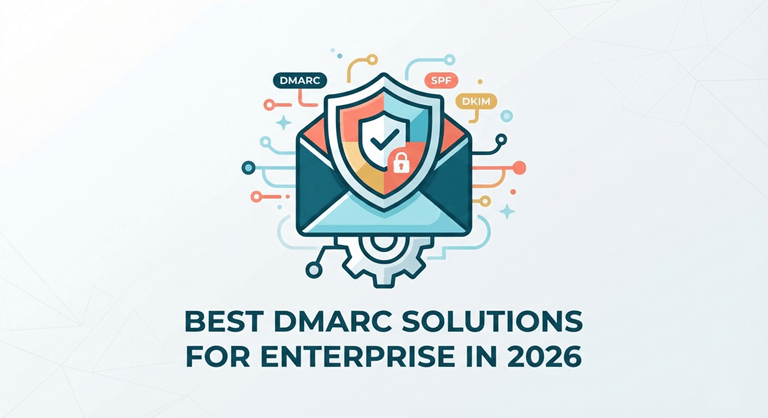
Large organizations must use tools designed to work with complex legacy infrastructure, a huge amount of reporting data, and multi-tenant environments to avoid blocking business-critical emails. Let’s break down one simple way to move from an overused tool to the best DMARC solution for enterprise use.
What “Enterprise-Grade” Actually Means for DMARC
If you are considering a DMARC provider for your enterprise, you have more than just an XML file parser to consider. You need a platform that actively minimizes the administrative burden of domain governance.
True enterprise DMARC readiness comes down to five core pillars:
- Multi-Domain and Multi-Tenant Management: View and manage the email authentication status of all parent domains, subdomains and any newly acquired entities with a single pane of glass without having to log in and out of multiple accounts.
- Automated Discovery: There are hundreds of SaaS platforms sending emails as part of your different departments (HR, marketing, finance, sales), and manual audits are no longer an option. It is crucial that the platform can recognize and classify these third-party senders.
- Role-Based Access Control (RBAC): Local IT admins or certain business units must have some control over their own domains or be able to view their domains. They shouldn’t be able to modify or access security settings in the rest of the organization.
- Integration with SOC/SIEM and Ticketing: Email security data does not belong in an isolated silo. Enterprise solutions must offer robust API integration. This feeds DMARC data and alert logs straight into your existing Security Operations Center (SOC) workflows and Security Information and Event Management (SIEM) tools.
- SLA-Backed Support: Moving to strict enforcement is a high-stakes operational risk. You need dedicated support and concrete Service Level Agreements (SLAs) to help guide your internal teams and coordinate safely with external stakeholders.
Common Enterprise DMARC Challenges
Although DMARC implementation can be technically simple, achieving a project across a global organization is complex in terms of people and processes. Enterprise IT leaders face the following most common challenges when dealing with roadblocks:
- Shadow IT: Departments are regularly buying marketing software, customer support tools, or automated HR applications that are sending emails on the corporate domain without Security’s knowledge. These legitimate sources can be discovered manually, a slow process.
- M&A Complexity: When M&As occur, there are a lot of unmanaged legacy DNS records, unknown sending sources,s and inconsistent security standards that need to be unified in a short time.
- Slow Internal Coordination: Decades of heads of departments are needed to approve and confirm moving a primary domain to p=reject. When one piece of the marketing puzzle is missing, a false positive is possible and can slow vital parts of the business.
- Subdomain Sprawl: Regions or campaign teams for short-term product campaigns will often create subdomains that work around proper corporate security systems, creating vulnerabilities for hackers.
Leading Enterprise DMARC Solutions
PowerDMARC
PowerDMARC, an email authentication platform, offers a highly scalable approach to managing complex corporate footprints. It balances automated operational tools with a clean, structured interface designed to handle high domain volumes.
- Native Multi-Tenancy: Provides a unified, hierarchical dashboard built to manage completely separate business units, parent brands, and subsidiaries from a single login.
- Dynamic SPF Flattening (PowerSPF): Automatically bypasses the standard 10-lookup SPF limit by compiling complex records into a single optimized record, removing the risk of manual DNS syntax errors.
- Advanced AI-Driven Threat Intelligence: Leverages machine-learning classification engines to automatically map and identify malicious sources trying to spoof your domain
- Multi-Lingual Global Dashboard: The entire interface, including reporting, video tutorials, and tooltips, can be fully translated into 11 global languages.
- Granular Role-Based Access Controls: Enables enterprises to define highly specific user roles and permissions, ensuring local IT admins only see their assigned domains.
- Robust API & SIEM Integration: Offers full API access out of the box, allowing security teams to pipe forensic logs and authentication metrics straight into Splunk or Sentinel.
- Dedicated MSP (Managed Service Provider)/Reseller Portal: Features a specialized DMARC for MSPs platform with full white-label capabilities for partners managing DMARC across various external client portfolios.
Proofpoint Email Fraud Defense
Proofpoint is a massive name in the enterprise email security space. Their DMARC capability is tightly woven into their broader security and threat intelligence ecosystem.
- Integrated Threat Intelligence: Links DMARC data with Proofpoint’s global threat intelligence network to track and analyze active phishing campaigns targeting your brand.
- Dedicated Consultant-Led Onboarding: Pairs enterprise accounts with dedicated consultants to guide internal teams through the discovery and rollout phases.
- Geographically Distributed Hosted DKIM (DomainKeys Identified Mail): Provides a simple way to handle the DKIM selector and keys, and hosts these in a geographically distributed, fault-tolerant manner with support of DNSSEC.
- Hosted SPF Capabilities: Automated records that can help bypass the standard DNS record lookup restrictions and decrease administration burden.
- Supplier Risk Analytics: Analyzes incoming and outgoing traffic automatically to discover vulnerabilities in the supply chain and any spoofed supplier look-alike domains.
- Deep Forensic Reporting: Provides detailed visual deliverables on look-alike domain and domain spoofing attempts on all corporate communication channels.
- Proofpoint Gateway Integration: Integrates with the industry-standard Proofpoint email gateway, allowing users to enforce a strict DMARC policy with flexibility.
Valimail
Identity-driven automation is a core part of Valimail’s offering, automating the time-consuming task of parsing DMARC reports.
- Patented Instant SPF®: Solves the 10-lookup SPF limit permanently using automated macro-based technology, eliminating manual TXT record updates.
- Precision Sender Intelligence: UA’s huge database of known sending services in cloud stores, allowing instant identification and naming of third-party sources (such as Shopify, Salesforce).
- Zero-DNS Maintenance Approach: This feature allows a transition to p=reject without always having to make changes to your DNS at your registrar manually.
- M&A Domain Consolidation Tools: Enables quick identification and audit of acquired (legacy) domains.
- DigiCert BIMI Integration: Streamlines the deployment of Brand Indicators for Message Identification (BIMI) and Verified Mark Certificates (VMC).
- Enterprise Compliance Readiness: Completely compliant with all major standards, such as FedRAMP (Federal Risk and Authorization Management Program).
- SLA-Backed Support Tiers: Provides customer success managers and technical account managers (TAMs) dedicated to your account, with clear SLAs for complex rollouts.
Mimecast
Mimecast views DMARC as an integral part of its extensive cloud-based email security, archive, and continuity solution.
- Consolidated Security Suite: Best for security teams who want to manage their DMARC visibility within a single-vendor suite, along with their spam and gateway filters.
- Centralized Domain Management: Provides an interactive dashboard with all organizational domains, active configurations, and missing configurations listed in a single table.
- SPF Delegation Tooling: Built-in DNS delegation engine to avoid limits on SPF lookups and automate record synchronization.
- Granular Forensic Options: Allows admins to configure customized alert rules for specific alignment failures (e.g., triggering alerts only if DKIM fails).
- Historical Audit Logs: Searchable, exportable CSV Audit logs for all 365 days of configuration and DNS changes.
- Proactive Threat Alerts: Alerts are sent in real time within the platform if the registered enterprise domain is found on other spam blocklists.
Evaluation Checklist for Enterprise Buyers
If you are an IT director or CISO (Chief Information Security Officer) who is actively searching for a DMARC provider, evaluate your candidates against this simple checklist of a realistic evaluation:
- Scale: Can the platform comfortably ingest and visualize reports for 100+ domains without lag?
- RBAC: Can you lock down access so specific regional offices only see and edit their respective subdomains?
- Automation: Does the system feature built-in SPF flattening, or will your team be stuck manually resolving DNS lookup errors?
- Integrations: Is there an open API to push security logs to Splunk, Microsoft Sentinel, or your ticketing system?
- Onboarding: Does the vendor provide dedicated deployment managers who understand the nuances of enterprise-scale rollouts?
Frequently Asked Questions
How is enterprise DMARC different from DMARC for a single domain?
SingleDomain is relatively simple because the IT administrator typically has a good idea of all the tools sending email on that domain. In the enterprise, it’s not just thousands of legitimate outbound emails per day. Still, hundreds of thousands of emails from multiple business units, third-party marketing services, and acquired brands from undocumented sources. All enterprise-grade tools need complex automation to use them without business impact.
How long does enterprise DMARC enforcement typically take?
Most organizations can take 3 to 9 months to move a complex enterprise environment from p=none to p=reject safely. Although highly automated platforms can help achieve meaningful progress in this timeline, the process cannot be rushed, and teams need to work through each legitimate sending service carefully, configure SPF and DKIM correctly, and ensure alignment before applying strict blocking rules.
Can DMARC be managed centrally across acquired brands and subsidiaries?
Yes. New multi-tenant solutions enable parent organizations to track compliance rates centrally and establish global policy standards. At the same time, they allow local IT staff to configure the domain as needed from day to day using role-based access.
Do enterprise DMARC solutions integrate with SIEM tools?
Yes, enterprise solutions are characterized by having a strong integration with SIEM/SOAR. Platforms offer APIs or syslog feeds for transferring raw forensic data, threat indicators, and compliance logs to a tool such as Splunk, Sentinel, or ServiceNow for security monitoring.
What is SPF flattening and why do enterprises need it?
The default SPF protocol has an extremely low limit of 10 DNS lookups to prevent Denial of Service (DoS) exploits against the DNS. Enterprise organizations have many third-party services, such as Salesforce, Marketo, HR systems, etc., and they soon start to cross this limit. These lookups are automatically flattened to a single optimized record in SPF to ensure that email continues to deliver without DNS failures.
How do strict email requirements from major providers impact enterprise email?
Major email providers, including Google, enforce strict authentication requirements for bulk senders (defined as organizations sending thousands of messages daily). According to Google’s email sender guidelines, senders without SPF, DKIM, and a valid DMARC record face rate-limiting, delivery failure, or being routed straight to the spam folder. Enterprise brands must maintain strict authentication to guarantee basic email deliverability to their customer base.
The decision on which DMARC solution to use in an enterprise environment depends ultimately on what your organization is currently running and how fast you need to proceed. Our experience suggests that teams with a larger security suite are more likely to go with Proofpoint or Mimecast. In contrast, teams that require automation and hands-off maintenance tend to go with PowerDMARC or Valimail. Either way, test the platform with a few representative domains first, and verify that the integration of the SIEM and role-based access control aligns with your team’s real-world operations before a widespread rollout.
Popular on OTW Right Now!


About The Author

Gagan Bhangu
Founder of otechworld.com and managing editor. He is a tech geek, web-developer, and blogger. He holds a master's degree in computer applications and making money online since 2015.